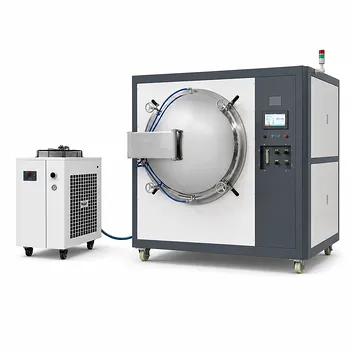
A vacuum hot pressing sintering furnace provides a decisive technical advantage by integrating degassing, pressing, and sintering into a single, controlled environment. For Fe-Ni/Zr2P2WO12 composites specifically, this integration directly addresses the material's tendency toward porosity, ensuring a level of density and structural integrity that traditional cold-press methods cannot consistently achieve.
Core Takeaway The simultaneous application of high vacuum and axial pressure is the critical differentiator for this material. By actively removing internal gases while mechanically forcing particle contact, this process lowers the required sintering temperature and facilitates atomic diffusion, resulting in a significantly denser and more uniform composite.
The Mechanics of Densification
To understand why this furnace is essential for Fe-Ni/Zr2P2WO12, you must look beyond the heat and understand the synergy between the vacuum atmosphere and mechanical force.
The Role of the High-Vacuum Environment
The vacuum creates an ideal condition for material consolidation by removing physical barriers to bonding.
First, the high-vacuum environment effectively lowers the necessary sintering temperature. This is critical for maintaining the stability of the composite phases while still achieving consolidation.
Second, and perhaps most importantly, the vacuum facilitates active degassing. It extracts gas trapped within the internal micropores of the composite material, preventing the formation of voids that would otherwise weaken the final structure.
The Impact of Axial Pressure
While the vacuum prepares the environment, the axial pressure drives the physical consolidation.
The furnace applies continuous pressure during the heating phase, which significantly promotes particle contact. This mechanical force reduces the distance between particles, overcoming the resistance that usually leads to porosity in static sintering.
Furthermore, this pressure accelerates atomic diffusion. By forcing materials together at the atomic level, the furnace enhances the bonding between the Iron-Nickel (Fe-Ni) matrix and the Zr2P2WO12 reinforcement.
Overcoming Traditional Limitations
The primary reason for selecting this equipment is to bypass the inherent flaws of simpler fabrication methods.
Solving the Cold-Press Density Issue
Traditional cold-press sintering separates the pressing and heating stages. This separation often results in "spring-back" effects or incomplete bonding, making it difficult to produce high-density Fe-Ni/Zr2P2WO12 materials.
The Integrated Advantage
The vacuum hot pressing furnace solves this by combining forces. The coupling of heat, vacuum, and pressure ensures that the material does not just bond, but flows plastically into a dense state, effectively eliminating the porosity issues common in cold-pressed samples.
Understanding the Trade-offs
While vacuum hot pressing is superior for density, it introduces specific operational constraints that must be managed.
Geometric Constraints
Because the pressure is typically applied axially (unidirectionally), there are limitations on the complexity of shapes you can produce. Unlike pressureless sintering, this method is best suited for simple geometries like discs or plates, rather than intricate, near-net-shape components.
Process Sensitivity
The integration of three variables—temperature, pressure, and vacuum level—requires precise control. An imbalance, such as applying pressure too early before the binder is fully degassed or the material softens, can lead to density gradients or entrapped gases despite the vacuum.
Making the Right Choice for Your Project
When deciding on a fabrication route for Fe-Ni/Zr2P2WO12 composites, consider your specific performance metrics.
- If your primary focus is Maximizing Density: Utilize the vacuum hot press to leverage the coupling effect of heat and force, which promotes plastic flow and eliminates micropores.
- If your primary focus is Material Purity: Rely on the high-vacuum capability to degas internal pores and prevent oxidation, ensuring the interface between the matrix and reinforcement remains clean.
Ultimately, the vacuum hot pressing sintering furnace is not just a heating element; it is a mechanism for forcing atomic cooperation in difficult-to-densify composites.
Summary Table:
| Feature | Vacuum Hot Pressing Advantage | Benefit for Fe-Ni/Zr2P2WO12 |
|---|---|---|
| Atmosphere | High-Vacuum Environment | Active degassing; removes micropores and prevents oxidation. |
| Pressure | Continuous Axial Force | Promotes particle contact and accelerates atomic diffusion. |
| Sintering Temp | Lowered Temperature Threshold | Maintains phase stability while ensuring full consolidation. |
| Structural Integrity | Integrated Press & Heat | Eliminates "spring-back" effects and minimizes internal voids. |
| Material State | Plastic Flow Promotion | Achieves superior densification compared to cold-press methods. |
Elevate Your Material Research with KINTEK Precision
Are you struggling with porosity or incomplete bonding in your advanced composites? KINTEK specializes in high-performance laboratory equipment designed to solve your most complex fabrication challenges. Our industry-leading vacuum hot pressing furnaces provide the precise control over temperature, pressure, and vacuum levels required to produce high-density Fe-Ni/Zr2P2WO12 and other advanced materials.
Beyond sintering, our comprehensive portfolio supports your entire workflow, including:
- High-Temperature Furnaces: Muffle, tube, and vacuum systems for diverse heat treatments.
- Hydraulic Presses: Pellet, hot, and isostatic presses for superior sample preparation.
- Crushing & Milling: Advanced systems to ensure optimal particle size for your composites.
- High-Pressure Reactors & Autoclaves: For specialized chemical synthesis and material aging.
Ready to achieve superior material properties? Contact our technical experts today to find the perfect solution for your lab’s specific needs and experience the KINTEK advantage in precision and reliability.
Related Products
- 600T Vacuum Induction Hot Press Furnace for Heat Treat and Sintering
- Vacuum Heat Treat and Pressure Sintering Furnace for High Temperature Applications
- Vacuum Heat Treat and Sintering Furnace with 9MPa Air Pressure
- 2200 ℃ Tungsten Vacuum Heat Treat and Sintering Furnace
- Vacuum Hot Press Furnace Heated Vacuum Press Machine Tube Furnace
People Also Ask
- What role does an induction vacuum hot pressing furnace play in sintering? Achieve 98% Density in Carbide Blocks
- What advantages does a vacuum hot press furnace provide for LSLBO ceramic electrolytes? Achieve 94% Relative Density
- What role does a Vacuum Hot Press (VHP) furnace play in the densification of austenitic stainless steel 316 composites?
- What are the advantages of a vacuum hot press furnace for W-50%Cu? Achieve 99.6% Density at Lower Temperatures
- What role does mechanical pressure play during the vacuum diffusion bonding of tungsten and copper? Keys to Solid Bonding