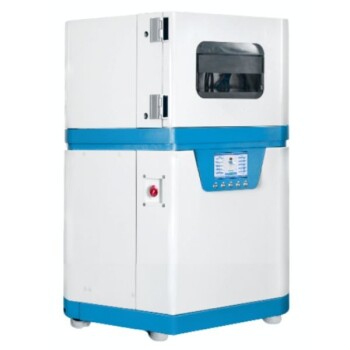
Maintaining a vacuum level of approximately 30Pa is a fundamental requirement when preparing C-SiC-B4C composite materials via hot pressing. This specific low-pressure environment serves two immediate functions: it prevents the destructive oxidation of your graphite and non-oxide ceramic raw materials, and it actively removes trapped gases that would otherwise compromise the structural integrity of the final product.
The 30Pa vacuum level acts as both a chemical shield and a mechanical aid, protecting raw materials from degradation while clearing the path for maximum densification.
The Critical Role of Atmosphere Control
To understand why this vacuum level is necessary, you must look beyond simple pressure readings and consider the chemical stability of your components at high temperatures.
Protecting Carbon and Non-Oxide Ceramics
At the elevated temperatures required for hot pressing, materials like graphite (C), Silicon Carbide (SiC), and Boron Carbide (B4C) are highly reactive.
In the presence of oxygen, these materials will degrade rapidly. Oxidation alters the chemical composition of the composite, leading to the formation of unwanted oxides and a loss of material properties.
Maintaining a vacuum of approximately 30Pa effectively removes oxygen from the chamber. This preserves the purity of the graphite and ceramic powders, ensuring the final composite retains the intended stoichiometry and performance characteristics.
Mechanisms of Densification
Beyond chemical protection, the vacuum plays a vital role in the physical consolidation of the material. The goal of hot pressing is to achieve high density, and trapped gas is the enemy of this process.
Removal of Adsorbed Gases
Raw powder particles often have layers of gas molecules adsorbed onto their surfaces. If these gases are not removed before the particles bond, they become trapped within the material.
The 30Pa vacuum environment strips these adsorbed gases away from the powder surfaces.
Extraction of Volatiles
During the heating process, volatile components within the powder interstices may be released.
A vacuum environment ensures these volatiles are evacuated from the matrix rather than being sealed inside.
Promoting Pore Closure
The presence of gas pockets inhibits the sintering process. By removing adsorbed gases and volatiles, the vacuum facilitates pore closure.
This creates a cleaner environment for the particles to fuse, significantly improving the final density of the C-SiC-B4C composite.
Understanding the Trade-offs
While a vacuum of 30Pa is critical, it is important to understand the risks associated with atmosphere management in this specific context.
The Risk of Insufficient Vacuum
If the pressure rises significantly above 30Pa, the protective effect diminishes. Even trace amounts of oxygen at high temperatures can initiate surface oxidation on the particles.
This oxidation acts as a barrier to diffusion, preventing strong bonding between particles and resulting in a mechanically weak composite.
Porosity and Structural Failure
Failure to reach or maintain the 30Pa level leads to trapped gas.
These gas pockets create internal voids (porosity) in the final product. A porous composite will suffer from reduced mechanical strength, lower thermal conductivity, and poor wear resistance.
Making the Right Choice for Your Goal
The vacuum level is not just a setting on a machine; it is a process variable that dictates the quality of your material.
- If your primary focus is Material Purity: Ensure your system can reliably hold 30Pa to prevent chemical alteration and oxidation of the graphite and ceramic phases.
- If your primary focus is Mechanical Strength: Prioritize the vacuum phase to fully evacuate volatiles and adsorbed gases, as this is the prerequisite for achieving maximum density.
By strictly maintaining this vacuum threshold, you ensure the C-SiC-B4C composite achieves both the chemical stability and physical density required for high-performance applications.
Summary Table:
| Factor | Impact of 30Pa Vacuum | Consequence of Poor Vacuum |
|---|---|---|
| Atmosphere Control | Prevents oxidation of graphite, SiC, and B4C | Chemical degradation and loss of material properties |
| Surface Adsorption | Strips gas molecules from powder surfaces | Trapped gas pockets inhibiting particle bonding |
| Volatiles Removal | Efficiently evacuates released volatile components | Internal voids and increased porosity |
| Final Density | Facilitates pore closure for maximum strength | Weak structure with low thermal conductivity |
Elevate Your Advanced Material Synthesis with KINTEK
Precision is non-negotiable when dealing with reactive C-SiC-B4C composites. At KINTEK, we specialize in high-performance vacuum hot pressing furnaces and high-temperature furnaces designed to maintain rigorous atmosphere control. Whether you are focused on achieving theoretical density or maintaining chemical purity, our laboratory equipment—including crushing and milling systems, hydraulic presses, and ceramic consumables—is engineered to meet the demands of sophisticated material science.
Ready to optimize your densification process? Contact KINTEK Today to Consult Our Specialists
Related Products
- Vacuum Hot Press Furnace Heated Vacuum Press Machine Tube Furnace
- 600T Vacuum Induction Hot Press Furnace for Heat Treat and Sintering
- Vacuum Hot Press Furnace Machine Heated Vacuum Press
- Vacuum Hot Press Furnace Machine for Lamination and Heating
- Vacuum Heat Treat and Pressure Sintering Furnace for High Temperature Applications
People Also Ask
- What advantages does a vacuum hot press furnace provide for LSLBO ceramic electrolytes? Achieve 94% Relative Density
- What role does a Vacuum Hot Press (VHP) furnace play in the densification of austenitic stainless steel 316 composites?
- What are the advantages of using a vacuum hot pressing furnace? Superior Densification for 2024Al/Gr/SiC Composites
- What are the advantages of a vacuum hot press furnace for LTPO solid electrolytes? Boost Density and Conductivity
- What core processing conditions does a vacuum hot press furnace provide? Achieve High-Density Cu-SiC/Diamond Composites