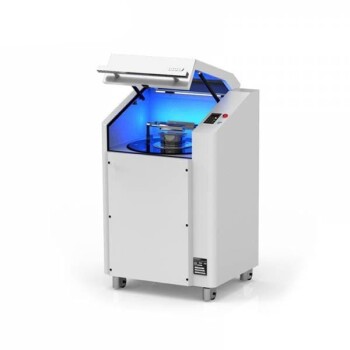
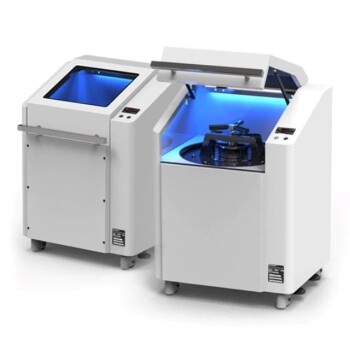
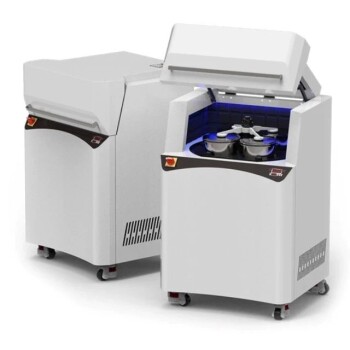
The primary role of a vibration mill is to pulverize mineral samples into ultrafine powders, specifically reducing particle size to below 5 micrometers. This reduction is achieved through high-energy impact forces, ensuring the particles are small enough to create the stable suspensions required for valid micro-electrophoresis measurements.
Core Takeaway: Accurate surface potential (Zeta potential) analysis relies heavily on sample consistency. The vibration mill is the essential preparatory tool that utilizes high-frequency vibration to achieve the micron-level fineness required to prevent sedimentation and ensure precise data collection.
The Mechanism of Particle Reduction
Utilizing High-Frequency Vibration
The vibration mill operates by generating high-frequency vibrations. These vibrations translate into high-energy impact forces within the grinding chamber.
Achieving Ultrafine Granularity
Unlike standard crushing methods, this high-energy impact efficiently grinds pure minerals like magnesite and limonite. The goal is to produce micron-level ultrafine powders rather than coarse granules.
The 5-Micrometer Threshold
For micro-electrophoresis to work, particles must meet a specific size constraint. The vibration mill is specifically capable of reducing samples to below 5 micrometers, the critical threshold for this type of analysis.
Why Particle Size Matters for Zeta Potential
Enabling Micro-Electrophoresis
Zeta potential is typically measured using micro-electrophoresis. This technique requires the sample to behave predictably under an electric field, which is only possible with ultrafine particles.
Ensuring Suspension Stability
Large particles tend to settle quickly in liquid, leading to unreliable readings. The ultrafine powder produced by the vibration mill forms a stable suspension in electrolyte solutions.
Guaranteeing Data Accuracy
The stability of the suspension is directly linked to the quality of the electrical surface data. Without the grinding capabilities of the vibration mill, obtaining accurate Zeta potential data would be impossible due to particle instability.
Understanding the Operational Dependencies
The Consequence of Oversized Particles
If the vibration mill is not employed or fails to reach the sub-5 micrometer target, the mineral particles will not remain suspended. This leads to rapid sedimentation, rendering the micro-electrophoresis measurement invalid.
The Requirement for Pure Input
The process assumes the input consists of pure minerals. While the mill is excellent at size reduction, the final data accuracy also depends on the initial purity of the magnesite or limonite being ground.
Making the Right Choice for Your Goal
To ensure your Zeta potential measurements are valid, you must prioritize sample preparation before the sample ever reaches the analyzer.
- If your primary focus is Suspension Stability: Ensure the vibration mill settings are tuned to consistently achieve a particle size below 5 micrometers.
- If your primary focus is Data Precision: Verify that the resulting powder forms a uniform mixture in the electrolyte solution without rapid settling.
The vibration mill is not just a grinder; it is a prerequisite tool for stabilizing samples to unlock accurate surface chemistry insights.
Summary Table:
| Feature | Specification/Requirement | Role in Zeta Potential Analysis |
|---|---|---|
| Particle Size | < 5 Micrometers | Prevents sedimentation; enables micro-electrophoresis |
| Energy Source | High-frequency vibration | Efficiently pulverizes pure minerals like magnesite |
| Sample State | Ultrafine Powder | Ensures a stable, uniform suspension in electrolytes |
| Mechanism | High-energy impact | Breaks down granules to critical micron-level fineness |
| Data Goal | High Precision | Guarantees reliable electrical surface data collection |
Elevate Your Material Analysis with KINTEK Precision
Don't let poor sample preparation compromise your research data. KINTEK specializes in high-performance crushing and milling systems, specifically designed to achieve the micron-level fineness required for Zeta potential and surface chemistry studies.
Whether you are processing magnesite, limonite, or advanced battery materials, our comprehensive range of equipment—from vibration mills and sieving tools to high-temperature furnaces and hydraulic presses—ensures your lab maintains the highest standards of accuracy.
Ready to optimize your sample preparation workflow? Contact KINTEK today to find the perfect equipment solution for your laboratory!
Related Products
- Vibrating Disc Mill Small Laboratory Grinding Machine
- Lab Vibration Mill
- Laboratory Disc Cup Vibratory Mill for Sample Grinding
- Disc Cup Vibrating Mill Multi-Platform for Lab
- High Energy Vibratory Laboratory Ball Mill Double Tank Type
People Also Ask
- What role do disc mills play in the wet or dry pretreatment of lignocellulosic waste? Scalable Biomass Solutions
- What is the function of a laboratory grinding mill? Achieve Precise Sample Preparation for Accurate Results
- What is the function of an industrial vibratory mill? Optimize Fe-Cr-Al Alloy Powder Production
- What laboratory apparatus is used for grinding? Match the Right Mill to Your Sample Material
- Why use stainless steel jars and balls for solid-state battery slurries? Maximize Dispersion and Conductivity