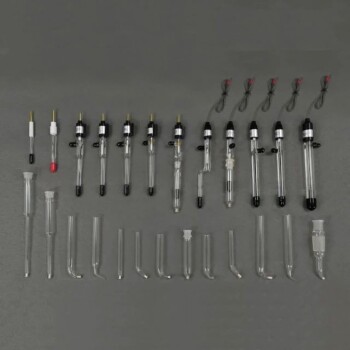
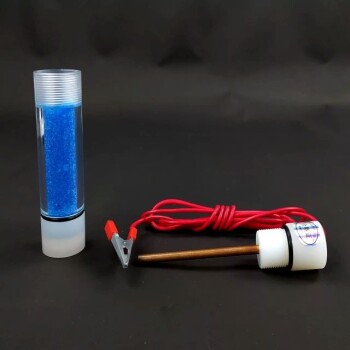
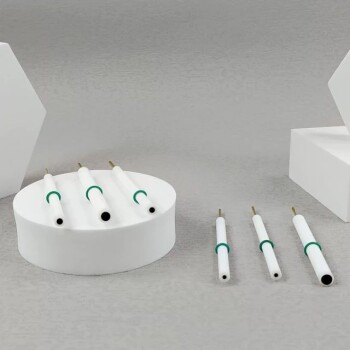
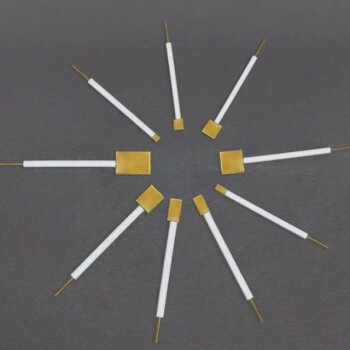
The Ag/AgCl reference electrode serves as the stable anchor for voltage measurements in electrochemical dissolution experiments. Its primary function is to provide a fixed, known potential, which allows researchers to precisely control the polarization state of the working electrode within organic electrolyte environments.
Core Takeaway In complex organic environments, accurate data depends entirely on a stable baseline. The Ag/AgCl electrode provides this stability, enabling the precise identification of the specific oxidation and reduction thresholds required to trigger the dissolution of noble metals like platinum or gold.
The Mechanics of Stability
Providing a Known Reference Point
A reference electrode, such as Ag/AgCl, maintains a constant potential (typically 199mV ±5mV vs. NHE at 25°C).
Because the potential of the working electrode cannot be measured in isolation, it must be measured relative to this stable standard.
The "Well-Poised" Principle
To maintain accuracy, the reference electrode must remain "well-poised."
This means the electrochemical system is designed so that almost no current flows through the reference electrode itself.
Instead, the potentiostat directs current between the working electrode and a counter electrode (often Platinum), protecting the reference electrode’s chemical equilibrium and ensuring its potential remains constant throughout the experiment.
The Role in Organic Dissolution
Controlling Polarization States
Dissolving noble metals like platinum or gold in organic solvents requires hitting very specific energy targets.
The Ag/AgCl electrode allows you to manipulate the polarization state of the working electrode with high precision.
Without this reference, you would be unable to distinguish the applied potential from the inherent noise of the cell.
Identifying Critical Thresholds
The dissolution of metals in organic electrolytes is triggered at specific oxidation and reduction potentials.
By using a standard Ag/AgCl reference, you can accurately map exactly where these dissolution events occur.
This allows for the replication of results and comparison against standard electrochemical data.
Understanding the Trade-offs
The Liquid Junction Challenge
While Ag/AgCl is a standard reference, using it in organic solvents introduces a liquid junction potential.
This occurs at the interface between the reference electrode's internal solution (usually aqueous KCl) and the external organic electrolyte.
Potential for Contamination
If the reference electrode uses a porous frit to make electrical contact, there is a risk of the internal electrolyte leaking into the organic solvent.
In sensitive dissolution experiments, even minor contamination from the reference solution can alter the electrochemical behavior of the organic solvent or the metal interface.
Making the Right Choice for Your Goal
- If your primary focus is Precision: Rely on Ag/AgCl to provide the absolute voltage scale needed to identify exact oxidation potentials for noble metals.
- If your primary focus is Reproducibility: Ensure your reference electrode is properly maintained and "well-poised" to prevent current flow from shifting your baseline measurements.
- If your primary focus is System Compatibility: Be aware of the interface between the aqueous reference and organic solvent to account for junction potentials in your final data analysis.
Precise control of the reference potential is the only way to turn observing a reaction into understanding the mechanism behind it.
Summary Table:
| Feature | Function in Organic Dissolution Experiments |
|---|---|
| Potential Stability | Provides a fixed baseline (approx. 199mV vs. NHE) to measure working electrode polarization. |
| Current Control | Operates under zero-current conditions to maintain chemical equilibrium and accuracy. |
| Target Identification | Enables precise mapping of oxidation/reduction thresholds for metals like Pt and Au. |
| Junction Potential | Creates a predictable interface between aqueous internal solution and organic electrolytes. |
| Data Comparability | Allows results to be benchmarked against standard electrochemical scales and literature. |
Elevate Your Electrochemical Precision with KINTEK
Achieving accurate dissolution data in organic environments requires more than just high-quality reagents—it demands the right hardware. KINTEK specializes in professional-grade laboratory equipment designed for the most sensitive research applications. From precision electrolytic cells and electrodes (including Ag/AgCl, Platinum, and custom references) to advanced high-temperature reactors and battery research tools, we provide the stability your data depends on.
Whether you are studying noble metal dissolution or developing next-generation energy storage, KINTEK’s comprehensive portfolio of laboratory consumables, cooling solutions, and specialized reactors ensures your experiments are contamination-free and reproducible.
Ready to optimize your lab setup? Contact our technical experts today to find the perfect equipment solution for your research goals.
References
- Primož Jovanovič, Nejc Hodnik. In situ electrochemical dissolution of platinum and gold in organic-based solvent. DOI: 10.1038/s41529-018-0031-8
This article is also based on technical information from Kintek Solution Knowledge Base .
Related Products
- Reference Electrode Calomel Silver Chloride Mercury Sulfate for Laboratory Use
- Electrolytic Electrochemical Cell Gas Diffusion Liquid Flow Reaction Cell
- Copper Sulfate Reference Electrode for Laboratory Use
- Graphite Disc Rod and Sheet Electrode Electrochemical Graphite Electrode
- Glassy Carbon Electrochemical Electrode
People Also Ask
- What is the function of a reference electrode? Master Precision in Three-Electrode Reactor Reconstruction
- What is the recommended maintenance for the filling solution of a reference electrode? A Guide to Stable & Accurate Readings
- Which electrode is used as a ground reference? Master the Key to Accurate Electrochemical Measurements
- What is the reference electrode in potentiometry? The Key to Stable & Accurate Measurements
- Which electrode is used as a reference? A Guide to Accurate Electrochemical Measurements