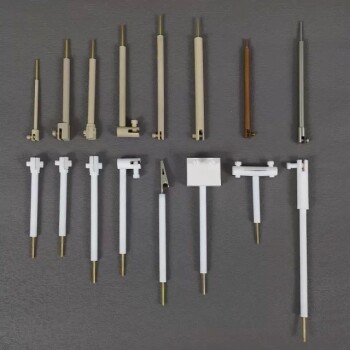
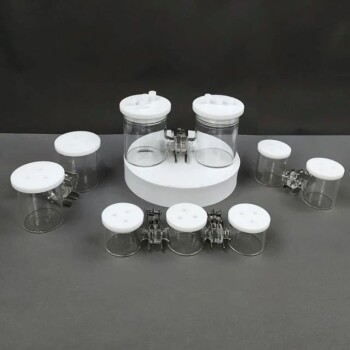
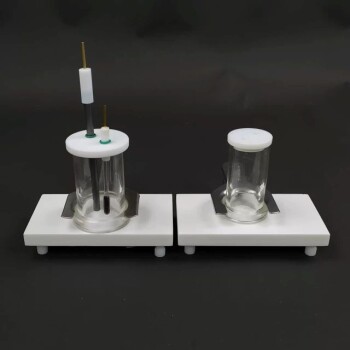
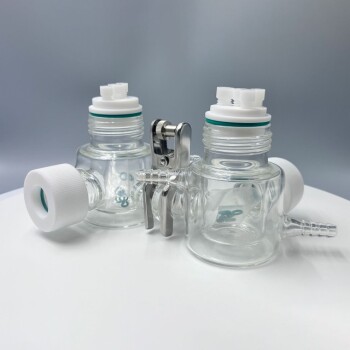
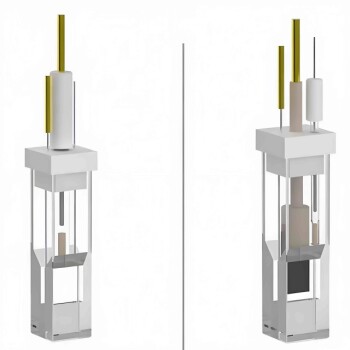
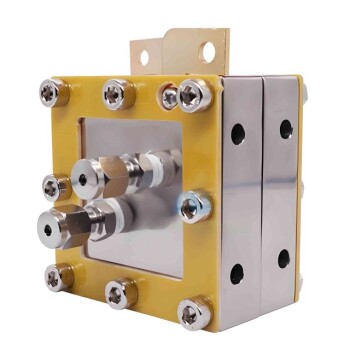
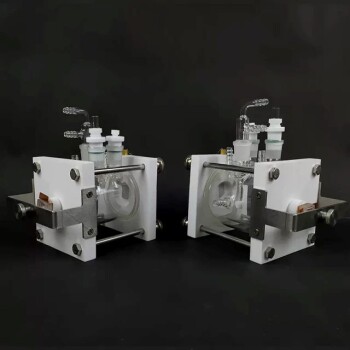
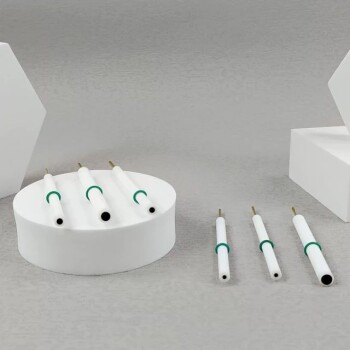
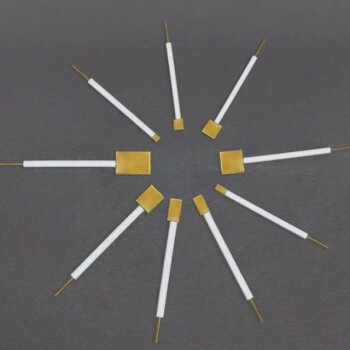
The electrochemical cell and electrode system act as the precise engine and steering mechanism for the anodic deposition of ZIF-8 thin layers.
This setup provides a controlled electric field that drives the dissolution of a zinc source layer (the anode) into zinc ions ($Zn^{2+}$). These ions immediately coordinate with organic ligands present in the electrolyte, causing the ZIF-8 material to precipitate and form a thin layer directly onto the electrode surface.
The core function of this system is to convert electrical energy into chemical control. By manipulating the voltage and time, you dictate exactly how fast zinc ions are released, allowing you to tune the thickness, morphology, and coverage of the ZIF-8 layer with a precision impossible in standard chemical mixing.
The Mechanics of Anodic Deposition
The Role of the Anode (The Zinc Source)
In this specific configuration, the anode is often a zinc layer on a copper substrate.
When voltage is applied, the anode undergoes oxidation. This forces the metallic zinc to dissolve, releasing zinc ions into the electrolyte. This electrode is not merely a passive conductor; it is the active source of the metal centers required to build the ZIF-8 structure.
The Function of the Counter Electrode
A specific counter electrode, such as platinum, completes the circuit.
While the primary reaction of interest happens at the anode (oxidation), the counter electrode facilitates the necessary reduction reaction to maintain electrical neutrality. This ensures a stable flow of current through the cell, which is critical for consistent deposition.
Localized Coordination and Precipitation
The electrochemical cell ensures the reaction remains localized.
As zinc ions are released from the anode, they encounter organic ligands dissolved in the surrounding electrolyte. Because the ion concentration is highest right at the electrode surface, the ZIF-8 crystals nucleate and grow there rapidly. This results in a film attached to the substrate rather than loose powder floating in the liquid.
Achieving Precision Through System Configuration
Regulating Growth Rate and Morphology
The primary advantage of using an electrochemical cell is the ability to adjust the electrical potential (voltage).
By increasing or decreasing the voltage, researchers can control the rate at which zinc dissolves. A faster dissolution rate changes how quickly the crystals form, directly impacting the morphology (shape and structure) of the ZIF-8 crystals.
Ensuring Uniform Coverage
The electric field distribution within the cell dictates where the reaction occurs.
A well-configured system ensures that the electric field is applied evenly across the substrate. This allows for the uniform growth of ZIF-8 layers even on complex surfaces that would be difficult to coat using traditional dip-coating methods.
Understanding the Trade-offs
Process Stability vs. Speed
While high voltage can accelerate the process, it introduces instability.
If the current density is too high, zinc ions may dissolve faster than they can coordinate with the ligands. This can lead to disordered growth or defects in the thin layer. The cell voltage must be balanced to match the chemical dissolution rate with the coordination rate.
Substrate Dependency
This method relies heavily on the conductivity of the substrate.
Because the process requires the substrate to act as an anode, it is inherently limited to conductive materials (like copper/zinc) or conductive coatings. You cannot effectively use this specific anodic deposition method on non-conductive surfaces without pre-treatment.
Making the Right Choice for Your Goal
To maximize the effectiveness of the electrochemical deposition process, align your system parameters with your specific objective:
- If your primary focus is Uniformity: Prioritize a lower, stable voltage and ensure your electrode arrangement provides an even current density distribution across the sample.
- If your primary focus is Thickness Control: Focus on the precise calibration of deposition time, as the film thickness correlates linearly with the duration of the applied current.
- If your primary focus is Crystal Morphology: Experiment with varying the applied potential, as different voltages can yield different crystal sizes and shapes.
The electrochemical cell is not just a container; it is the active regulator that determines the quality and structure of your final ZIF-8 film.
Summary Table:
| Component/Parameter | Role in ZIF-8 Anodic Deposition | Key Advantage |
|---|---|---|
| Anode (Zinc Source) | Releases $Zn^{2+}$ ions via oxidation | Serves as the active metal source for MOF growth |
| Counter Electrode | Maintains electrical neutrality/completes circuit | Ensures stable current flow for consistent layers |
| Electric Field | Drives ion dissolution and localization | Enables uniform coating on complex geometries |
| Applied Voltage | Regulates dissolution rate and crystal shape | High-precision control over film morphology |
| Deposition Time | Controls the duration of ion release | Allows for linear calibration of layer thickness |
Elevate Your Material Research with KINTEK Precision
Ready to achieve unparalleled control over your MOF thin-film deposition? KINTEK specializes in high-performance laboratory equipment designed for advanced electrochemical applications. From high-purity electrolytic cells and electrodes to specialized battery research tools and high-temperature furnaces, we provide the precision you need for reliable, repeatable results.
Whether you are refining ZIF-8 morphology or scaling up chemical processing with our high-pressure reactors and crushing systems, our team is here to support your innovation.
Optimize Your Lab Setup — Contact KINTEK Today!
References
- Martin Schernikau, Daria Mikhailova. Preparation and Application of ZIF-8 Thin Layers. DOI: 10.3390/app11094041
This article is also based on technical information from Kintek Solution Knowledge Base .
Related Products
- Electrolytic Electrochemical Cell Gas Diffusion Liquid Flow Reaction Cell
- Electrode Fixture for Electrochemical Experiments
- H Type Electrolytic Cell Triple Electrochemical Cell
- Electrolytic Electrochemical Cell with Five-Port
- Super Sealed Electrolytic Electrochemical Cell
People Also Ask
- How does the design of an electrochemical electrolytic cell influence the coating uniformity? Optimize Your Catalysts
- What is the correct shutdown and disassembly procedure after an experiment? Ensure Safety and Protect Your Equipment
- Why are electrolytic cells essential in titanium production? Powering Circular Efficiency and Cost Savings
- What is galvanic cell or electrolytic cell? Unlock the Secrets of Electrochemical Power
- What are the three essential components that comprise an electrolytic cell? Key Elements of Chemical Synthesis