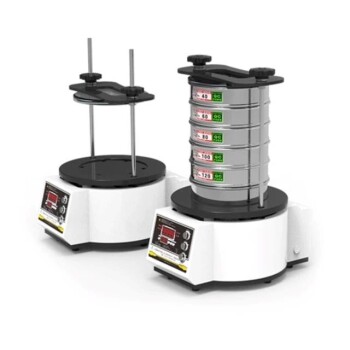
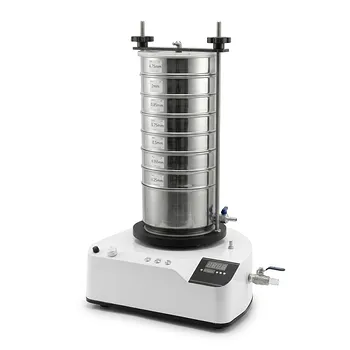
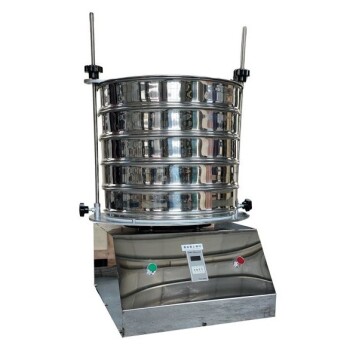
In the precise context of azide combustion synthesis (CS), the industrial-grade vibrating sieve serves as a critical standardization tool for raw materials. Specifically, it is responsible for sifting sodium azide and halide salts through standard screens to guarantee a uniform particle size distribution prior to mixing.
By eliminating particle size discrepancies, the vibrating sieve ensures mixture homogeneity. This uniformity is the prerequisite for stable combustion wave velocity and temperature, preventing incomplete reactions caused by material segregation.
The Mechanics of Raw Material Preparation
Processing Key Ingredients
The sieving process specifically targets sodium azide and halide salt raw materials.
These components are passed through standard screens to filter out agglomerates and irregular chunks.
Achieving Uniformity
The primary mechanical objective is to enforce a uniform particle size distribution.
This step standardizes the physical surface area of the reactants, which is a fundamental requirement for consistent chemical kinetics.
The Impact on Combustion Dynamics
Ensuring Mixture Homogeneity
Uniform particle sizes are essential for maintaining homogeneity during the mixing stage.
If particles vary significantly in size, they tend to separate rather than blend, leading to an inconsistent fuel-oxidizer ratio throughout the batch.
Stabilizing Reaction Parameters
Proper sieving directly contributes to the stability of the combustion wave velocity.
It also regulates the combustion temperature, ensuring the reaction propagates predictably through the material.
The Risks of Inadequate Processing
The Danger of Segregation
The most significant pitfall avoided by this process is particle segregation.
When raw materials are not uniform, heavier or larger particles settle differently than finer ones, destroying the mix's consistency.
Incomplete Reactions
Segregation inevitably leads to incomplete reactions.
Without the vibrating sieve to ensure uniformity, parts of the mixture may fail to combust fully, compromising the integrity and performance of the final synthesized product.
Optimizing Your Synthesis Process
To ensure the success of your azide combustion synthesis, apply the sieving process based on your specific quality metrics:
- If your primary focus is Process Control: Implement strict sieving protocols to stabilize combustion wave velocity and temperature for predictable thermodynamics.
- If your primary focus is Product Purity: Use industrial sieving to eliminate particle segregation, thereby preventing incomplete reactions and ensuring a homogeneous final material.
Standardizing your raw material input is the single most effective step toward guaranteeing a stable and complete chemical reaction.
Summary Table:
| Process Component | Role of Vibrating Sieve | Impact on Synthesis |
|---|---|---|
| Raw Materials | Sifting sodium azide & halide salts | Eliminates agglomerates and irregular chunks |
| Particle Size | Enforcing uniform distribution | Standardizes physical surface area for chemical kinetics |
| Mixing Stage | Preventing particle segregation | Ensures fuel-oxidizer homogeneity and blend consistency |
| Reaction Control | Regulating combustion parameters | Stabilizes wave velocity and maintains reaction temperature |
| Product Quality | Ensuring complete reactions | Prevents incomplete combustion and improves final purity |
Optimize Your Synthesis with KINTEK Precision Solutions
Don't let material segregation compromise your research or production quality. At KINTEK, we specialize in high-performance laboratory equipment designed for the rigorous demands of chemical synthesis. From our industrial-grade vibrating sieves and crushing systems that ensure perfect particle uniformity to our high-temperature furnaces and pressure reactors for controlled combustion, we provide the tools you need for consistent, predictable results.
Ready to enhance your lab's efficiency and product purity? Contact our technical experts today to discover how KINTEK's comprehensive range of sieving equipment and material processing solutions can transform your raw material preparation.
References
- А. П. Амосов, Irina Kerson. Combustion Synthesis of TiN-BN Nanostructured Composite Powder with the Use of Sodium Azide and Precursors of Titanium and Boron. DOI: 10.5539/mas.v9n3p133
This article is also based on technical information from Kintek Solution Knowledge Base .
Related Products
- Vibratory Sieve Shaker Machine Dry Three-Dimensional Vibrating Sieve
- Laboratory Vibratory Sieve Shaker Machine Slap Vibrating Sieve
- Laboratory Vibratory Sieve Shaker Machine for Dry and Wet Three-Dimensional Sieving
- Laboratory Test Sieves and Vibratory Sieve Shaker Machine
- Laboratory Wet Three-Dimensional Vibratory Sieve Shaker Machine
People Also Ask
- How is a vibratory sieve shaker used in the particle size analysis of mechanically alloyed powders? Expert Guide
- Why use a vibratory sieve shaker for PET powder? Achieve Precise Particle Size Control for Chemical Research
- What is the principle of vibratory sieve shaker? Achieve Accurate Particle Size Analysis
- What is the function of a vibratory sieve shaker? Achieve Precise Particle Size Analysis
- What is the use of vibratory sieve shaker? Achieve Precise Particle Size Analysis for Your Lab