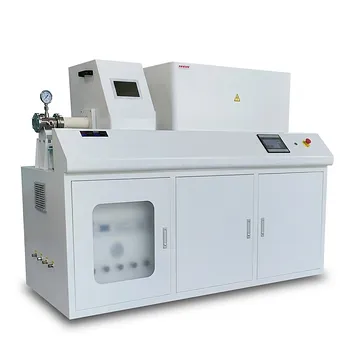
Chemical Vapor Deposition (CVD) equipment functions as a precision engineering tool used to encapsulate non-precious metal cores within a single-layer graphene shell. By managing the high-temperature decomposition of gas-phase precursors, the equipment creates a unified "armor" that physically isolates the metal core from corrosive environments while maintaining the electrical connectivity required for catalysis.
The core value of CVD in this context is its ability to solve the stability-activity paradox. It creates a barrier effectively impermeable to corrosive chemicals but thin enough to allow electron transfer via the tunneling effect.
The Mechanics of Graphene Encapsulation
Precision Growth Control
The primary role of CVD equipment is to regulate the deposition environment to achieve a specific structural outcome: single-layer graphene. Unlike simpler coating methods, CVD allows for atomic-level control, ensuring the carbon shell forms a complete, ultra-thin structure rather than a thick, amorphous layer.
High-Temperature Decomposition
The process relies on the thermal decomposition of gas-phase precursors within a reactor chamber. The equipment provides the necessary energy to break down carbon-carrying gases, which then reassemble on the surface of the metal core. This results in a high-purity carbon lattice that is chemically bonded to the substrate.
Uniformity on Nanostructures
Non-precious metal catalysts often consist of irregular nanoparticles. A critical advantage of CVD equipment is its ability to provide uniform coverage on these zero-dimensional or irregular surfaces. The gas-phase nature of the process ensures that the protective graphene layer wraps completely around the metal core, leaving no exposed areas vulnerable to degradation.
Achieving Dual Functionality
Preventing Electrochemical Corrosion
The single-layer graphene shell acts as a physical shield. In harsh environments, such as those found during alkaline oxygen evolution reactions (OER), non-precious metals are highly susceptible to corrosion. The CVD-grown shell blocks direct contact between the metal and the electrolyte, significantly extending the lifespan of the catalyst.
Enabling Electron Tunneling
While protection is vital, a coating that insulates the metal would render the catalyst useless. The CVD process is tuned to keep the graphene layer ultra-thin. This specific thickness allows for the electron tunneling effect, where electrons can pass through the barrier. This ensures the catalyst remains electrically active despite being fully encapsulated.
Understanding the Trade-offs
The "Thickness" Tolerance
The success of this method hinges on extreme precision. If the CVD process deposits a layer that is too thick (multi-layer graphene), the electron tunneling effect diminishes, and catalytic activity drops. Conversely, if the layer is incomplete, the core metal will corrode. The equipment must be calibrated to hit this narrow window perfectly.
Operational Complexity
CVD is not a simple "dip and dry" method. It requires a sophisticated apparatus, including high-vacuum systems, precise gas delivery manifolds, and exhaust treatment for volatile by-products. This makes the preparation process more resource-intensive compared to standard wet-chemical synthesis methods.
Optimizing Catalyst Preparation
When utilizing CVD for M@C catalyst preparation, consider your specific performance targets:
- If your primary focus is Durability: Prioritize process parameters that ensure a complete, defect-free lattice structure to maximize corrosion resistance in alkaline media.
- If your primary focus is Activity: Focus on minimizing the deposition time and precursor concentration to guarantee the shell remains strictly single-layer, maximizing electron tunneling efficiency.
- If your primary focus is Scalability: Evaluate the reactor chamber capacity and gas delivery uniformity to ensure consistent quality across larger batches of nanomaterials.
The ultimate goal of using CVD in this context is to transform unstable, non-precious metals into robust, high-performance catalysts that rival expensive alternatives.
Summary Table:
| Feature | CVD Equipment Role | Impact on M@C Catalyst |
|---|---|---|
| Structural Control | Precision growth of single-layer graphene | Ensures electron tunneling and high activity |
| Protection | Complete encapsulation of metal cores | Prevents electrochemical corrosion in harsh media |
| Uniformity | Gas-phase deposition on nanostructures | Full coverage of irregular surfaces without gaps |
| Bonding | High-temperature thermal decomposition | Creates a high-purity, chemically bonded carbon lattice |
| Precision | Calibration of shell thickness | Balances the stability-activity paradox |
Elevate your materials science with KINTEK’s precision engineering. Whether you are developing next-generation M@C catalysts or advanced carbon nanostructures, our industry-leading CVD and PECVD systems provide the atomic-level control required for single-layer excellence. Beyond vapor deposition, KINTEK offers a comprehensive suite of laboratory solutions, including high-temperature furnaces, high-pressure reactors, and specialized electrolytic cells tailored for catalyst research. Our equipment empowers researchers to overcome the stability-activity paradox with unmatched uniformity and scalability. Contact KINTEK today to optimize your catalyst synthesis and scale your laboratory breakthroughs!
References
- Xiaohong Xie, Yuyan Shao. Oxygen Evolution Reaction in Alkaline Environment: Material Challenges and Solutions. DOI: 10.1002/adfm.202110036
This article is also based on technical information from Kintek Solution Knowledge Base .
Related Products
- Chemical Vapor Deposition CVD Equipment System Chamber Slide PECVD Tube Furnace with Liquid Gasifier PECVD Machine
- Customer Made Versatile CVD Tube Furnace Chemical Vapor Deposition Chamber System Equipment
- HFCVD Machine System Equipment for Drawing Die Nano-Diamond Coating
- Multi Heating Zones CVD Tube Furnace Machine Chemical Vapor Deposition Chamber System Equipment
- CVD Diamond Dressing Tools for Precision Applications
People Also Ask
- What are the advantages of chemical vapor deposition? Achieve Superior Thin Films for Your Lab
- What types of substrates are used in CVD to facilitate graphene films? Optimize Graphene Growth with the Right Catalyst
- What is the chemical vapor deposition growth process? Build Superior Thin Films from the Atom Up
- How expensive is chemical vapor deposition? Understanding the True Cost of High-Performance Coating
- Why is Chemical Vapor Deposition (CVD) equipment uniquely suited for constructing hierarchical superhydrophobic structures?