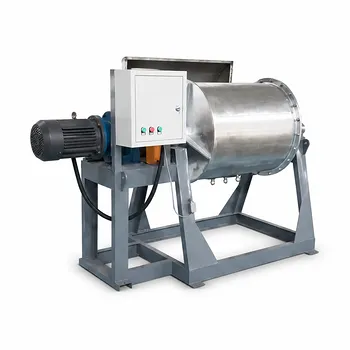
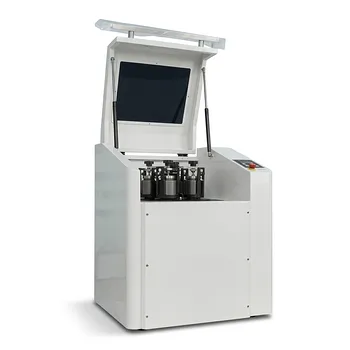
High-energy ball milling equipment functions as the primary driver for atomic-level structural transformation during the mechanical alloying of ferritic Oxide Dispersion Strengthened (ODS) steels. By facilitating a cycle of repetitive fracturing, cold welding, and dynamic recrystallization, the equipment generates the mechanical energy necessary to force the mutual diffusion of alloying elements and create a uniform single-phase alloy.
The core function of this equipment is to overcome thermodynamic barriers through mechanical force, converting a heterogeneous powder mixture into a supersaturated solid solution that serves as the essential foundation for the precipitation of nano-oxides in later processing stages.
The Mechanism of Mechanical Alloying
The ball milling process is not merely a mixing operation; it is a high-intensity structural modification process.
Repetitive Fracturing and Cold Welding
The equipment generates high-frequency, high-energy impacts between the grinding media (balls) and the metal powders. This causes the powder particles to fracture and subsequently cold weld together repeatedly.
Severe Plastic Deformation
Through these impacts and shear forces, the equipment induces severe plastic deformation in the matrix. This physical trauma is necessary to break down agglomerates and embed alloying elements directly into the pre-alloyed powder matrix.
Dynamic Recrystallization
As the material undergoes intense deformation and fracturing, it triggers dynamic recrystallization. This microstructural change refines the grain size, often reducing it to the nanometer scale, which contributes to the final material's strength.
Creating a Forced Solid Solution
The most critical role of high-energy ball milling is its ability to bypass standard thermodynamic limitations.
Atomic-Level Diffusion
The mechanical energy supplied by the mill drives the mutual diffusion of various alloying elements. This allows elements that might be thermodynamically immiscible (resistant to mixing) under normal conditions to mix at the atomic level.
The Single-Phase Precursor
The ultimate output of this stage is a single-phase alloy. This transformation ensures that oxide particles (such as nano-sized Y2O3) are broken down and dissolved into the matrix.
This creates a supersaturated environment. While the oxides are dissolved now, this state is the critical precursor that allows them to precipitate uniformly as stable nano-barriers during the subsequent sintering process.
Critical Process Requirements and Trade-offs
While high-energy ball milling is essential for ODS steel production, it introduces specific processing constraints that must be managed to ensure quality.
Necessity of Protective Atmospheres
Because the process involves fracturing fresh metal surfaces and generating significant heat, the material is highly reactive.
To prevent unwanted oxidation or contamination, the equipment must operate under a protective atmosphere, typically argon gas. Failing to maintain this environment compromises the purity and mechanical properties of the final alloy.
Energy Intensity vs. Homogeneity
The process relies on "high-energy" input to achieve a solid solution. Insufficient energy (impact force or duration) will result in a heterogeneous mixture rather than a true alloy.
However, the equipment must be capable of sustaining these high-impact forces (using horizontal or planetary configurations) without degrading the equipment or introducing excessive impurities from the grinding media.
Making the Right Choice for Your Goal
The effectiveness of your mechanical alloying stage directly dictates the performance of the final ODS steel.
- If your primary focus is High-Temperature Creep Strength: Ensure your milling parameters are set to achieve a complete solid solution, as this uniformity is what allows for the stable dislocation barriers needed to resist deformation at heat.
- If your primary focus is Radiation Swelling Resistance: Prioritize the refinement of the grain structure (dynamic recrystallization) during milling, as the resulting nanostructure is key to absorbing radiation-induced defects.
The success of ODS steel fabrication hinges on using the ball mill not just as a mixer, but as a reactor that forces atomic-level integration through mechanical energy.
Summary Table:
| Process Stage | Mechanism | Impact on ODS Steel |
|---|---|---|
| Deformation | Repetitive Fracturing & Cold Welding | Breaks down agglomerates and embeds alloying elements. |
| Grain Refinement | Dynamic Recrystallization | Reduces grain size to nanometer scale for higher strength. |
| Alloying | Forced Atomic Diffusion | Creates a supersaturated solid solution of immiscible elements. |
| Output | Single-phase Precursor | Ensures uniform precipitation of nano-oxides during sintering. |
Elevate Your Material Research with KINTEK Precision
Achieving the perfect supersaturated solid solution requires more than just mixing—it demands high-intensity mechanical energy and atmospheric control. KINTEK specializes in advanced laboratory solutions designed for the rigors of ODS steel production and beyond.
From high-performance crushing and milling systems (planetary and horizontal) to high-temperature furnaces and vacuum/atmosphere reactors, we provide the tools needed to overcome thermodynamic barriers. Whether you are developing radiation-resistant alloys or high-temperature creep-strength materials, our comprehensive range of laboratory equipment and consumables ensures your research is backed by reliability and precision.
Ready to optimize your mechanical alloying process? Contact KINTEK today to discover how our expert solutions can accelerate your material breakthroughs.
References
- Andrea García‐Junceda, Mónica Campos. Effect of Small Variations in Zr Content on the Microstructure and Properties of Ferritic ODS Steels Consolidated by SPS. DOI: 10.3390/met10030348
This article is also based on technical information from Kintek Solution Knowledge Base .
Related Products
- High Energy Planetary Ball Mill Milling Machine for Laboratory
- High Energy Planetary Ball Mill for Laboratory Horizontal Tank Type Milling Machine
- High-Energy Omnidirectional Planetary Ball Mill Milling Machine for Laboratory
- High Energy Planetary Ball Mill Milling Machine for Laboratory
- High Energy Planetary Ball Mill Machine for Laboratory Horizontal Tank Type
People Also Ask
- How does a planetary ball mill provide mechanical activation for scandium recovery? Maximize Your Leaching Efficiency
- What role do planetary ball mills and zirconia media play in LLZT preparation? Optimize Your Solid Electrolyte Research
- What is the function of a planetary ball mill in the preparation of high-entropy rare earth silicate multi-phase ceramics?
- What is the purpose of using a planetary ball mill for cathode material regeneration? Achieve Atomic-Level Mixing
- What is the primary function of a planetary ball mill? Mastering SiC/Al Composite Mixing for Homogeneity