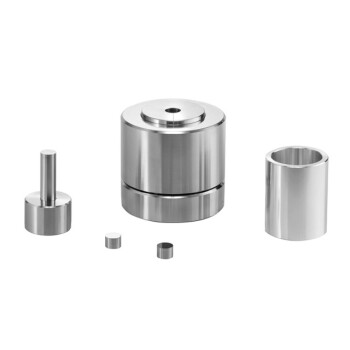
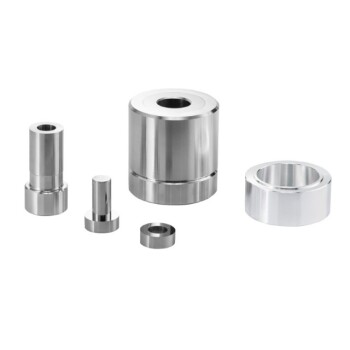
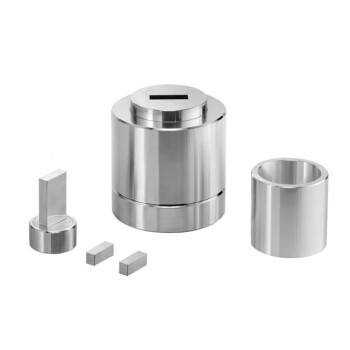
In the powder metallurgy process for carbon fiber and aluminum composites, graphite molds function as both the geometric definition tool and the active processing medium. They serve two distinct roles: acting as a forming container for the initial powder shape and serving as a conduit for heat and pressure during the final sintering phase.
Core Insight Graphite molds are indispensable in this process because they possess a unique combination of high-temperature strength and thermal conductivity. They allow for the uniform transfer of extreme uniaxial pressure and heat to the composite material while remaining chemically inert to the aluminum matrix.
The Dual-Stage Role of the Mold
The function of the graphite mold evolves as the manufacturing process moves from the initial setup to the final densification.
Defining the Green Compact
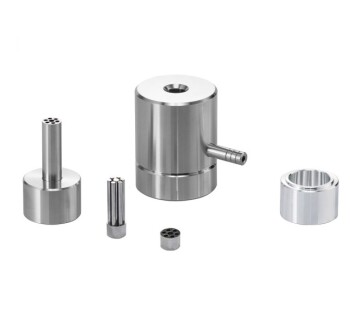
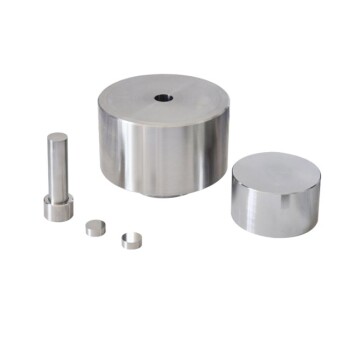
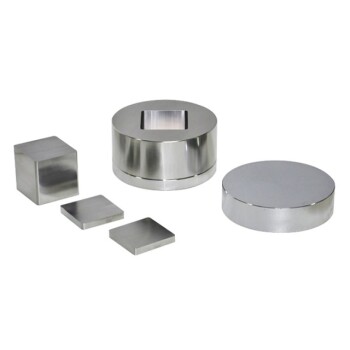
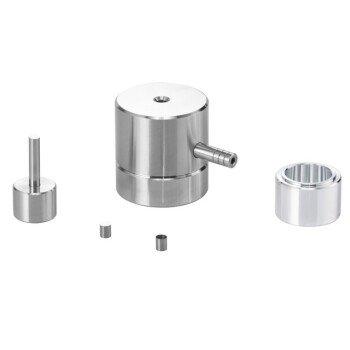
During the initial cold pressing stage, the mold acts strictly as a forming container. It confines the loose mixture of aluminum powder and carbon fiber to define the geometry of the "green compact." This step establishes the preliminary shape and density of the material before any heat is applied.
Facilitating Vacuum Hot Pressing
During the vacuum hot pressing and sintering stage, the mold becomes an active participant in the physics of the process. Because the mold possesses high-temperature strength, it is used to transfer uniaxial pressure (often 35–55 MPa) directly to the internal powder. Simultaneously, the mold leverages its high thermal conductivity to distribute furnace heat uniformly throughout the composite.
Critical Material Interactions
Beyond mechanical shaping, the chemical relationship between the mold and the raw materials is vital for the quality of the final composite.
Chemical Inertness
Aluminum is highly reactive at elevated temperatures, often leading to unwanted chemical byproducts. Graphite is chosen because it remains chemically inert when in contact with the aluminum matrix in a vacuum environment. This stability prevents the formation of brittle reaction layers that could compromise the structural integrity of the composite.
Surface Quality and Demolding
The chemical stability of high-purity graphite also plays a key role in the post-processing phase. Because the graphite does not bond chemically with the aluminum, it preserves the surface quality of the sintered sample. This property also facilitates the demolding process, allowing the final part to be removed without damage.
Understanding the Trade-offs
While graphite is the standard for this application, it requires careful handling to maintain its effectiveness.
Oxidation Risks
Graphite is stable in a vacuum, but it degrades rapidly if exposed to oxygen at sintering temperatures. The process must strictly maintain a vacuum environment to prevent the mold from eroding or contaminating the composite.
Mechanical Brittleness
Although graphite has excellent compressive strength at high temperatures, it is inherently brittle. It cannot withstand significant shear forces or impact shocks. Misalignment during the pressing phase can lead to catastrophic mold failure rather than deformation.
Making the Right Choice for Your Goal
When designing your powder metallurgy process, the specific requirements of your composite dictate how you utilize the mold.
- If your primary focus is Dimensional Precision: Ensure the mold wall thickness is sufficient to resist deformation under uniaxial pressure, thereby maintaining the exact geometry of the green compact.
- If your primary focus is Microstructural Homogeneity: Prioritize high-conductivity graphite grades to ensure heat is transferred evenly to the center of the powder mass, preventing uneven sintering.
Ultimately, the graphite mold acts not just as a vessel, but as a critical regulator of the thermal and mechanical energy required to densify the composite.
Summary Table:
| Role Segment | Key Function | Benefit for Composites |
|---|---|---|
| Initial Shaping | Forms the 'green compact' | Defines precise preliminary geometry |
| Vacuum Hot Pressing | Transmits 35–55 MPa uniaxial pressure | Ensures high-density material consolidation |
| Thermal Management | High thermal conductivity | Promotes uniform sintering & microstructural homogeneity |
| Material Compatibility | Chemical inertness with Aluminum | Prevents brittle reaction layers & preserves surface quality |
| Post-Processing | Low bonding affinity | Facilitates easy demolding and clean surface finish |
Elevate Your Material Research with KINTEK Precision Solutions
Achieving the perfect composite material requires more than just high-quality powders; it demands the right environment and precision tooling. KINTEK specializes in high-performance laboratory equipment and consumables tailored for advanced powder metallurgy and sintering processes.
Whether you are developing carbon fiber composites or complex aluminum alloys, we offer a comprehensive range of high-temperature vacuum furnaces, hot presses, and specialized graphite consumables designed to withstand extreme conditions while ensuring chemical purity. Our portfolio also includes crushing and milling systems, hydraulic presses, and ceramic crucibles to support every stage of your workflow.
Ready to optimize your densification process? Contact KINTEK today to discover how our high-temperature solutions can enhance your laboratory's efficiency and material integrity.
Related Products
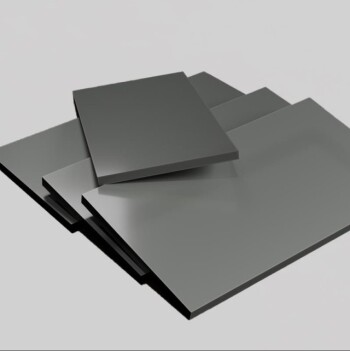
- Carbon Graphite Plate Manufactured by Isostatic Pressing Method
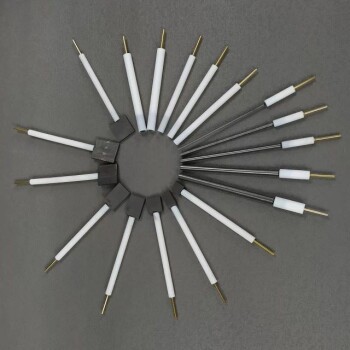
- Graphite Disc Rod and Sheet Electrode Electrochemical Graphite Electrode
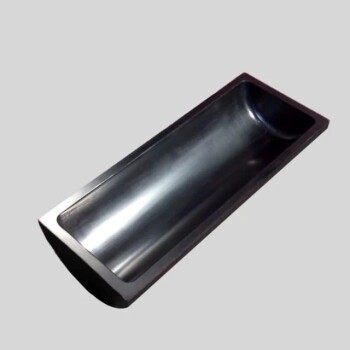
- High Purity Pure Graphite Crucible for Evaporation
- Carbon Graphite Boat -Laboratory Tube Furnace with Cover
- High Purity Pure Graphite Crucible for Electron Beam Evaporation
People Also Ask
- What is the process of isostatic graphite manufacturing? Achieve Unmatched Material Uniformity and Performance
- What is isostatic graphite? The Ultimate Material for High-Tech and High-Temperature Applications
- What is the density of isostatic graphite? Unlock Superior Performance for Demanding Applications
- How big is the isostatic pressing market? A Deep Dive into the $1.2B+ Advanced Manufacturing Enabler
- Why Use an Isostatic or High-Precision Hydraulic Press for Li/LLZO/Li Batteries? Master Solid-State Interfaces