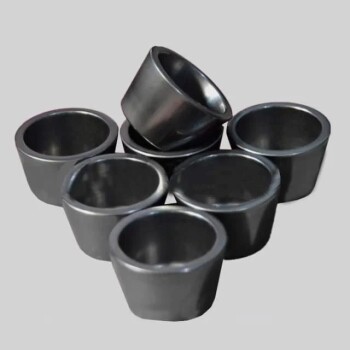
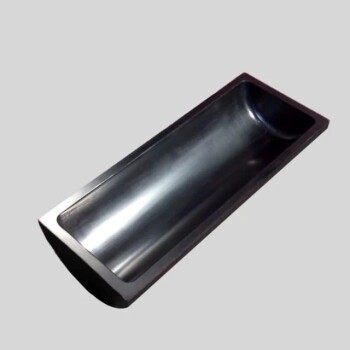
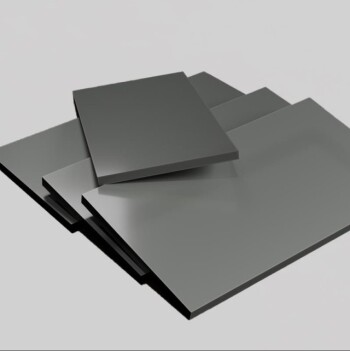
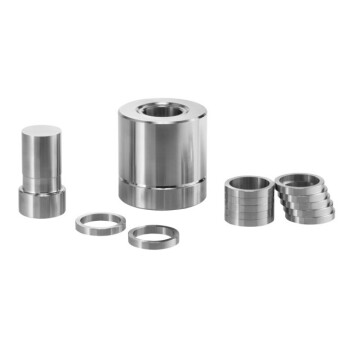
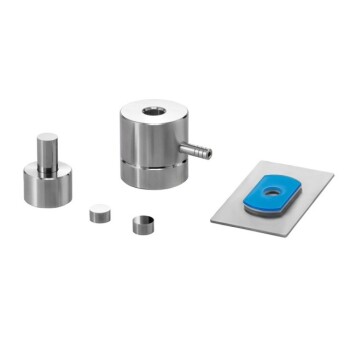
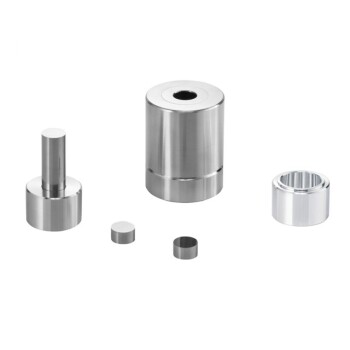
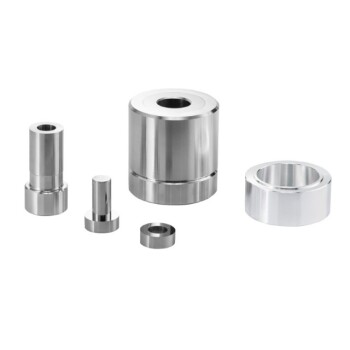
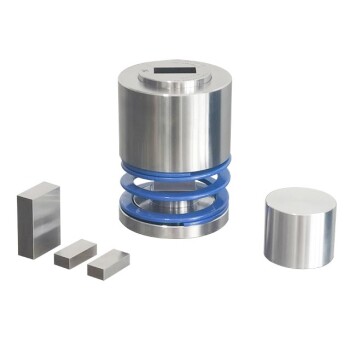
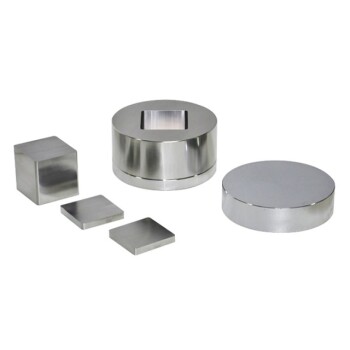
High-purity graphite molds act as the critical interface between the vacuum hot press equipment and the SiC/Al composite material. They perform three simultaneous functions: containing the powder mixture to define its geometry, transmitting the uniaxial mechanical pressure required for densification, and conducting heat uniformly to ensure a homogeneous sintering temperature field.
Core Takeaway The effectiveness of Vacuum Hot Pressing (VHP) relies entirely on how well the mold bridges the gap between the machine and the material. High-purity graphite is essential because it maintains structural integrity under extreme heat and pressure, ensuring the SiC/Al composite achieves full density without thermal gradients or dimensional distortion.
The Mechanics of Containment and Shaping
Defining Geometry Under Stress
The most fundamental role of the graphite mold is serving as a high-temperature resistant container. It holds the loose SiC/Al mixed powder or stacked foils in place during the process.
Because the mold maintains high mechanical strength at elevated temperatures, it ensures the composite retains its intended shape (such as a circular disk) throughout the sintering cycle. It defines the final dimensions of the product, preventing the powder from spreading outward when pressure is applied.
Ensuring Alignment
For composites involving layered structures or metal foils, the mold acts as a positioning tool. It ensures the alignment of stacks is preserved, which is critical for the structural integrity of the final composite plate.
Pressure Transmission and Densification
Converting Force to Density
The mold acts as the primary pressure-transmitting medium. It transfers the uniaxial load from the hot press hydraulic system directly onto the sample surface.
Effective transmission is vital for SiC/Al composites because the pressure drives the plastic deformation of the aluminum matrix. This forces the metal to fill pores between ceramic particles, resulting in a dense, void-free material.
Preventing Structural Defects
A key function of the mold is ensuring this pressure is distributed uniformly across the entire surface area.
If the mold were to flex or deform unevenly, it would lead to local non-bonding, uneven thickness, or density gradients. High-strength graphite resists this deformation, ensuring every part of the composite receives the same force.
Thermal Management for Homogeneity
Ensuring Uniform Heating
Graphite is utilized specifically for its superior thermal conductivity. In a vacuum environment where convection is absent, the mold must efficiently conduct heat from the furnace elements to the internal composite powder.
Eliminating Thermal Gradients
By transferring heat efficiently, the mold maintains the homogeneity of the sintering temperature field.
This prevents "hot spots" or "cold spots" within the composite. Uniform temperature is critical for ensuring consistent mechanical properties and preventing internal stresses that could crack the ceramic reinforcement.
Operational Considerations and Trade-offs
The Importance of Chemical Stability
While graphite is chosen for its inertness, the "high purity" aspect is non-negotiable. Lower-grade graphite can release impurities at high temperatures, which may react adversely with the aluminum matrix.
Mechanical Limitations
Despite its high-temperature strength, graphite is brittle compared to metals used in lower-temperature molding. Care must be taken during the loading and unloading phases, as impact damage to the mold will directly translate to dimensional inaccuracies in future SiC/Al sintering cycles.
Making the Right Choice for Your Goal
The specific design and grade of your graphite mold should be dictated by your primary quality metric.
- If your primary focus is Dimensional Precision: Prioritize high-strength graphite grades that resist deformation under high uniaxial loads (e.g., >25 MPa) to ensure exact thickness control.
- If your primary focus is Microstructural Homogeneity: Prioritize high-purity graphite with maximized thermal conductivity to ensure the aluminum matrix melts and bonds uniformly across the entire cross-section.
Ultimately, the graphite mold is not just a container; it is an active thermal and mechanical component that dictates the final density and reliability of your composite.
Summary Table:
| Functional Role | Contribution to SiC/Al Composite Quality | Key Benefit |
|---|---|---|
| Containment | Maintains precise dimensions and prevents powder spread | Geometric accuracy |
| Pressure Transmission | Ensures plastic deformation of Al matrix into ceramic pores | Full densification (void-free) |
| Thermal Management | Conducts uniform heat in vacuum environments | Microstructural homogeneity |
| High Purity | Prevents chemical reactions with the aluminum matrix | Material purity and integrity |
Optimize Your Advanced Material Fabrication with KINTEK
Precision in SiC/Al composite manufacturing begins with the right equipment and high-performance consumables. KINTEK specializes in laboratory and industrial solutions, providing the high-temperature vacuum hot presses and high-purity graphite components necessary for superior material densification.
From high-temperature furnaces (vacuum, CVD, atmosphere) and hydraulic presses to precision graphite crucibles and ceramics, we empower researchers and manufacturers with the tools to eliminate thermal gradients and structural defects.
Ready to achieve industry-leading material density? Contact KINTEK experts today to find the perfect match for your laboratory or production needs.
Related Products
- High Purity Pure Graphite Crucible for Evaporation
- High Purity Pure Graphite Crucible for Electron Beam Evaporation
- High Purity Alumina Granulated Powder for Engineering Advanced Fine Ceramics
- Horizontal High Temperature Graphite Vacuum Graphitization Furnace
- Ultra-High Temperature Graphite Vacuum Graphitization Furnace
People Also Ask
- Why are high-purity graphite crucibles preferred for sulfide solid electrolytes? Achieve Superior Material Purity
- Why is a high-purity graphite crucible required for Chromel-TaC composites? Ensure Peak Purity at 1400°C
- What role do high-purity graphite crucibles play in molten salt corrosion research? Ensure Reactor-Grade Precision
- Why are high-purity graphite crucibles used for magnesium distillation? Ensure 3N8 Purity & Thermal Stability
- Why is a high-purity graphite crucible ideal for nitrogen-doped graphene at 1500 °C? Maximize Purity and Stability