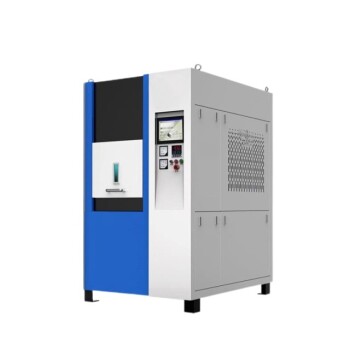
High-strength graphite dies act as the fundamental multifunctional interface in the Spark Plasma Sintering (SPS) of tungsten carbide (WC) composites. They serve three simultaneous roles: they are the containment vessel for near-net-shape forming, the active heating element that generates rapid temperature rises, and the mechanical medium for transmitting extreme hydraulic pressure to the powder.
The core advantage of using high-strength graphite in SPS is thermo-mechanical coupling. By conducting pulsed electric current to generate Joule heat while simultaneously transmitting pressures up to 60 MPa, these dies enable WC composites to achieve over 99.8% theoretical density at lower temperatures than conventional methods allow.
The Functional Roles of the Graphite Die
Role 1: The Active Heating Element
Unlike traditional sintering where heat is applied externally, the graphite die in SPS is an active part of the thermal system. Pulsed electric current passes directly through the graphite mold.
This resistance generates Joule heat within the die itself and the enclosed powder. This mechanism allows for extremely high heating rates, which is essential for minimizing grain growth while ensuring rapid densification.
Role 2: The Pressure Transmission Medium
While generating heat, the die must also serve as a robust mechanical component. It acts as the transmission medium, transferring force from the hydraulic system directly to the WC powder.
In the processing of WC composites, the die transmits pressures up to 60 MPa at high temperatures. This pressure facilitates particle rearrangement and plastic deformation, driving the material toward full density.
Role 3: Precision Container for Shaping
The die functions as the primary vessel that defines the geometry of the final product. This allows for near-net-shape forming, reducing the need for extensive post-sintering machining.
To perform this role effectively, the graphite must maintain high dimensional stability even under extreme thermal and mechanical stress.
Why This Matters for Tungsten Carbide (WC)
Achieving Theoretical Density
The specific combination of heat and pressure provided by the die is critical for WC materials. The thermo-mechanical coupling ensures that the composites reach theoretical densities of over 99.8%.
Lowering Process Temperatures
High-strength graphite enables the process to occur at relatively lower sintering temperatures. By combining mechanical pressure with direct Joule heating, the system bypasses the need for the excessive thermal loads required in pressureless sintering.
Understanding the Operational Trade-offs
Mechanical Limits of Graphite
While termed "high-strength," graphite is brittle compared to metals. The pressure transmission is generally limited to ranges like 60 MPa to 100 MPa, depending on the die design and grade. Exceeding these limits to achieve higher density carries the risk of die fracture.
Dimensional Stability vs. Degradation
The die must remain chemically stable and structurally sound to ensure easy demolding. However, repeated cycling at high temperatures and pressures can eventually degrade the mold's surface or dimensional accuracy, necessitating replacement.
Making the Right Choice for Your Goal
When selecting die parameters for WC sintering, consider your specific density and efficiency targets:
- If your primary focus is maximizing density: Prioritize a die design capable of sustaining the upper limits of pressure (60 MPa) to force particle deformation and eliminate porosity.
- If your primary focus is process efficiency: Leverage the Joule heating capability of the graphite to utilize fast heating rates, reducing overall cycle time while maintaining near-net-shape precision.
High-strength graphite dies are not merely containers; they are the active engine of the SPS process, directly converting electrical energy and mechanical force into high-performance material properties.
Summary Table:
| Role | Functional Mechanism | Impact on WC Composites |
|---|---|---|
| Active Heating | Generates Joule heat via pulsed current | Rapid densification; minimizes grain growth |
| Pressure Medium | Transmits up to 60 MPa hydraulic force | Facilitates particle rearrangement & deformation |
| Precision Container | Defines geometry & near-net-shape | Reduces post-sintering machining requirements |
| Thermo-Mechanical | Simultaneous heat and pressure | Achieves >99.8% theoretical density |
Elevate Your Material Research with KINTEK Precision Solutions
Unlock the full potential of Spark Plasma Sintering (SPS) for your tungsten carbide and advanced composite projects. KINTEK specializes in providing high-performance laboratory equipment, including high-strength graphite dies, vacuum furnaces, and hydraulic presses designed to withstand the rigors of extreme thermo-mechanical coupling.
Whether you are refining battery research, developing high-temperature ceramics, or perfecting near-net-shape forming, our comprehensive portfolio—from graphite and ceramic consumables to high-pressure reactors—ensures your lab achieves maximum efficiency and theoretical density.
Ready to optimize your sintering process? Contact KINTEK today for a customized consultation and see how our expertise can drive your innovation forward.
References
- Ahmed-Ameur Zegai, Antonio Javier Sánchez‐Herencia. Microstructural and Mechanical Characterization of Colloidal Processed WC/(W5Vol%Ni) via Spark Plasma Sintering. DOI: 10.3390/ma16134584
This article is also based on technical information from Kintek Solution Knowledge Base .
Related Products
- Spark Plasma Sintering Furnace SPS Furnace
- 2200 ℃ Graphite Vacuum Heat Treat Furnace
- Ultra-High Temperature Graphite Vacuum Graphitization Furnace
- High Purity Pure Graphite Crucible for Electron Beam Evaporation
- High Purity Pure Graphite Crucible for Evaporation
People Also Ask
- What is SPS sintering method? A Guide to High-Speed, High-Performance Material Fabrication
- Why are Spark Plasma Sintering (SPS) furnaces or hot presses utilized in the preparation of Li3PS4 solid electrolytes?
- What is the difference between spark plasma sintering and flash sintering? A Guide to Advanced Sintering Methods
- What technical advantages does a Spark Plasma Sintering (SPS) furnace offer for LZP ceramics? Enhance Ionic Conductivity
- What is the theory of spark plasma sintering? A Guide to Rapid, Low-Temperature Densification