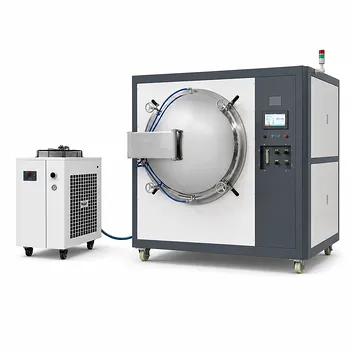
A high-vacuum tube furnace provides a strictly controlled, oxygen-free thermal environment that enables the precise pyrolysis of biomass. This equipment integrates precise heating rates, high-temperature stability (up to 850°C), and a sealed atmosphere—either under vacuum or purged with inert gases like nitrogen or argon. These conditions ensure that organic matter undergoes chemical reconstruction and carbonization without combustion, resulting in biochar with high carbon stability and developed pore structures.
The core value of a high-vacuum tube furnace lies in its ability to decouple thermal energy from atmospheric oxygen. By isolating these variables, researchers can manipulate the chemical pathways of biomass decomposition to maximize carbon yield and engineer specific surface properties.
Precise Thermal Management
The furnace acts as a thermodynamic reactor where temperature is not merely a setting, but a highly regulated variable.
Programmable Heating Rates
The furnace provides a platform for controlled heating rates, such as 10°C/min or up to 1500°C/h. This "slow pyrolysis" environment is critical for managing the release of volatile matter and preventing the collapse of the biomass cellular structure.
Constant Pyrolysis Temperatures
Maintaining a steady-state temperature (e.g., 300°C to 850°C) is essential for uniform carbonization. This thermal stability ensures that the dehydration, deoxygenation, and polycondensation reactions occur consistently throughout the entire sample.
Sophisticated Atmospheric Control
Beyond heat, the furnace manages the chemical composition of the space surrounding the biomass.
Strict Oxygen-Deficient Environments
The primary function of the furnace is to provide an anaerobic or oxygen-free atmosphere. By using high-purity nitrogen or vacuum seals, the furnace prevents the biomass from igniting, allowing it to "crack" and reconstruct into a stable carbon skeleton instead of turning to ash.
Integrated Gas Flow Systems
The furnace utilizes gas flow channels to introduce protective or reactive gases like nitrogen, argon, or carbon dioxide. This flow removes gaseous byproducts (devolatilization) and can even facilitate physical activation to improve the biochar's internal surface area.
High-Vacuum Capabilities
Under vacuum conditions, the furnace reduces the partial pressure of evolved gases. This environment accelerates the removal of tars and volatile organic compounds, which can help in researching the mechanisms of carbon sequestration and phosphorus transformation.
Chemical and Structural Engineering
The furnace provides the extreme conditions necessary for altering the physical state of the carbon.
Thermodynamic Activation Environments
High-temperature environments (up to 850°C) provide the energy required for chemical activation using agents like potassium hydroxide (KOH). In this state, the furnace facilitates a "gas-solid" reaction that etches the carbon skeleton, creating a vast network of micropores and mesopores.
Pore Structure Development
By controlling the interaction between temperature and gas flow, the furnace enables the uniform growth of hierarchical pore structures. This results in high-quality biochar with specific surface areas that can exceed 3500 m²/g, making it ideal for filtration or catalysis.
Understanding the Trade-offs
While highly precise, the vacuum tube furnace environment presents specific limitations.
Batch Size and Scalability
Tube furnaces are typically designed for small-scale laboratory or pilot research. The physical dimensions of the tube limit the volume of biomass that can be processed at once, making it less suitable for high-volume industrial production compared to rotary kilns.
System Complexity and Maintenance
The requirement for airtight seals and vacuum integrity increases the complexity of operation. Any leak in the system introduces oxygen, which can lead to sample combustion and potential damage to the heating elements or the quartz/alumina tube.
How to Apply This to Your Project
Choosing the right settings within a tube furnace depends on your intended biochar application.
- If your primary focus is carbon sequestration: Prioritize a stable, constant temperature between 500°C and 700°C under a nitrogen atmosphere to maximize the stability of the carbon skeleton.
- If your primary focus is high-surface-area adsorbents: Utilize high-temperature chemical activation (e.g., 850°C with KOH) and a continuous flow of argon to etch the maximum number of pores.
- If your primary focus is researching pyrolysis mechanisms: Use the programmable heating rates to conduct slow pyrolysis at various intervals (e.g., 300°C to 500°C) to observe how different temperatures impact phosphorus or nutrient retention.
The high-vacuum tube furnace remains the definitive tool for the precise, reproducible production of specialized biochar materials.
Summary Table:
| Environment Category | Key Feature | Impact on Biochar Quality |
|---|---|---|
| Thermal Control | Programmable Rates (up to 1500°C/h) | Prevents cellular collapse; manages volatile release |
| Atmospheric | Anaerobic (Vacuum or Inert Gas) | Prevents combustion; ensures stable carbonization |
| Structural | Thermodynamic Activation (up to 850°C) | Develops high surface area (up to 3500 m²/g) |
| Chemical | Integrated Gas Flow (N2, Ar, CO2) | Facilitates devolatilization and chemical etching |
Elevate Your Carbon Research with KINTEK Precision
Are you looking to engineer biochar with specific pore structures or maximize carbon sequestration yields? KINTEK specializes in advanced laboratory equipment designed for the most demanding thermal processes. From our high-precision high-vacuum tube furnaces and rotary kilns to our high-temperature reactors and crushing/milling systems, we provide the tools you need for reproducible, high-quality results.
Whether you require specialized MPCVD/PECVD systems, hydraulic pellet presses for sample preparation, or essential ceramics and crucibles, KINTEK is your partner in material science innovation. Our expertise ensures your lab achieves maximum efficiency with reliable, industry-leading technology.
Ready to optimize your pyrolysis workflows? Contact KINTEK today to discuss your equipment needs!
References
- Mariem Zouari, David DeVallance. Effect of demineralization and ball milling treatments on the properties of Arundo donax and olive stone-derived biochar. DOI: 10.1007/s13762-023-04968-9
This article is also based on technical information from Kintek Solution Knowledge Base .
Related Products
- Laboratory High Pressure Vacuum Tube Furnace
- 1700℃ Controlled Atmosphere Furnace Nitrogen Inert Atmosphere Furnace
- Vacuum Sealed Continuous Working Rotary Tube Furnace Rotating Tube Furnace
- Ultra-High Temperature Graphite Vacuum Graphitization Furnace
- 1200℃ Split Tube Furnace with Quartz Tube Laboratory Tubular Furnace
People Also Ask
- What is the role of a high-vacuum tube furnace in preparing Co3S4@NiS2/C composite materials? Expert Synthesis Insights
- What role does a high-vacuum tube furnace play in synthesizing manganese nitride? Achieve Precise Phase & Stoichiometry.
- What is the primary function of a high-vacuum tube furnace in CVD synthesis of Sb-doped Bi2Se3? Precision Growth Control
- Role of High-Pressure Tube Furnace in Ru/OMC Synthesis: Achieve Precise Reduction & Nanostructure Control
- What is the primary function of a high-pressure tube furnace in the preparation of Laver biochar? Expert Pyrolysis Guide