Rotary Freeze-Dryers fundamentally transform large-scale production by utilizing a continuous rotating drum to keep frozen pharmaceutical particles in constant motion within a vacuum. This dynamic mechanical action maximizes heat transfer efficiency, ensuring every particle is heated uniformly to prevent local overheating and significantly shorten the overall drying cycle.
By replacing static shelves with a dynamic rotating drum, these systems solve the critical challenge of uneven heating in mass production, delivering rapid throughput while preserving the biological activity of sensitive drugs.
The Mechanics of Dynamic Drying
Continuous Particle Motion
Unlike traditional static dryers where product sits stationary on trays, Rotary Freeze-Dryers employ a continuous rotating drum.
This mechanism ensures that frozen pharmaceutical particles are kept in a state of constant, gentle motion throughout the entire process.
Enhanced Heat Transfer
The physical movement within the drum creates a dynamic mixing environment.
This movement significantly improves the heat transfer efficiency between the heat source and the frozen material, overcoming the insulating effects often seen in static particle beds.
Critical Advantages for Quality and Speed
Preventing Drug Inactivation
In biological drug production, maintaining the stability of the active ingredient is paramount.
The constant mixing ensures that no single particle remains in contact with the heat source for too long, preventing local overheating. This uniformity is essential for avoiding drug inactivation and maintaining high potency.
Accelerating the Production Cycle
Efficiency is the primary driver for adopting rotary systems in large-scale manufacturing.
Because heat transfer is optimized and the surface area exposure is maximized, Rotary Freeze-Dryers markedly shorten the drying cycle. This allows manufacturers to process larger volumes in less time compared to static alternatives.
Operational Considerations
Suitability for Bulk Particulates
It is important to recognize that this technology is specifically designed for frozen pharmaceutical particles.
Because the mechanism relies on tumbling and mixing, it is optimized for bulk intermediate processing rather than finished dosage forms (such as liquid-filled vials) that require static placement.
Complexity of Motion
The shift from static to dynamic drying introduces moving parts within the vacuum chamber.
While this delivers superior uniformity, it requires a process specifically engineered to handle the physical movement of the drug substance without causing attrition or damage to the particles.
Making the Right Choice for Your Production Line
To determine if a Rotary Freeze-Dryer fits your manufacturing strategy, consider your specific production goals:
- If your primary focus is Production Speed: These systems are ideal because they significantly shorten drying cycles through enhanced heat transfer efficiency.
- If your primary focus is Product Potency: The dynamic mixing prevents local overheating, making this the superior choice for heat-sensitive biologicals prone to inactivation.
Rotary freeze-drying represents the shift from batch-based static constraints to a high-efficiency, continuous manufacturing standard.
Summary Table:
| Feature | Static Freeze-Drying | Rotary Freeze-Drying |
|---|---|---|
| Mechanism | Stationary trays/shelves | Continuous rotating drum |
| Heat Transfer | Conductive/Passive (Slower) | Dynamic mixing (Highly Efficient) |
| Temperature Control | Risk of local hotspots | Uniform heating; no local overheating |
| Drying Cycle Time | Standard/Long | Significantly shortened |
| Best Suited For | Finished vials/dosage forms | Bulk frozen pharmaceutical particles |
| Primary Benefit | Simple operation | Rapid throughput & high potency |
Elevate Your Pharmaceutical Production with KINTEK Precision
Transitioning from batch constraints to high-efficiency continuous manufacturing requires reliable equipment tailored to sensitive biologicals. KINTEK specializes in advanced laboratory and production solutions, including high-performance freeze dryers (lyophilizers), cold traps, and ULT freezers designed to preserve the integrity of your most critical compounds.
Beyond cooling solutions, our comprehensive portfolio supports every stage of your workflow with:
- High-Temperature & High-Pressure Reactors for complex synthesis.
- Crushing, Milling, and Sieving Systems for precise particle preparation.
- Advanced Ceramics and PTFE Consumables for contamination-free processing.
Ready to accelerate your drying cycles and ensure maximum product potency? Contact our technical experts today to discover how KINTEK’s specialized equipment can optimize your large-scale production line.
References
- Merve B. Adali, Roberto Pisano. Spray Freeze-Drying as a Solution to Continuous Manufacturing of Pharmaceutical Products in Bulk. DOI: 10.3390/pr8060709
This article is also based on technical information from Kintek Solution Knowledge Base .
Related Products
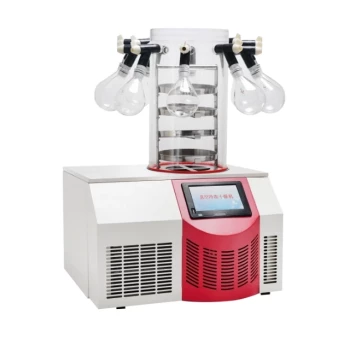
- High Performance Laboratory Freeze Dryer
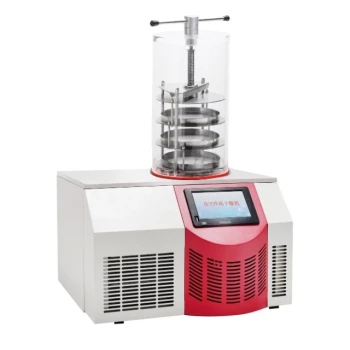
- Benchtop Laboratory Freeze Dryer for Lab Use
- Benchtop Laboratory Vacuum Freeze Dryer
- High Performance Laboratory Freeze Dryer for Research and Development
- 158L Precision Vertical Ultra Low Freezer for Laboratory Applications
People Also Ask
- What role does a laboratory freeze dryer play in the synthesis of graphene-based electrocatalysts? Preserve 3D Structures
- What are the technical advantages of using a laboratory freeze dryer for porous carbon precursors? Preserve 3D Networks
- What types of liquid samples can be processed using a laboratory freeze dryer? Preserve Your Sensitive Materials
- How do laboratory freeze dryers support scientific research? Preserve Sample Integrity for Reproducible Results
- Why is a laboratory freeze dryer preferred over traditional heating? Preserve Biochar Structure & Maximize Porosity