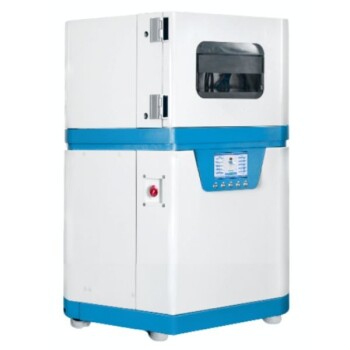
The defining characteristic of a Hot Isostatic Press (HIP) is the simultaneous application of high-temperature heating and isotropic gas pressure. For the synthesis of Li2MnSiO4/C composites, this involves subjecting reactants to pressures ranging from 10 to 200 MPa while maintaining temperatures between 400 and 600 degrees Celsius.
The combination of uniform gas pressure and heat maximizes the contact area between reactant particles. This unique environment drives solid-state reactions at lower temperatures than conventional methods, preserving fine grain sizes and ensuring high material purity.
The Mechanics of the HIP Environment
Simultaneous Heat and Pressure
Unlike standard furnaces that rely solely on thermal energy, HIP introduces a critical mechanical variable: isotropic gas pressure.
This means pressure is applied equally from all directions via an inert gas. This uniformity is essential for consistent material density and structural integrity.
Enhanced Particle Contact
The physical force exerted by the high-pressure gas (up to 200 MPa) significantly compresses the reactant powders.
This compression drastically increases the contact area between particles. It creates a higher number of active sites where the chemical reaction can initiate.
Accelerating Solid-State Reactions
By forcing particles into closer proximity, HIP reduces the diffusion distance required for atoms to react.
This allows the synthesis reaction to occur at relatively low temperatures (400 to 600°C). Under standard atmospheric pressure, these reactions would typically require much higher heat to achieve the same level of diffusion.
Physical Processes Driving Synthesis
Facilitating Diffusion and Deformation
The elevated temperature and pressure environment triggers specific physical mechanisms within the material.
Key processes include plastic deformation, creep, and diffusion. These mechanisms allow the material to reorganize and bond at the atomic level, resulting in a dense, cohesive composite.
Preserving Nanostructure
Because the reaction occurs at lower temperatures, there is less thermal energy available to drive unwanted crystal growth.
This results in fine grain sizes. The ability to synthesize materials at 400-600°C is a critical factor in producing high-purity nanomaterials rather than coarse, bulk crystals.
Understanding the Operational Trade-offs
The Temperature-Pressure Balance
While HIP allows for lower synthesis temperatures, the relationship between pressure and heat is sensitive.
If the temperature drops below the 400°C threshold, the activation energy for the solid-state reaction may not be met, regardless of the pressure applied.
Conversely, if temperatures exceed the 600°C range, you risk negating the benefits of the process. Excessive heat can lead to grain coarsening, which degrades the unique electrochemical properties of the nanomaterial.
Making the Right Choice for Your Goal
To maximize the benefits of Hot Isostatic Pressing for Li2MnSiO4/C synthesis, consider your specific material requirements:
- If your primary focus is Grain Size Control: Prioritize the lower end of the temperature range (near 400°C) while maximizing pressure to drive the reaction without thermal coarsening.
- If your primary focus is Reaction Completeness: Utilize the higher pressure range (near 200 MPa) to maximize particle contact area and active sites, ensuring the reactants are fully consumed.
Leveraging the unique physics of HIP allows you to decouple temperature from reaction kinetics, granting you precise control over the final material structure.
Summary Table:
| Parameter | HIP Condition Range | Impact on Synthesis |
|---|---|---|
| Pressure Type | Isotropic Gas (10 - 200 MPa) | Maximizes particle contact area & active sites |
| Temperature | Low-Range (400 - 600°C) | Preserves fine grain size & prevents coarsening |
| Mechanism | Diffusion & Deformation | Facilitates plastic deformation & atomic bonding |
| Atmosphere | Inert Gas | Ensures high material purity & structural integrity |
Elevate Your Material Research with KINTEK Precision
Unlock the full potential of your synthesis processes with KINTEK’s industry-leading Hot Isostatic Pressing (HIP) technology. Whether you are developing next-generation battery materials, high-purity ceramics, or advanced composites like Li2MnSiO4/C, our equipment provides the uniform pressure and precise thermal control required to maintain nanostructures and accelerate reaction kinetics.
From high-temperature furnaces and isostatic presses to specialized electrolytic cells and battery research tools, KINTEK is your partner in laboratory excellence.
Ready to achieve superior material density and purity? Contact our technical experts today to find the perfect solution for your lab’s unique requirements.
Related Products
- Warm Isostatic Press for Solid State Battery Research
- Electric Split Lab Cold Isostatic Press CIP Machine for Cold Isostatic Pressing
- Manual Cold Isostatic Pressing Machine CIP Pellet Press
- Automatic High Temperature Heated Hydraulic Press Machine with Heated Plates for Lab
- Isostatic Molding Pressing Molds for Lab
People Also Ask
- What is the temperature of a warm isostatic press? Achieve Optimal Densification for Your Materials
- What is the function of a Warm Isostatic Press (WIP) in all-solid-state pouch cells? Optimize Battery Density
- Why are Warm Isostatic Presses (WIP) necessary for solid-state batteries? Achieve Atomic-Level Contact
- What advantages does a warm isostatic press offer over a traditional uniaxial press for Li6PS5Cl electrolyte sheets?
- How do warm isostatic presses improve dry electrode performance? Enhance ASSB Conductivity with Heat & Pressure