Knowledge thermal elements Which is better quartz or ceramic heating element? Choose the Right Heat for Your Application
Author avatar

Tech Team · Kintek Solution

Updated 3 months ago

Which is better quartz or ceramic heating element? Choose the Right Heat for Your Application


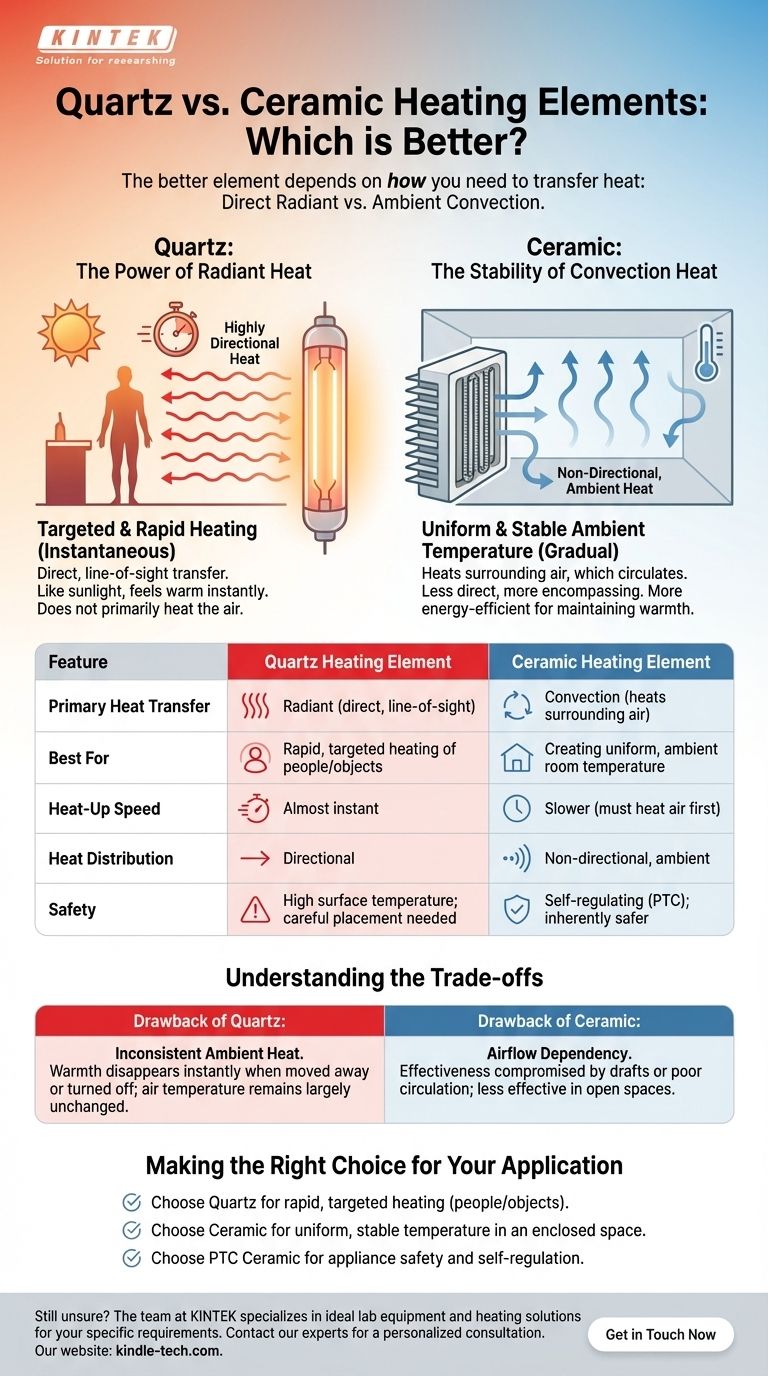
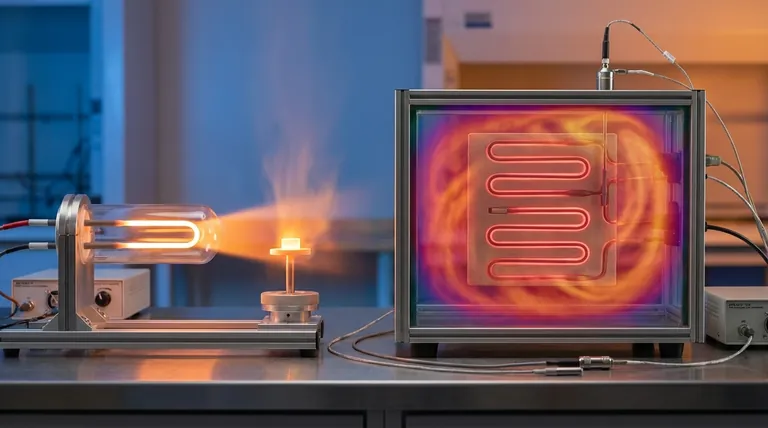
The better heating element depends entirely on how you need to transfer heat. For direct, line-of-sight heating of a specific person or object, a quartz element is superior due to its radiant heat properties. For creating a uniform, warm ambient temperature throughout an enclosed space, a ceramic element is the more effective choice because it operates through convection.

The core decision is not about which technology is "better," but which method of heat transfer—direct radiation or ambient convection—solves your specific problem. Quartz provides targeted, fast heat, while ceramic delivers stable, room-filling warmth.
Which is better quartz or ceramic heating element? Choose the Right Heat for Your Application

The Fundamental Difference: Radiant vs. Convection

To choose the right element, you must first understand the two different ways they heat. This single distinction is the most important factor in your decision.

Quartz Elements: The Power of Radiant Heat

Quartz elements do not primarily heat the air. Instead, they emit infrared radiation, a form of energy that travels in a straight line until it is absorbed by an object.

Think of it like the sun. When you stand in sunlight, you feel warm instantly, even if the air around you is cool. The energy is transferred directly to you. This makes quartz ideal for targeted and rapid heating.

Ceramic Elements: The Stability of Convection Heat

Ceramic elements work by heating up and transferring that thermal energy to the surrounding air, a process called convection.

This heated air then circulates throughout a space, gradually raising the overall ambient temperature. It's a less direct but more encompassing method, perfect for achieving a uniform and stable temperature in a room.

A Head-to-Head Comparison

With the core physics understood, we can compare the practical performance of each element.

Speed and Efficiency

Quartz elements provide a feeling of warmth almost instantly because the radiant energy travels at the speed of light.

Ceramic heaters take longer to feel because they must first heat the air, which then needs to circulate. However, for maintaining warmth in a well-insulated room over hours, they can be more energy-efficient.

Heat Distribution

The heat from a quartz element is highly directional. If you move out of its direct line of sight, you will no longer feel its effect.

Ceramic heaters provide non-directional, ambient heat. Once the air in the room is warm, you will feel it everywhere, regardless of your position relative to the heater.

Safety and Regulation

Modern ceramic heaters, particularly Positive Temperature Coefficient (PTC) types, are inherently safe. They are self-regulating, meaning their resistance increases as they get hotter, which naturally limits their maximum temperature and reduces the risk of overheating.

Quartz elements can reach very high surface temperatures. While safe when used as directed, they pose a higher immediate burn risk if touched and require careful placement away from flammable materials.

Understanding the Trade-offs

Neither technology is perfect. Acknowledging their limitations is key to avoiding frustration.

The Drawback of Quartz: Inconsistent Ambient Heat

A quartz heater will warm you, but it will not effectively warm the room. The air temperature will remain largely unchanged. This means that as soon as you turn it off or move away, the feeling of warmth disappears instantly.

The Drawback of Ceramic: Airflow Dependency

Because ceramic heaters rely on warming the air, their effectiveness can be compromised by drafts or poor air circulation. As noted in technical analyses, the heat will go "wherever the air currents in the process go," making them less effective in open or drafty spaces.

Making the Right Choice for Your Application

Select your heating element based on a clear understanding of your primary goal.

  • If your primary focus is rapid, targeted heating of people or objects: Choose a quartz element for its unmatched speed and direct radiant energy transfer.
  • If your primary focus is creating a uniform, stable temperature in an enclosed space: Choose a ceramic element for its effective and even convection heating.
  • If your primary focus is safety and self-regulation for an appliance: A PTC ceramic element is the superior choice due to its inherent thermal stability and durability.

Ultimately, understanding the physics of heat transfer—radiant versus convection—is the key to selecting the right tool for your specific job.

Summary Table:

Feature Quartz Heating Element Ceramic Heating Element
Primary Heat Transfer Radiant (direct, line-of-sight) Convection (heats surrounding air)
Best For Rapid, targeted heating of people/objects Creating uniform, ambient room temperature
Heat-Up Speed Almost instant Slower (must heat air first)
Heat Distribution Directional Non-directional, ambient
Safety High surface temperature; careful placement needed Self-regulating (PTC); inherently safer

Still unsure which heating element is right for your lab or process?

The team at KINTEK specializes in providing the ideal lab equipment, including heating solutions, for your specific requirements. We can help you select the perfect heating element to ensure efficiency, safety, and performance in your application.

Contact our experts today for a personalized consultation and discover how KINTEK can support your laboratory needs.

Get in Touch Now

Visual Guide

Which is better quartz or ceramic heating element? Choose the Right Heat for Your Application Visual Guide

Related Products

People Also Ask

Related Products

Molybdenum Disilicide (MoSi2) Thermal Elements Electric Furnace Heating Element

Molybdenum Disilicide (MoSi2) Thermal Elements Electric Furnace Heating Element

Discover the power of Molybdenum Disilicide (MoSi2) Heating Element for high-temperature resistance. Unique oxidation resistance with stable resistance value. Learn more about its benefits now!

Silicon Carbide SiC Thermal Heating Elements for Electric Furnace

Silicon Carbide SiC Thermal Heating Elements for Electric Furnace

Experience the advantages of Silicon Carbide (SiC) Heating Element: Long service life, high corrosion and oxidation resistance, fast heating speed, and easy maintenance. Learn more now!

Silicon Carbide (SIC) Ceramic Sheet Flat Corrugated Heat Sink for Engineering Advanced Fine Ceramics

Silicon Carbide (SIC) Ceramic Sheet Flat Corrugated Heat Sink for Engineering Advanced Fine Ceramics

Silicon carbide (sic) ceramic heat sink not only does not generate electromagnetic waves, but also can isolate electromagnetic waves and absorb part of electromagnetic waves.

10L Heating Chilling Circulator Cooling Water Bath Circulator for High and Low Temperature Constant Temperature Reaction

10L Heating Chilling Circulator Cooling Water Bath Circulator for High and Low Temperature Constant Temperature Reaction

Experience efficient lab performance with KinTek KCBH 10L Heating Chilling Circulator. Its all-in-one design offers reliable heating, chilling, and circulating functions for industrial and lab use.

50L Heating Chilling Circulator Cooling Water Bath Circulator for High and Low Temperature Constant Temperature Reaction

50L Heating Chilling Circulator Cooling Water Bath Circulator for High and Low Temperature Constant Temperature Reaction

Experience versatile heating, chilling, and circulating capabilities with our KinTek KCBH 50L Heating Chilling Circulator. Ideal for labs and industrial settings, with efficient and reliable performance.

Double Plate Heating Press Mold for Lab

Double Plate Heating Press Mold for Lab

Discover precision in heating with our Double Plate Heating Mold, featuring high-quality steel and uniform temperature control for efficient lab processes. Ideal for various thermal applications.

Engineering Advanced Fine Ceramics Aluminum Oxide Al2O3 Heat Sink for Insulation

Engineering Advanced Fine Ceramics Aluminum Oxide Al2O3 Heat Sink for Insulation

The hole structure of the ceramic heat sink increases the heat dissipation area in contact with the air, which greatly enhances the heat dissipation effect, and the heat dissipation effect is better than that of super copper and aluminum.

High Temperature Constant Temperature Heating Circulator Water Bath Chiller Circulator for Reaction Bath

High Temperature Constant Temperature Heating Circulator Water Bath Chiller Circulator for Reaction Bath

Efficient and reliable, KinTek KHB Heating Circulator is perfect for your lab needs. With a max. heating temperature of up to 300℃, it features accurate temperature control and fast heating.

30L Heating Chilling Circulator Cooling Water Bath Circulator for High and Low Temperature Constant Temperature Reaction

30L Heating Chilling Circulator Cooling Water Bath Circulator for High and Low Temperature Constant Temperature Reaction

Get versatile lab performance with KinTek KCBH 30L Heating Chilling Circulator. With max. heating temp of 200℃ and max. chilling temp of -80℃, it's perfect for industrial needs.

5L Heating Chilling Circulator Cooling Water Bath Circulator for High and Low Temperature Constant Temperature Reaction

5L Heating Chilling Circulator Cooling Water Bath Circulator for High and Low Temperature Constant Temperature Reaction

KinTek KCBH 5L Heating Chilling Circulator - Ideal for labs and industrial conditions with multi-functional design and reliable performance.

100L Heating Chilling Circulator Cooling Water Bath Circulator for High and Low Temperature Constant Temperature Reaction

100L Heating Chilling Circulator Cooling Water Bath Circulator for High and Low Temperature Constant Temperature Reaction

Get all-in-one heating, chilling, and circulating capabilities with our KinTek KCBH 80L Heating Chilling Circulator. High efficiency, reliable performance for labs and industrial applications.

20L Heating Chilling Circulator Cooling Water Bath Circulator for High and Low Temperature Constant Temperature Reaction

20L Heating Chilling Circulator Cooling Water Bath Circulator for High and Low Temperature Constant Temperature Reaction

Maximize lab productivity with KinTek KCBH 20L Heating Chilling Circulator. Its all-in-one design offers reliable heating, chilling, and circulating functions for industrial and lab use.

Laboratory Small Constant Temperature Heated Magnetic Stirrer Heater and Stirrer

Laboratory Small Constant Temperature Heated Magnetic Stirrer Heater and Stirrer

The Laboratory Small Constant Temperature Heating Magnetic Stirrer is a versatile tool designed for precise temperature control and efficient mixing in various laboratory applications.

Electron Beam Evaporation Coating Conductive Boron Nitride Crucible BN Crucible

Electron Beam Evaporation Coating Conductive Boron Nitride Crucible BN Crucible

High-purity and smooth conductive boron nitride crucible for electron beam evaporation coating, with high temperature and thermal cycling performance.

Automatic High Temperature Heated Hydraulic Press Machine with Heated Plates for Lab

Automatic High Temperature Heated Hydraulic Press Machine with Heated Plates for Lab

The High Temperature Hot Press is a machine specifically designed for pressing, sintering and processing materials in a high temperature environment. It is capable of operating in the range of hundreds of degrees Celsius to thousands of degrees Celsius for a variety of high temperature process requirements.

Manual High Temperature Heated Hydraulic Press Machine with Heated Plates for Lab

Manual High Temperature Heated Hydraulic Press Machine with Heated Plates for Lab

The High Temperature Hot Press is a machine specifically designed for pressing, sintering and processing materials in a high temperature environment. It is capable of operating in the range of hundreds of degrees Celsius to thousands of degrees Celsius for a variety of high temperature process requirements.

Evaporation Boat for Organic Matter

Evaporation Boat for Organic Matter

The evaporation boat for organic matter is an important tool for precise and uniform heating during the deposition of organic materials.

Multi Heating Zones CVD Tube Furnace Machine Chemical Vapor Deposition Chamber System Equipment

Multi Heating Zones CVD Tube Furnace Machine Chemical Vapor Deposition Chamber System Equipment

KT-CTF14 Multi Heating Zones CVD Furnace - Precise Temperature Control and Gas Flow for Advanced Applications. Max temp up to 1200℃, 4 channels MFC mass flow meter, and 7" TFT touch screen controller.

Molybdenum Vacuum Heat Treat Furnace

Molybdenum Vacuum Heat Treat Furnace

Discover the benefits of a high-configuration molybdenum vacuum furnace with heat shield insulation. Ideal for high-purity, vacuum environments like sapphire crystal growth and heat treatment.

Laboratory Scientific Electric Heating Blast Drying Oven

Laboratory Scientific Electric Heating Blast Drying Oven

The desktop fast autoclave sterilizer is a compact and reliable device used for rapid sterilization of medical, pharmaceutical, and research items.


Leave Your Message