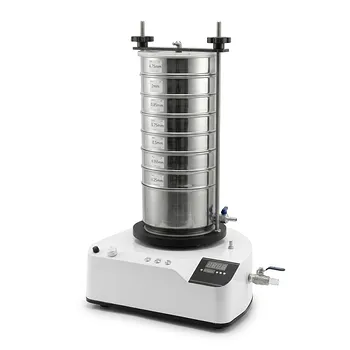
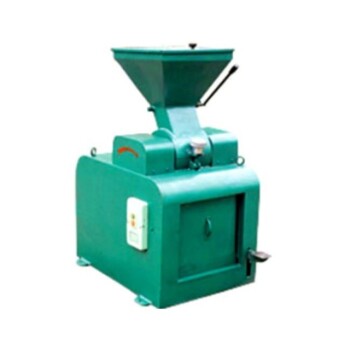
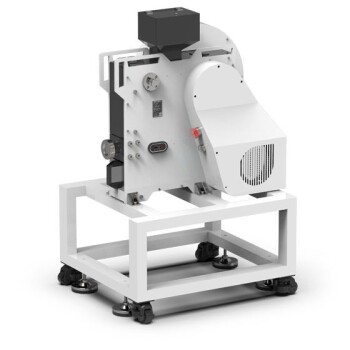
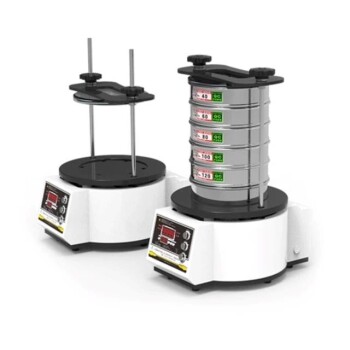
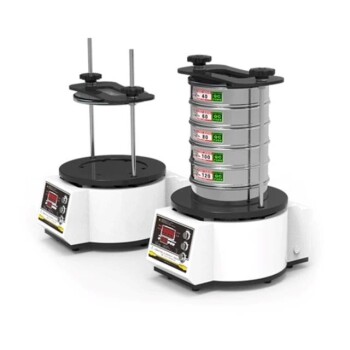
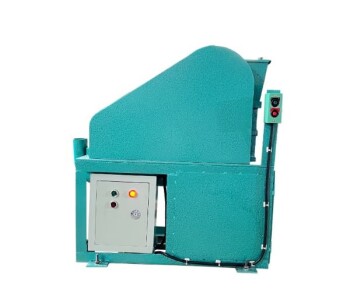
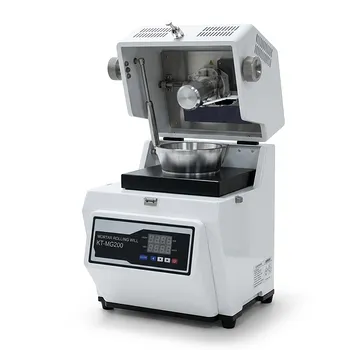
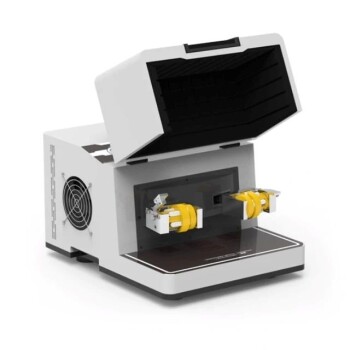
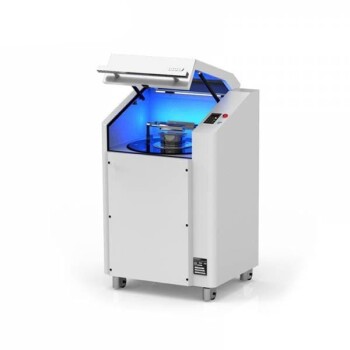
To maximize hesperidin yield, a laboratory crusher and a standard sieve are strictly necessary for mechanical pretreatment. These tools function together to convert raw orange peel waste into a uniform powder with a specific, controlled particle size. By physically breaking down the material, you dramatically increase the surface area available for solid-liquid contact and significantly shorten the path the solvent must travel to reach the target compounds.
Core Takeaway: Extraction efficiency is governed by mass transfer kinetics. Reducing particle size is not just about making the material smaller; it is about maximizing the interfacial area between the solid and the solvent to ensure the extraction is fast, complete, and reproducible.
The Mechanics of Efficient Extraction
Increasing Surface Area
The primary function of the laboratory crusher is to break down the physical structure of the orange peel.
When you reduce raw material into a powder, you exponentially increase the specific surface area. This exposes more of the hesperidin-containing cells directly to the solvent. According to the primary technical data, this increased contact area is the fundamental driver for improved extraction performance.
Shortening the Diffusion Path
Solvents work by penetrating the solid matrix to dissolve the target compound.
In large pieces of raw material, the solvent must travel a long distance to reach the center. Crushing the material reduces this "penetration path." A shorter path means the solvent reaches the hesperidin faster, and the dissolved compound diffuses back out into the bulk liquid more quickly.
Optimizing Extraction Kinetics
The combination of high surface area and short diffusion paths accelerates the entire process.
This is referred to as optimizing "extraction kinetics." It ensures that the chemical interactions happen rapidly. Without this mechanical step, the extraction would be sluggish, and a significant portion of the hesperidin would likely remain trapped deep within the raw material.
The Role of Consistency
Ensuring Uniformity via Sieving
While the crusher reduces size, the standard sieve ensures consistency.
A crusher alone produces a mix of dust and larger fragments. The sieve filters this output to ensure a uniform geometric dimension. Uniformity is critical because it ensures that every particle extracts at roughly the same rate, preventing a scenario where fine dust extracts instantly while larger chunks remain under-processed.
Reproducibility Across Solvents
Standardizing particle size allows for predictable results regardless of the solvent used.
When the particle size is fixed, you can accurately compare the performance of different solvents. This control is essential for determining the optimal chemical conditions for maximum yield, as it removes physical irregularity as a variable.
Understanding the Trade-offs
The Diminishing Returns of Size Reduction
While smaller is generally better for yield, there are practical limits.
Extremely fine powders can become difficult to handle or filter downstream. The goal is to reduce size enough to maximize surface area without creating processing bottlenecks later in the workflow.
Energy Input vs. Extraction Output
Mechanical preparation adds a step to the process that requires energy and equipment.
However, this "cost" is almost always offset by the efficiency gains in the extraction phase. Skipping this step usually results in the need for longer extraction times, more solvent usage, or lower overall yields.
Making the Right Choice for Your Goal
Mechanical preparation is the foundation of high-yield chemical extraction.
- If your primary focus is Maximum Yield: Prioritize a finer mesh sieve to maximize surface area and ensure no hesperidin remains trapped in the matrix.
- If your primary focus is Process Speed: Focus on the uniformity of the powder to ensure rapid, predictable solvent penetration and faster mass transfer.
By strictly controlling particle size through crushing and sieving, you transform a variable raw waste product into a standardized material ready for high-efficiency chemical processing.
Summary Table:
| Equipment Component | Key Function in Pretreatment | Impact on Extraction Performance |
|---|---|---|
| Laboratory Crusher | Mechanical size reduction | Increases interfacial area and shortens solvent diffusion paths. |
| Standard Sieve | Particle size classification | Ensures uniformity, preventing uneven extraction and ensuring reproducibility. |
| Powder Output | Controlled geometric dimension | Optimizes mass transfer kinetics for faster, more complete recovery. |
| Process Synergy | Standardized material preparation | Reduces solvent waste and extraction time while maximizing total yield. |
Maximize Your Extraction Efficiency with KINTEK Precision Equipment
Don't let inconsistent raw material preparation hinder your laboratory results. KINTEK specializes in high-performance crushing and milling systems and sieving equipment designed to provide the exact particle uniformity required for sensitive chemical extractions like hesperidin recovery.
Our comprehensive range of laboratory solutions includes:
- Sample Preparation: Advanced crushers, mills, and hydraulic pellet presses.
- Thermal Processing: High-temperature muffle, tube, and vacuum furnaces.
- Advanced Synthesis: CVD, PECVD, and high-pressure reactors.
- Lab Essentials: ULT freezers, homogenizers, and high-quality PTFE consumables.
Whether you are refining botanical extracts or conducting advanced battery research, KINTEK delivers the durability and precision you need to achieve reproducible success. Contact KINTEK today to optimize your workflow and discover how our specialized equipment can transform your raw materials into standardized, high-yield outputs.
References
- Mahesh Kumar Samota, P. N. Guru. Hesperidin from citrus peel waste: extraction and its health implications. DOI: 10.15586/qas.v15i2.1256
This article is also based on technical information from Kintek Solution Knowledge Base .
Related Products
- Laboratory Test Sieves and Sieving Machines
- Laboratory Vibratory Sieve Shaker Machine for Dry and Wet Three-Dimensional Sieving
- Laboratory Vibratory Sieve Shaker Machine Slap Vibrating Sieve
- Laboratory Test Sieves and Vibratory Sieve Shaker Machine
- Laboratory Sealed Hammer Crusher for Efficient Sample Preparation
People Also Ask
- What are laboratory test sieves used for? A Guide to Particle Size Analysis
- How do you calculate the sieve test? Master Particle Size Distribution for Quality Control
- How does a lab test sieve contribute to biomass charcoal powder preparation? Achieve Uniform Particle Size
- What are the specifications for test sieves? A Guide to ASTM & ISO Standards for Accurate Particle Analysis
- What materials are required for sieving? Achieve Accurate Particle Size Analysis