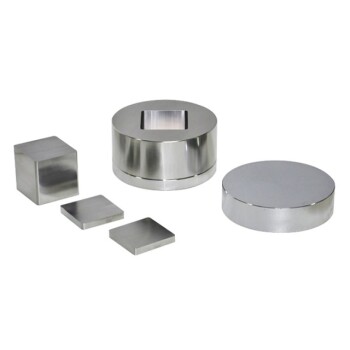
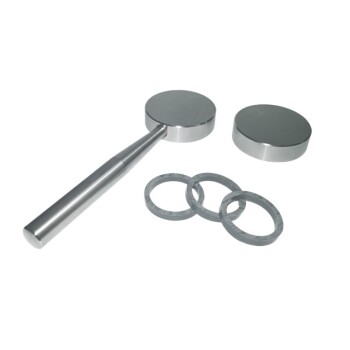
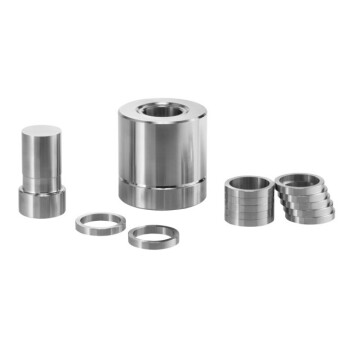
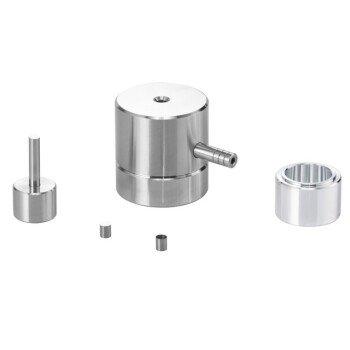
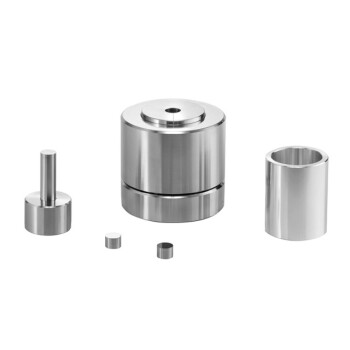
Graphite molds are the structural and functional backbone of the hot pressing process for Zirconium Diboride-Silicon Carbide (ZrB2-SiC) composites. They are necessary because they act as the only viable containment vessel capable of surviving the extreme 2000°C sintering environment while simultaneously conducting the electricity and heat required to densify the material.
The Core Takeaway Successful sintering of ZrB2-SiC requires a mold that functions as more than just a container; it must act as an active conductor of heat and pressure. Graphite is uniquely suited for this role because it retains structural integrity at temperatures that would melt other materials, ensuring uniform densification through superior thermal and electrical conductivity.
WITHSTANDING EXTREME ENVIRONMENTS
Thermal Survival at 2000°C
Processing ZrB2-SiC composites requires immense heat to fuse the ceramic particles.
Graphite molds are necessary because they possess exceptional thermal stability. They can withstand the extreme sintering temperatures of up to 2000°C required for these ceramics without melting or deforming.
Structural Integrity Under Load
Heat alone is not enough; the material must be physically compressed to remove porosity.
Graphite molds maintain their mechanical strength even at these extreme temperatures. In the specific context of ZrB2-SiC processing, they are relied upon to withstand mechanical pressures up to 10 MPa without failing.
DRIVING THE DENSIFICATION PROCESS
The Role of Electrical Conductivity
In a resistance-heated vacuum hot press, the heat is often generated by passing current through the system.
Graphite provides excellent electrical conductivity. This allows the mold itself to facilitate the heating process, ensuring that the energy is efficiently directed into the composite material.
Uniform Heat Transfer
Uneven heating leads to defects, warping, or incomplete sintering.
Graphite’s high thermal conductivity ensures that heat is distributed evenly throughout the mold. This facilitates uniform heat transfer to the ZrB2-SiC powder, promoting a consistent temperature field and homogeneous densification of the final product.
SHAPING AND PRESSURE TRANSMISSION
Defining Geometry
The mold acts as the primary "shaping container."
It defines the final geometry of the sintered part. Because graphite does not soften significantly at 2000°C, it ensures the composite achieves precise dimensional accuracy.
Axial Pressure Distribution
The hot press applies force from a single direction (uniaxial), which can lead to uneven density if not managed correctly.
The graphite mold acts as a transmission medium. It transfers the axial pressure from the press head directly to the powder. This ensures the pressure is uniformly distributed, forcing the particles together to create a dense, void-free structure.
UNDERSTANDING THE TRADE-OFFS
Mechanical Pressure Limits
While graphite is strong, it is not infinitely durable compared to cold-working tooling.
According to the primary data for this application, these molds are rated for pressures up to 10 MPa. Exceeding this limit at peak temperatures carries a risk of mold fracture or deformation, potentially ruining the expensive ceramic composite.
Environmental Constraints
Graphite is highly susceptible to oxidation at high temperatures.
Therefore, this process strictly requires a vacuum environment. The molds cannot be used in an open-air furnace at 2000°C, as the graphite would essentially burn away, compromising the sample and the equipment.
MAKING THE RIGHT CHOICE FOR YOUR GOAL
When planning the sintering of Ultra-High Temperature Ceramics (UHTCs) like ZrB2-SiC:
- If your primary focus is densification uniformity: Prioritize high-purity graphite with verified electrical homogeneity to prevent hot spots during resistance heating.
- If your primary focus is process safety: Strictly adhere to the 10 MPa pressure limit and ensure a stable vacuum to prevent mold oxidation and failure.
Graphite is not just a toolholder; it is an active participant in the thermal and mechanical physics that make high-performance ceramic sintering possible.
Summary Table:
| Feature | Requirement for ZrB2-SiC Sintering | Why Graphite is Essential |
|---|---|---|
| Temperature Resistance | Up to 2000°C | Retains structural integrity where metals melt |
| Pressure Handling | Up to 10 MPa | Maintains mechanical strength under high axial load |
| Conductivity | High Thermal & Electrical | Ensures uniform heat distribution and efficient heating |
| Geometry Control | Precise Dimensional Accuracy | Provides a stable, non-deforming containment vessel |
| Environment | Vacuum/Inert Atmosphere | Prevents oxidation of the mold and composite material |
Elevate Your Advanced Ceramic Research with KINTEK
Precise material densification requires more than just high temperatures—it demands high-quality equipment designed for extreme environments. At KINTEK, we specialize in providing the laboratory equipment and consumables necessary for the most demanding sintering and hot-pressing applications.
Whether you are developing ZrB2-SiC composites or other Ultra-High Temperature Ceramics, our portfolio offers the tools you need for success:
- High-Temperature Vacuum Hot Presses designed for uniform pressure distribution.
- Muffle, Tube, and Vacuum Furnaces capable of reaching extreme sintering temperatures.
- High-Purity Graphite Consumables and ceramic crucibles to ensure process purity.
- Crushing, Milling, and Sieving systems for optimal powder preparation.
Ready to optimize your densification process? Our experts are here to help you select the right hydraulic presses, furnaces, and consumables to achieve void-free, high-density results.
Contact KINTEK Today to Enhance Your Lab’s Capabilities
Related Products
- Carbon Graphite Plate Manufactured by Isostatic Pressing Method
- High Purity Pure Graphite Crucible for Evaporation
- High Purity Pure Graphite Crucible for Electron Beam Evaporation
- Carbon Graphite Boat -Laboratory Tube Furnace with Cover
- Vertical High Temperature Graphite Vacuum Graphitization Furnace
People Also Ask
- What is the process of isostatic graphite manufacturing? Achieve Unmatched Material Uniformity and Performance
- What is isostatic graphite? The Ultimate Material for High-Tech and High-Temperature Applications
- What is the density of isostatic graphite? Unlock Superior Performance for Demanding Applications
- How big is the isostatic pressing market? A Deep Dive into the $1.2B+ Advanced Manufacturing Enabler
- Why Use an Isostatic or High-Precision Hydraulic Press for Li/LLZO/Li Batteries? Master Solid-State Interfaces