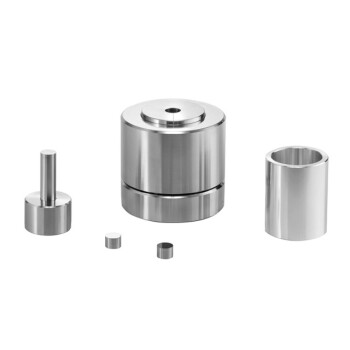
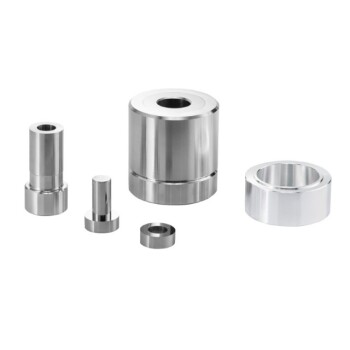
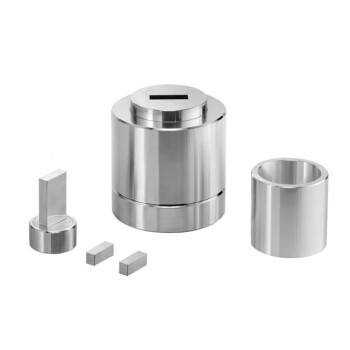
Graphite molds are the industry standard for this process because they possess a unique combination of extreme thermal resistance, electrical conductivity, and mechanical strength required to shape MoSi2-based composites.
Specifically, these molds must maintain structural integrity while holding mixed powders at temperatures up to 1700°C and under axial pressures of 24.5 MPa. This environment forces the powder to undergo plastic flow and densification, which is critical for achieving a "near-net-shape" final product.
Core Takeaway Graphite acts as more than just a container; it serves as a dual-function tool that facilitates the generation of heat through conductivity while simultaneously acting as a pressure vessel. Its ability to maintain dimensional stability under extreme heat and mechanical stress allows for the precise densification of high-performance composites like MoSi2.
The Role of Thermal and Electrical Properties
Withstanding Extreme Sintering Temperatures
The sintering of MoSi2-based composites requires thermal environments that would melt or deform most standard mold materials.
Graphite molds are essential because they remain stable and rigid at temperatures as high as 1700°C. This thermal resistance ensures the mold does not collapse or lose accuracy during the critical heating phase.
Acting as an Induction Receptor
Graphite is not merely a passive vessel; its excellent electrical conductivity allows it to play an active role in the heating process.
In many vacuum hot-press setups, the graphite mold acts as an induction heating receptor, converting electromagnetic energy directly into heat. This ensures the heat is generated efficiently and applied uniformly to the MoSi2 powder within.
Mechanics of Densification and Shaping
Facilitating Plastic Flow via Pressure
To turn loose powder into a solid composite, the material must undergo plastic flow.
Graphite molds have the mechanical strength to transmit significant uniaxial pressure (specifically 24.5 MPa for this application) from the hydraulic head to the powder. This pressure forces particles into contact, expelling internal gases and eliminating voids to achieve high density.
Achieving Near-Net-Shape Precision
A primary goal of hot-press sintering is to produce a component that requires minimal post-processing.
Because graphite maintains high dimensional stability under load and heat, it effectively fixes the shape of the powder throughout the process. This capability allows for near-net-shape manufacturing, ensuring the sintered billet matches the intended geometric specifications.
Understanding the Trade-offs
The Necessity of a Vacuum Environment
While graphite is mechanically robust, it is chemically sensitive to oxygen at high temperatures.
Graphite molds are used in vacuum hot-press sintering specifically because they suffer from oxidative loss in air. The vacuum environment protects the mold, significantly extending its service life and reducing production costs compared to non-vacuum methods.
Interaction and Demolding
Direct contact between the composite material and the mold at extreme temperatures can sometimes lead to adhesion or chemical interaction.
To mitigate this, graphite paper or spacers are often employed as a barrier between the punches and the powder. This ensures that the structural integrity of the mold is preserved and allows for the successful demolding of the finished specimen.
Making the Right Choice for Your Goal
When designing a sintering process for MoSi2 composites, consider the following specific requirements:
- If your primary focus is Maximum Density: Ensure your graphite grade acts as an effective pressure transfer medium to sustain the required 24.5 MPa axial load without deformation.
- If your primary focus is Dimensional Accuracy: Prioritize high-strength graphite molds that maintain rigidity at 1700°C to guarantee near-net-shape results.
- If your primary focus is Cost Efficiency: strict adherence to vacuum protocols is required to minimize oxidative loss and extend the usable life of the graphite tooling.
Graphite molds are the linchpin of this process, translating raw energy and pressure into a structurally sound, high-density composite material.
Summary Table:
| Feature | Graphite Mold Requirement | Impact on MoSi2 Composites |
|---|---|---|
| Thermal Stability | Stable up to 1700°C | Prevents deformation during high-heat sintering |
| Conductivity | High Electrical Conductivity | Acts as an induction receptor for uniform heating |
| Mechanical Strength | Sustains 24.5 MPa Pressure | Facilitates plastic flow and maximum densification |
| Dimensional Accuracy | High Rigidity | Ensures near-net-shape manufacturing precision |
| Environment | Vacuum Compatibility | Protects mold from oxidation to extend service life |
Elevate Your Material Research with KINTEK
Precision is non-negotiable in high-temperature sintering. KINTEK specializes in advanced laboratory equipment and high-performance consumables designed for the most demanding environments. Whether you are working with MoSi2-based composites or advanced ceramics, our high-temperature furnaces, hydraulic pellet presses, and precision-engineered graphite crucibles provide the reliability you need.
From vacuum and atmosphere furnaces to isostatic presses and specialized PTFE or ceramic consumables, we empower researchers and manufacturers to achieve superior material density and near-net-shape accuracy.
Ready to optimize your sintering process? Contact KINTEK today to discuss your equipment needs and see how our comprehensive solutions can drive your innovation forward.
Related Products
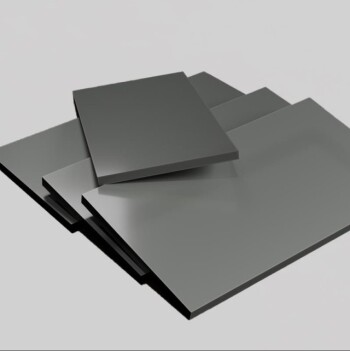
- Carbon Graphite Plate Manufactured by Isostatic Pressing Method
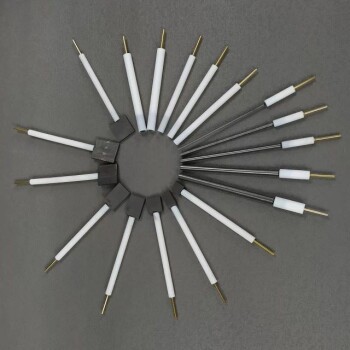
- Graphite Disc Rod and Sheet Electrode Electrochemical Graphite Electrode
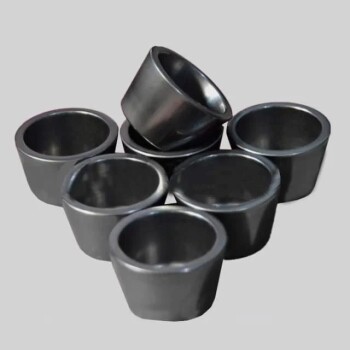
- High Purity Pure Graphite Crucible for Evaporation
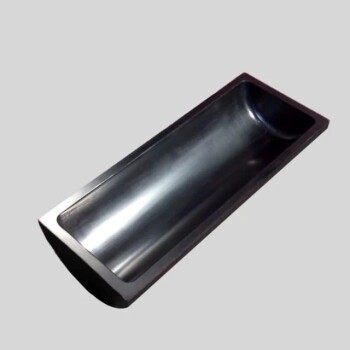
- Carbon Graphite Boat -Laboratory Tube Furnace with Cover
- High Purity Pure Graphite Crucible for Electron Beam Evaporation
People Also Ask
- What is the process of isostatic graphite manufacturing? Achieve Unmatched Material Uniformity and Performance
- What is isostatic graphite? The Ultimate Material for High-Tech and High-Temperature Applications
- What is the density of isostatic graphite? Unlock Superior Performance for Demanding Applications
- How big is the isostatic pressing market? A Deep Dive into the $1.2B+ Advanced Manufacturing Enabler
- Why Use an Isostatic or High-Precision Hydraulic Press for Li/LLZO/Li Batteries? Master Solid-State Interfaces