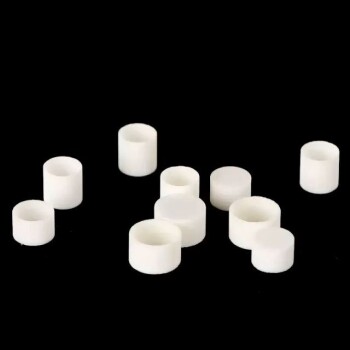
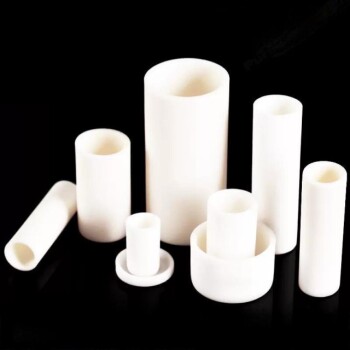
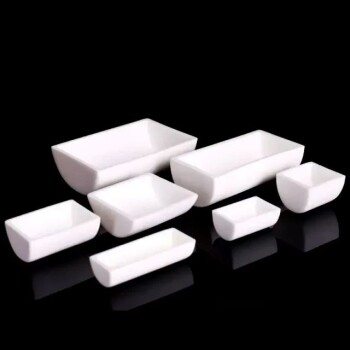
High-purity alumina tubes are the preferred choice for converter cavity simulations because they provide a chemically inert and thermally stable environment at temperatures exceeding 1773 K. These tubes ensure that molten iron does not react with the vessel walls, preventing the introduction of impurities and maintaining the integrity of the experimental results during high-temperature gas blowing.
High-purity alumina serves as a "non-interfering" container that balances extreme heat resistance with chemical neutrality. This allows researchers to isolate the chemical reactions of the molten pool without the vessel itself becoming a variable in the experiment.
Unmatched Chemical and Thermal Stability
Resistance to Molten Iron Interaction
At the extreme temperatures required for converter simulations (up to 1773 K), most materials would melt or alloy with the metal samples. High-purity alumina (typically 99.7% Al2O3) remains stable and does not react with molten iron or slag. This chemical inertness is critical for ensuring that the final chemical analysis of the metal reflects the process, not the container.
Prevention of Impurity Leaching
High-purity alumina is specifically chosen to avoid cross-contamination. Because the material is highly refined, it does not release trace elements into the molten pool even under the corrosive influence of metal vapors or molten salts. This level of purity is essential for quantitative analysis and maintaining the reliability of experimental data.
Performance in Corrosive Atmospheres
Beyond contact with liquid metal, these tubes resist erosion from corrosive gases such as hydrogen, steam, or battery decomposition products like hydrogen fluoride. This versatility makes them suitable for a wide range of metallurgical and chemical simulations where gas-phase reactions are present.
Structural Integrity Under Stress
Thermal Shock and Mechanical Strength
Converter simulations involve rapid temperature changes and mechanical stress from gas blowing. High-purity alumina possesses excellent thermal shock resistance, which prevents the tube from cracking or shattering when exposed to sudden thermal gradients. Its mechanical strength ensures it can hold the weight of the molten pool without deforming.
Resistance to Bending and Sagging
Compared to alternative materials like mullite, high-purity alumina offers superior resistance to sagging at temperatures above 1400°C. This maintains the consistency of the internal flow field and prevents the vessel from warping during long-duration experiments. This dimensional stability is vital for maintaining a consistent reaction environment.
Gas Tightness for Controlled Environments
High-purity dense alumina is valued for its excellent gas tightness. This property allows researchers to create a perfectly sealed reaction space, which is necessary for controlling the internal atmosphere and accurately measuring gas-metal interactions.
Understanding the Trade-offs
Brittleness and Handling
While alumina is exceptionally strong at high temperatures, it is a brittle ceramic material. It is highly susceptible to mechanical impact and can fail catastrophically if dropped or handled roughly. Careful installation and support structures are required to avoid physical stress on the tube.
Cost and Thermal Conductivity
High-purity alumina is significantly more expensive than standard refractory materials or lower-grade ceramics. Additionally, while it has high thermal conductivity for a ceramic, it does not match the conductivity of metals. This means heating systems must be carefully designed to ensure uniform temperature distribution within the reaction zone.
How to Apply This to Your Project
Selecting the Right Vessel for Your Goal
To achieve the best results in your high-temperature simulations, consider the specific requirements of your reaction environment.
- If your primary focus is analytical purity: Utilize 99.7% high-purity alumina to eliminate the risk of trace element contamination in your samples.
- If your primary focus is long-duration stability: Opt for dense alumina over mullite to prevent tube sagging and deformation during extended heating cycles.
- If your primary focus is controlled atmosphere reactions: Ensure you are using high-purity dense alumina to leverage its superior gas tightness for vacuum or pressurized gas environments.
Choosing high-purity alumina ensures that your simulation results are a true reflection of the chemical process rather than a byproduct of vessel interference.
Summary Table:
| Feature | Key Benefit in Converter Simulations |
|---|---|
| Chemical Inertness | Prevents reactions with molten iron; ensures sample purity. |
| High Melting Point | Maintains structural integrity at temperatures exceeding 1773 K. |
| Gas Tightness | Enables precise control of internal atmospheres for gas-metal analysis. |
| Sag Resistance | Prevents vessel warping and flow field distortion during long heating cycles. |
| Thermal Shock Resistance | Resists cracking during rapid temperature shifts and high-pressure gas blowing. |
Elevate Your Laboratory Precision with KINTEK
Don't let vessel interference compromise your research data. KINTEK specializes in high-performance laboratory equipment and consumables designed for the most demanding thermal environments. Whether you are conducting metallurgical simulations or advanced material synthesis, we provide the tools you need for absolute accuracy.
Our specialized portfolio includes:
- High-Temperature Solutions: Tube, vacuum, muffle, and CVD furnaces designed for stable thermal processing.
- Premium Consumables: High-purity alumina tubes, ceramics, crucibles, and PTFE products that ensure chemical neutrality.
- Advanced Reactors: High-temperature high-pressure reactors and autoclaves for complex chemical interactions.
- Material Processing: Precision crushing, milling, and hydraulic presses (pellet, isostatic) for sample preparation.
Ready to optimize your high-temperature simulations? Contact our technical experts today to find the perfect high-purity vessels and furnace systems for your specific application. Let KINTEK be your partner in achieving repeatable, world-class results.
References
- Yuewen Fan, Kuo‐Chih Chou. Decarburization Reactions of CO<sub>2</sub>–O<sub>2</sub> Mixed Gas in the Impact Zone of the Cavity for Converter by Dual Isotope Tracing Method. DOI: 10.2355/isijinternational.isijint-2023-110
This article is also based on technical information from Kintek Solution Knowledge Base .
Related Products
- High Temperature Alumina (Al2O3) Furnace Tube for Engineering Advanced Fine Ceramics
- High Purity Alumina Granulated Powder for Engineering Advanced Fine Ceramics
- High Temperature Aluminum Oxide (Al2O3) Protective Tube for Engineering Advanced Fine Ceramics
- 1700℃ Laboratory High Temperature Tube Furnace with Alumina Tube
- 1400℃ Laboratory High Temperature Tube Furnace with Alumina Tube
People Also Ask
- What is the primary function of an Alumina (Al2O3) tube in LLZTO sintering? Optimize Your Thermal Processing
- What role does a high-alumina furnace tube play in high-temperature nickel slag reduction? Ensure 1400°C Precision
- How does an alumina tube furnace with a controlled atmosphere simulate conditions in CSP environments? Master Accuracy.
- How do you clean an alumina tube furnace? Extend Tube Life with Proper Maintenance
- How to clean an alumina tube furnace? Extend Tube Life and Ensure Experimental Purity