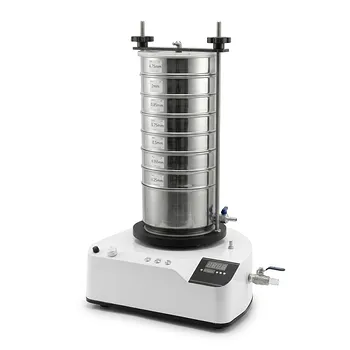
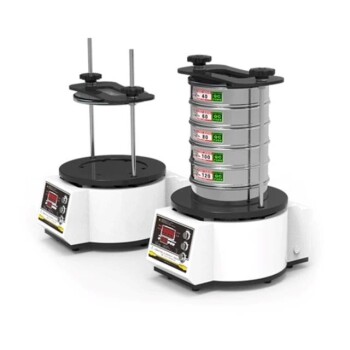
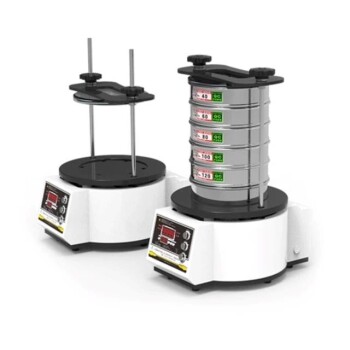
Ensuring consistent powder flow and chemical integrity is the primary reason for these pretreatment steps. In the Powder Aerosol Deposition (PAD) process, industrial sieving machines (typically using a 200-micrometer mesh) and high-temperature drying ovens (operating around 200°C) are used to eliminate powder agglomeration and moisture adsorption. This rigorous preparation ensures the ceramic powder remains chemically reactive and facilitates smooth, uniform aerosolization during the deposition phase.
Pretreatment transforms raw ceramic powder into a highly mobile, dry aerosol source. By removing physical clusters and moisture-induced stickiness, the process guarantees that particles can be accelerated to high velocities for successful impact consolidation at room temperature.
The Role of Industrial Sieving in PAD
Eliminating Agglomerates and Impurities
The primary function of a 200-micrometer sieve is to remove large clusters of particles that have bonded together. It also filters out impurities or uncrushed particles and any debris resulting from the wear of milling media during previous processing steps.
Controlling Particle Size Distribution
While the sieve removes large debris, it also helps maintain a specific particle size distribution, often targeted between 45 and 75 micrometers for high-precision applications. This consistency is vital because oversized particles can create stress concentration points or open-pore defects in the final deposited film.
Enhancing Aerosolization Efficiency
A well-sieved powder flows more predictably within the aerosol generator. By ensuring particle size uniformity, the system avoids clogging the nozzle and maintains a steady mass flow rate, which is critical for achieving a uniform coating thickness.
The Critical Function of High-Temperature Drying
Removing Adsorbed Moisture
Ceramic powders are naturally hygroscopic and quickly adsorb moisture from the atmosphere. Drying at 200°C breaks the capillary forces between particles that cause "clumping," allowing the powder to be easily aerosolized by the carrier gas.
Preserving Surface Chemical Reactivity
Moisture on the surface of the powder can act as a barrier or lubricant, interfering with the impact consolidation mechanism. High-temperature drying ensures the particle surfaces are clean and ready to bond upon high-velocity impact with the substrate.
Preventing Microstructural Defects
Residual moisture can lead to trapped vapor or poor adhesion during the deposition process. Eliminating water content ensures the final ceramic composite achieves maximum density and lower water absorption, improving the overall macroscopic physical properties.
Understanding the Trade-offs and Risks
Material Loss and Processing Time
Strict sieving protocols inevitably lead to material waste, as particles outside the target range are discarded. Additionally, the high-temperature drying phase adds a significant time buffer to the production cycle, requiring careful schedule management.
Risk of Thermal Phase Changes
While 200°C is generally safe for most ceramics, some sensitive materials may undergo undesirable phase transitions or surface oxidation at high temperatures. It is crucial to verify the thermal stability of the specific ceramic powder before setting oven parameters.
Re-contamination Hazards
Once powder is sieved and dried, it is highly susceptible to re-adsorbing moisture if not handled in a controlled environment. If the powder is not transferred immediately to the aerosol generator or stored in a desiccator, the benefits of the pretreatment can be lost within minutes.
How to Apply This to Your Project
Optimizing Pretreatment for Your Goal
To achieve the best results in your PAD workflow, tailor your pretreatment parameters to your specific performance requirements.
- If your primary focus is Maximum Coating Density: Prioritize the 200°C drying phase and immediate transfer to the deposition vacuum chamber to ensure zero moisture interference during impact.
- If your primary focus is Surface Uniformity and Smoothness: Utilize a finer high-precision sieve (45–75 $\mu$m) to eliminate large particles that cause surface roughness and stress concentrations.
- If your primary focus is High Process Throughput: Focus on industrial-scale sieving to ensure rapid powder preparation, but monitor for nozzle wear caused by any residual uncrushed particles.
Proper raw material pretreatment is the single most effective way to ensure the reliability and mechanical integrity of aerosol-deposited ceramic films.
Summary Table:
| Pretreatment Step | Equipment Used | Primary Purpose | Impact on PAD Coating |
|---|---|---|---|
| Industrial Sieving | 200μm Mesh Sieve | Removes agglomerates & impurities | Prevents nozzle clogging; ensures surface smoothness |
| High-Temp Drying | 200°C Drying Oven | Eliminates adsorbed moisture | Enhances particle bonding; achieves maximum density |
| Size Control | Precision Sieves | Target 45–75μm distribution | Minimizes stress concentration & micro-defects |
Elevate Your Material Research with KINTEK Precision
Success in Powder Aerosol Deposition (PAD) begins with flawless pretreatment. At KINTEK, we provide the specialized tools you need to ensure powder consistency and chemical integrity. From high-precision sieving equipment and milling systems to advanced drying ovens and high-temperature furnaces, our solutions are designed to meet the rigorous demands of modern material science.
Whether you are optimizing aerosol flow or ensuring maximum film density, our comprehensive portfolio—including hydraulic presses, high-temperature high-pressure reactors, and centrifuges—empowers your lab to achieve repeatable, high-quality results. We also offer essential consumables like PTFE products, ceramics, and crucibles to support every stage of your workflow.
Ready to optimize your deposition process and achieve superior coating performance?
Contact KINTEK today for expert guidance and tailored laboratory solutions!
References
- Mario Linz, Ralf Moos. Revealing the Deposition Mechanism of the Powder Aerosol Deposition Method Using Ceramic Oxide Core–Shell Particles. DOI: 10.1002/adma.202308294
This article is also based on technical information from Kintek Solution Knowledge Base .
Related Products
- Laboratory Vibratory Sieve Shaker Machine for Dry and Wet Three-Dimensional Sieving
- Laboratory Test Sieves and Sieving Machines
- Three-dimensional electromagnetic sieving instrument
- Laboratory Wet Three-Dimensional Vibratory Sieve Shaker Machine
- Laboratory Test Sieves and Vibratory Sieve Shaker Machine
People Also Ask
- How does a laboratory vibratory sieve shaker facilitate the microstructural study of gas-atomized alloy powders?
- What role does a laboratory vibrating sieve shaker play in the LiFePO4 powder processing workflow? Ensure Batch Quality
- Why use a vibratory sieve shaker for PET powder? Achieve Precise Particle Size Control for Chemical Research
- What is the principle of vibratory sieve shaker? Achieve Accurate Particle Size Analysis
- What is the function of a vibratory sieve shaker? Achieve Precise Particle Size Analysis