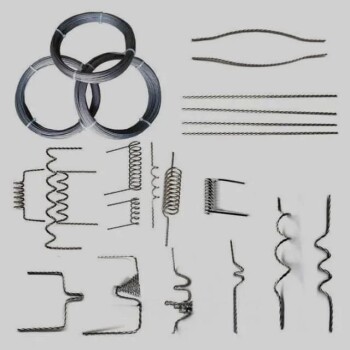
Platinum and nickel-chromium alloy wires are selected primarily for their exceptional resistance to oxidation and corrosion. In the high-temperature, oxidizing atmospheres typical of Thermogravimetric Analysis (TGA), these materials maintain their physical integrity without chemically reacting with the environment. This stability prevents the suspension wire from gaining weight due to oxidation, ensuring that the microbalance records only the mass changes of the sample itself.
Core Takeaway: The integrity of TGA data relies on the suspension system remaining "invisible" to the balance. By using inert metals like platinum or nickel-chromium, you prevent the wire from reacting with oxygen, ensuring the recorded weight change is derived solely from the sample and not from the apparatus degrading.
The Critical Role of Oxidation Resistance
Preventing Parasitic Weight Gain
When standard metals are exposed to high temperatures in air or oxygen, they oxidize. This chemical reaction adds mass to the metal as oxygen atoms bond to the surface.
In TGA, this creates a significant problem. Because the instrument measures minute changes in mass, an oxidizing suspension wire would register as a weight gain, falsifying the experimental results.
Maintaining a Constant Baseline
For accurate data, the weight of the suspension system must remain constant throughout the entire heating cycle.
Platinum and nickel-chromium alloys are chosen because they resist this high-temperature reaction. Their mass remains stable, providing a flat baseline against which the sample's behavior can be accurately measured.
Impact on Data Quality
Guaranteeing Kinetic Accuracy
Researchers often use TGA to determine reaction kinetics, such as how quickly a material decomposes.
If the suspension wire oxidizes, the resulting weight gain acts as interference. This noise obscures the true rate of the sample's reaction, making kinetic calculations unreliable.
Isolating Sample Behavior
The primary goal of TGA is to record mass change events specific to the sample material.
By using heat-resistant, non-reactive wires, you eliminate variables caused by the equipment. This guarantees that any curve observed in the data is a property of the sample, rather than an artifact of the wire failing.
Understanding the Risks of Improper Selection
The Consequence of "Phantom" Mass
Using wires with poor oxidation resistance introduces "phantom" mass gains. This can mask weight loss events in the sample or exaggerate weight gain events.
Compromising Reproducibility
If the suspension wire degrades differently in each run, experimental reproducibility is lost. Using standardized, high-resistance alloys ensures that the suspension setup performs identically in every iteration.
Making the Right Choice for Your Experiment
To ensure your TGA results are valid, the material selection of your suspension system is just as critical as the calibration of the balance.
- If your primary focus is data accuracy: Prioritize platinum or nickel-chromium wires to eliminate baseline drift caused by equipment oxidation.
- If your primary focus is kinetic analysis: Ensure your suspension wires are rated for your specific temperature range to prevent interference with reaction rate calculations.
The reliability of your thermal analysis depends on the inertness of your tools.
Summary Table:
| Feature | Platinum Wires | Nickel-Chromium Wires |
|---|---|---|
| Primary Benefit | Exceptional chemical inertness | High oxidation resistance |
| Temperature Stability | Very high (up to 1500°C+) | High (up to 1200°C) |
| Weight Integrity | Zero weight gain from oxidation | Minimal baseline drift |
| Primary Application | Precision TGA & Kinetic Analysis | General high-temp thermal analysis |
| Durability | High corrosion resistance | Excellent mechanical strength |
Elevate Your Research Precision with KINTEK
Don't let equipment interference compromise your thermal analysis. KINTEK specializes in high-performance laboratory solutions designed to ensure your data is always accurate and reproducible. From our precision high-temperature furnaces (muffle, vacuum, and atmosphere) to essential consumables like high-purity crucibles and ceramics, we provide the tools researchers need for success.
Whether you are performing complex TGA kinetic studies or routine material testing, our team is ready to support your lab with premium equipment and consumables tailored to your specific temperature and atmosphere requirements.
Ready to upgrade your lab's capabilities? Contact KINTEK today for expert advice and a custom quote!
References
- Zhixue Yuan, Hong Yong Sohn. Re-Oxidation Kinetics of Flash Reduced Iron Particles in O2–N2 Gas Mixtures Relevant to a Novel Flash Ironmaking Process. DOI: 10.2355/isijinternational.54.1235
This article is also based on technical information from Kintek Solution Knowledge Base .
Related Products
People Also Ask
- What are the disadvantages of tungsten filament? Key Limitations in Lighting Technology
- Does heat affect tungsten? Harnessing the Power of the Metal with the Highest Melting Point
- Is tungsten the most heat resistant material? It depends on your application's environment.
- What metal is closest to tungsten? Find the Best Alternative for Your High-Temp Needs
- Can tungsten withstand high temperature? Unlocking its full potential in extreme heat environments