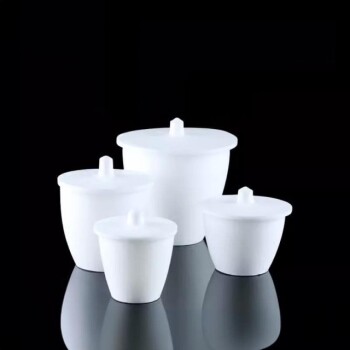
Transparent quartz crucibles are the preferred choice for synthesizing MAX phase precursors primarily because they combine high-temperature resistance with optical transparency. This unique combination allows researchers to visually monitor the reaction's progress while ensuring the intense heat of the process does not degrade the container or contaminate the sample.
Core Takeaway In the volatile environment of Self-propagating High-temperature Synthesis (SHS), transparent quartz provides a critical dual function: it acts as a chemically inert barrier to prevent impurity contamination and serves as a window to observe the initiation and propagation of the reaction wave.
The Critical Role of Material Stability
Withstanding Exothermic Reactions
The synthesis of MAX phase precursors often involves Self-propagating High-temperature Synthesis (SHS). This process triggers an intense exothermic reaction, generating significant heat in a very short timeframe.
Quartz crucibles are selected specifically for their ability to endure this rapid thermal shock without fracturing. This ensures the structural integrity of the experiment is maintained throughout the violent heating phase.
Preventing Chemical Contamination
Beyond thermal resilience, the purity of the final material is paramount. Quartz possesses superior chemical stability, meaning it remains inert even under high thermal stress.
This inertness ensures that the crucible does not react with the precursors. By preventing the introduction of impurities, quartz guarantees that the stoichiometry of the MAX phase precursors remains uncompromised.
The Advantage of Visual Monitoring
Observing Reaction Kinetics
Unlike opaque alternatives such as high-purity alumina or porcelain, transparent quartz offers a distinct operational advantage: visibility.
The transparency allows researchers to directly observe the initiation of the reaction. This is critical for confirming that the SHS process has triggered correctly and is sustaining itself.
Monitoring Solid-Phase Transformation
The synthesis involves a transformation of starting materials within a specific physical area.
Using a transparent vessel allows you to verify that the reaction propagation is occurring within a controlled geometric space. This visual confirmation ensures that the solid-phase transformation proceeds uniformly through the precursor mixture.
Understanding the Trade-offs
Transparency vs. Ultimate Thermal Limits
While quartz is excellent for SHS processes requiring observation, it is important to recognize why it is chosen over other ceramics.
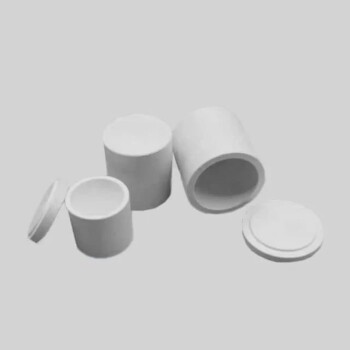
Alternative materials, such as the high-purity alumina mentioned in other high-temperature contexts, offer exceptional thermal stability and inertness but lack transparency. If your process requires temperatures exceeding the softening point of quartz, or if visual monitoring is unnecessary, opaque ceramics might be a valid alternative. However, for MAX phase SHS where propagation monitoring is key, quartz remains the superior option despite the thermal ceiling being lower than some advanced technical ceramics.
Making the Right Choice for Your Goal
To ensure the success of your material synthesis, select your crucible based on your specific process requirements:
- If your primary focus is process monitoring: Choose transparent quartz to visually track the initiation and wave propagation of the SHS reaction.
- If your primary focus is ultra-high purity: Rely on quartz for its chemical inertness to prevent container-induced contamination during exothermic spikes.
Selecting the right vessel is not just about holding the material; it is about controlling the environment to guarantee the fidelity of your final product.
Summary Table:
| Feature | Transparent Quartz Crucible | Alternative Ceramics (e.g., Alumina) |
|---|---|---|
| Transparency | High (Allows visual monitoring) | Opaque (No visual access) |
| Thermal Shock Resistance | Excellent (Suits rapid SHS reactions) | Moderate to High |
| Chemical Purity | High (Minimizes contamination) | High (Inert) |
| Best Application | SHS reaction propagation monitoring | Ultra-high temperature soaking |
| Primary Benefit | Real-time kinetics observation | Structural integrity at >1200°C |
Elevate Your Material Synthesis with KINTEK Precision
Don’t compromise on the integrity of your MAX phase research. KINTEK specializes in high-performance laboratory equipment, providing the transparent quartz crucibles and high-temperature furnaces (including vacuum, tube, and muffle systems) essential for precise material synthesis.
Whether you need advanced crushing and milling systems for precursor preparation or high-temperature high-pressure reactors for specialized transformations, our team is ready to equip your lab with durable, high-purity solutions.
Ready to optimize your reaction kinetics? Contact KINTEK today to discuss our comprehensive range of crucibles and thermal processing tools tailored for advanced materials research.
References
- S.N. Zhevnenko, В. А. Горшков. Interaction of Cu-Al melts with Cr₂AlC and (Cr₀.₉₅Mn₀.₀₅)₂AlC MAX-phases. DOI: 10.46690/capi.2025.05.02
This article is also based on technical information from Kintek Solution Knowledge Base .
Related Products
- High Purity Pure Graphite Crucible for Evaporation
- High Purity Pure Graphite Crucible for Electron Beam Evaporation
- Electron Beam Evaporation Coating Gold Plating Tungsten Molybdenum Crucible for Evaporation
- Electron Beam Evaporation Coating Oxygen-Free Copper Crucible and Evaporation Boat
- Engineering Advanced Fine Ceramics Alumina Al2O3 Crucible With Lid Cylindrical Laboratory Crucible
People Also Ask
- Why are high-purity graphite crucibles preferred for sulfide solid electrolytes? Achieve Superior Material Purity
- Why is a high-purity graphite crucible required for Chromel-TaC composites? Ensure Peak Purity at 1400°C
- What role do high-purity graphite crucibles play in molten salt corrosion research? Ensure Reactor-Grade Precision
- Why are high-purity graphite crucibles used for magnesium distillation? Ensure 3N8 Purity & Thermal Stability
- Why is a high-purity graphite crucible ideal for nitrogen-doped graphene at 1500 °C? Maximize Purity and Stability