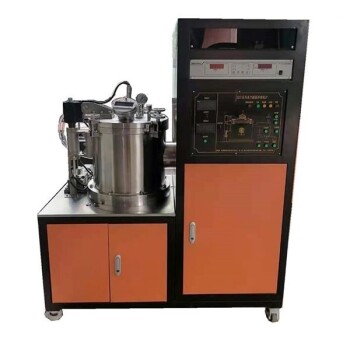
Vacuum or high-purity inert atmosphere furnaces are essential because refractory metals like tungsten possess extremely low oxidation resistance at the high temperatures required for joining. In standard atmospheric conditions, these metals rapidly react with oxygen, nitrogen, and carbon, creating brittle contaminants that destroy the mechanical integrity of the joint.
Core Insight: While refractory metals are prized for their hardness and heat resistance, they become chemically vulnerable during the joining process. A controlled vacuum or inert environment is the only way to lower oxygen partial pressure enough to prevent the formation of brittle oxides and carbides, ensuring a pure and durable diffusion bond.
The Paradox of Refractory Metals
High Strength, Low Resistance
Refractory metals, such as Tungsten, Molybdenum, and Tantalum, are defined by their incredible resilience. They possess immense hardness, high density, and melting points that can reach up to 3410°C.
The Achilles' Heel
Despite their resistance to corrosion and wear at ambient temperatures, these metals have a critical weakness: low oxidation resistance at high heat. As temperature rises to the levels needed for joining or diffusion bonding, their chemical stability plummets.
The Chemistry of Failure
Sensitivity to Contaminants
When heated, transition metals (including steel, vanadium, and titanium) become highly sensitive to elements commonly found in air: oxygen, nitrogen, and carbon.
Formation of Brittle Layers
If exposed to air during heating, these elements react with the metal surfaces to form oxide layers or brittle carbides. These compounds are structurally weak and lack the ductility of the base metal.
Compromising the Diffusion Layer
For a successful joint, atoms must diffuse across the interface between the two metals. Oxidation acts as a barrier to this process. Even if a bond forms, the presence of oxides ensures the joint will be brittle and prone to catastrophic failure under stress.
How Vacuum Furnaces Solve the Problem
Lowering Oxygen Partial Pressure
The primary function of a vacuum or high-purity atmosphere furnace is to drastically reduce the oxygen partial pressure. This removes the fuel for oxidation reactions.
Ensuring Interface Purity
By eliminating reactive gases, the furnace preserves the chemical purity of the metal surfaces. This allows for a clean diffusion layer to form between the tungsten and the steel.
Preserving Mechanical Properties
A pure environment ensures that the final assembly retains the desirable mechanical properties of the parent metals—such as ductility and tensile strength—rather than snapping due to internal embrittlement.
Common Pitfalls and Considerations
The Risk of Impure Inert Gas
Simply using an inert gas (like Argon) is not always sufficient if the purity is not strictly controlled. Even trace amounts of moisture or oxygen in the gas supply can trigger oxidation at refractory melting temperatures.
Understanding Diffusion Rates
Refractory metals generally exhibit a slow diffusion rate. This means the joining process often requires sustained high temperatures for longer periods, increasing the window of opportunity for oxidation if the vacuum integrity is compromised.
Making the Right Choice for Your Goal
To ensure a successful bond between tungsten and steel, apply the following principles:
- If your primary focus is Maximum Mechanical Strength: Prioritize a high-vacuum environment to eliminate virtually all potential for carbide or oxide formation at the joint interface.
- If your primary focus is Process Consistency: Ensure your inert atmosphere supply is certified high-purity and monitor oxygen levels continuously, as refractory metals are unforgiving of contamination.
Control the atmosphere, and you control the integrity of the bond.
Summary Table:
| Feature | Impact of Atmospheric Air | Benefit of Vacuum/Inert Atmosphere |
|---|---|---|
| Oxidation Resistance | Extremely low; rapid oxide formation | Prevents oxidation and preserves surface purity |
| Joint Integrity | Brittle; prone to catastrophic failure | Strong, ductile diffusion bond |
| Chemical Stability | Reactive with oxygen, nitrogen, carbon | Inert; eliminates reactive gas contaminants |
| Diffusion Layer | Blocked by oxide/carbide barriers | Clean interface for optimal atomic diffusion |
| Metal Properties | Loss of ductility and strength | Maintains original mechanical resilience |
Secure the Integrity of Your Advanced Materials with KINTEK
Don't let oxidation compromise your mission-critical joints. KINTEK specializes in high-performance laboratory equipment designed for the most demanding thermal processes. Whether you are joining tungsten to steel or developing new alloys, our vacuum furnaces, high-purity atmosphere furnaces, and hydrogen-capable systems provide the precise environmental control needed to eliminate brittle contaminants.
From high-temperature furnaces (muffle, tube, and rotary) to isostatic hydraulic presses and advanced ceramics, KINTEK delivers the tools global researchers and manufacturers trust for superior mechanical results.
Ready to elevate your lab's bonding precision? Contact our technical experts today to find the perfect furnace solution!
References
- Ishtiaque Robin, S.J. Zinkle. Evaluation of Tungsten—Steel Solid-State Bonding: Options and the Role of CALPHAD to Screen Diffusion Bonding Interlayers. DOI: 10.3390/met13081438
This article is also based on technical information from Kintek Solution Knowledge Base .
Related Products
- Vacuum Hot Press Furnace Heated Vacuum Press Machine Tube Furnace
- 600T Vacuum Induction Hot Press Furnace for Heat Treat and Sintering
- Vacuum Hot Press Furnace Machine Heated Vacuum Press
- Vacuum Heat Treat Furnace and Levitation Induction Melting Furnace
- 2200 ℃ Tungsten Vacuum Heat Treat and Sintering Furnace
People Also Ask
- What advantages does a vacuum hot press furnace provide for LSLBO ceramic electrolytes? Achieve 94% Relative Density
- What role does a Vacuum Hot Press (VHP) furnace play in the densification of austenitic stainless steel 316 composites?
- What are the advantages of using a vacuum hot pressing furnace? Superior Densification for 2024Al/Gr/SiC Composites
- What are the advantages of a vacuum hot press furnace for LTPO solid electrolytes? Boost Density and Conductivity
- What core processing conditions does a vacuum hot press furnace provide? Achieve High-Density Cu-SiC/Diamond Composites