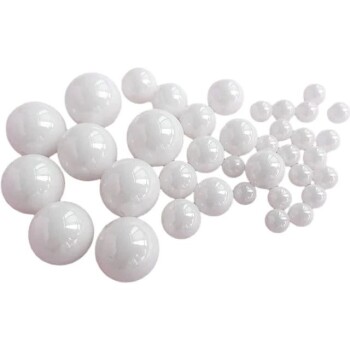
The preferred choice for preparing BCZYYb electrolyte precursors is high-density zirconia grinding media. This material offers the necessary hardness to pulverize refractory oxides efficiently while possessing the chemical inertness required to prevent contamination, ensuring the final electrolyte maintains the precise stoichiometry needed for optimal proton conductivity.
The preparation of BCZYYb electrolytes requires pulverizing hard materials without altering their delicate chemical balance. Zirconia grinding balls solve this engineering challenge by delivering high-impact energy for particle refinement while eliminating the risk of metallic impurity contamination that plagues softer or reactive milling media.
The Mechanics of Milling Efficiency
To create a high-performance electrolyte, the precursor powder must be refined to a specific, uniform particle size.
Overcoming Refractory Resistance
The raw materials used for BCZYYb are refractory oxides. These materials are naturally hard and resistant to breaking down.
Zirconia grinding balls possess superior hardness compared to standard media. This hardness allows them to fracture and refine the tough oxide particles effectively, rather than simply wearing down themselves.
The Role of Density
Hardness alone is not enough; kinetic energy is required. Zirconia is a high-density ceramic.
During planetary ball milling or similar processes, this high density translates into greater impact force when the balls collide with the powder. This reduces the milling time required to achieve a fine, reactive powder suitable for sintering.
Preserving Chemical Integrity
The most critical aspect of electrolyte preparation is purity. Even trace amounts of foreign contaminants can ruin the electrochemical performance of the final ceramic.
Eliminating Metallic Contamination
Standard steel grinding media inevitably sheds microscopic metallic particles due to wear. In a proton-conducting electrolyte like BCZYYb, these metallic impurities can block proton pathways or create electronic short circuits.
Zirconia is chemically inert and wear-resistant. It significantly minimizes the introduction of foreign matter, ensuring that the powder remains chemically pure throughout long milling cycles.
Maintaining Stoichiometry
High-performance electrolytes rely on precise stoichiometric ratios (the exact balance of chemical elements).
Because zirconia minimizes media wear, it prevents the "dilution" of the precursor mixture with unwanted abrasive debris. This ensures that the final chemical composition matches the intended formula, which is vital for achieving high ionic conductivity.
Understanding the Trade-offs
While zirconia is the technical standard for this application, it is important to recognize the operational realities of using this media.
Cost vs. Quality
Zirconia media is generally more expensive than alumina or steel alternatives. However, this cost is justifiable for BCZYYb preparation because the "cheaper" alternatives often result in wasted batches due to contamination-induced performance failure.
Wear is Minimized, Not Eliminated
Although zirconia is wear-resistant, it is not wear-proof. Over very long milling durations, a small amount of zirconia may still enter the mixture. Fortunately, because BCZYYb already contains zirconium, minor autogenous contamination is far less detrimental than iron or silica contamination.
Making the Right Choice for Your Goal
When setting up your milling protocol for BCZYYb or similar solid-state electrolytes, prioritize your outcomes based on the following principles:
- If your primary focus is maximizing ionic conductivity: Prioritize high-purity zirconia balls to prevent foreign impurities from disrupting the crystal lattice of the electrolyte.
- If your primary focus is sintering density: Utilize high-density zirconia media to achieve the finest possible particle size, which promotes better densification during the firing process.
- If your primary focus is process consistency: Standardize the ratio of balls to powder and replace the media regularly to ensure the mass and impact energy remain constant across batches.
By selecting zirconia, you align your physical processing method with the strict chemical requirements of high-performance ceramic electrolytes.
Summary Table:
| Feature | Benefit for BCZYYb Preparation | Why It Matters |
|---|---|---|
| High Density | Increases kinetic impact energy | Reduces milling time for refractory oxides |
| Superior Hardness | Efficient particle size reduction | Achieves fine powders for better sintering |
| Chemical Inertness | Eliminates metallic contamination | Prevents electronic shorts in electrolytes |
| Wear Resistance | Maintains stoichiometric precision | Ensures high ionic and proton conductivity |
Elevate Your Electrolyte Research with KINTEK
Precise stoichiometry and ultra-fine particle sizes are the foundation of high-performance BCZYYb electrolytes. KINTEK specializes in premium laboratory equipment and high-purity consumables designed for advanced material science.
Whether you need high-density zirconia grinding media, advanced planetary ball mills, or high-performance crushing and milling systems, our solutions ensure your precursors remain contamination-free and perfectly refined. From high-temperature furnaces for sintering to pellet presses for sample preparation, we provide the tools you need for consistent, reliable results.
Ready to optimize your milling protocol? Contact us today to discuss how KINTEK can enhance your lab’s efficiency!
Related Products
- Laboratory Jar Ball Mill with Alumina Zirconia Grinding Jar and Balls
- Precision Machined Zirconia Ceramic Ball for Engineering Advanced Fine Ceramics
- Laboratory Jar Mill with Agate Grinding Jar and Balls
- Laboratory Ball Mill Jar Mill with Metal Alloy Grinding Jar and Balls
- Laboratory Micro Tissue Grinding Mill Grinder
People Also Ask
- What are the primary functions of using a ball mill for BZCY72 powder? Achieve High Purity and Enhanced Sintering
- In what way does a laboratory ball mill affect material properties when modifying PHBV/pulp fiber composites?
- Why is a laboratory ball mill required for ultra-fine fly ash? Unlock Nano-Scale Adsorption Power
- What is the function of a laboratory ball mill in the preparation of AMMCs? Optimize Dispersion & Grain Refinement
- What is the function of a laboratory ball mill in the pretreatment of waste tire char (WTC)? Optimize Material Reactivity