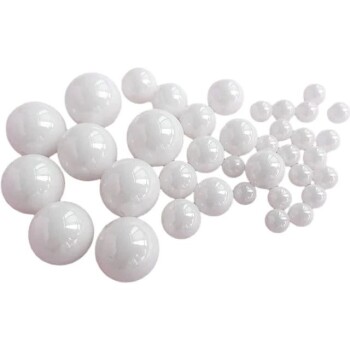
Zirconium oxide (zirconia) milling media is the critical standard for processing sensitive solid electrolytes like Li2S-based composites and Li3PO4-Li2SO4. The requirement stems from a dual necessity: maximizing kinetic energy transfer for effective mechanical alloying while rigorously excluding metallic impurities that would degrade electrochemical performance.
Zirconia’s unique combination of high density and chemical inertness allows for high-energy mechanical alloying without introducing contaminants. Unlike stainless steel, zirconia prevents the leaching of metallic impurities that destroy the ionic conductivity and stability of sensitive electrolyte materials.
The Critical Need for Chemical Inertness
Preventing Metallic Contamination
Standard milling media, such as stainless steel, are unsuitable for these specific electrolytes. During the prolonged high-energy ball milling required for synthesis, steel media inevitably degrades.
This physical wear introduces metallic iron fragments into the powder. Zirconia is chemically inert and exceptionally wear-resistant, ensuring that no reactive metal impurities contaminate the sample.
Avoiding Side Reactions
Li2S-based composites and Li3PO4-Li2SO4 are highly sensitive materials. The presence of metal impurities like iron can trigger unwanted side reactions during synthesis or subsequent battery operation.
By using zirconia, you maintain the chemical integrity of the sulfide or oxysalt structures. This purity is essential to prevent material degradation that would otherwise occur if reactive contaminants were present.
Preserving Electrochemical Performance
The ultimate goal of these materials is high performance in solid-state batteries. Metallic contamination acts as a poison to this goal.
Impurities introduced by non-zirconia media can significantly decrease ionic conductivity and narrow the electrochemical stability window. Zirconia ensures the synthesized material retains the high purity required for optimal electrical properties.
The Mechanics of High-Energy Milling
High Density for Kinetic Energy
Synthesizing these composites often requires "mechanical alloying," a process that goes beyond simple mixing to induce chemical changes via mechanical force.
Zirconia has a high density, which translates into powerful kinetic energy when the balls impact the jar walls. This high-impact energy is necessary to refine the powder and drive the mechanochemical reactions efficiently.
Extreme Hardness for Durability
The milling environment for these materials is aggressive. The media must be harder than the materials being processed to effectively break them down.
Zirconia’s extreme hardness allows it to withstand these heavy impact forces without fracturing or wearing down prematurely. It effectively transfers mechanical energy to the sample without compromising the integrity of the grinding jar.
Understanding the Trade-offs
Brittleness and Handling
While zirconia is hard, it is also a ceramic, making it more brittle than metal.
Operators must handle zirconia jars with care to avoid dropping them or subjecting them to extreme thermal shock, which can cause cracking. Unlike steel, it cannot deform under stress; it will shatter.
Cost Implications
High-quality, stabilized zirconia is significantly more expensive than stainless steel or agate.
However, for solid-state electrolyte synthesis, this cost is an unavoidable investment. The performance penalty of using cheaper, contaminating media renders the resulting material useless for high-performance applications.
Making the Right Choice for Your Goal
When selecting equipment for solid electrolyte preparation, align your choice with your specific technical requirements:
- If your primary focus is Electrochemical Purity: Select zirconia to strictly eliminate iron contamination, which is the primary cause of reduced ionic conductivity and stability.
- If your primary focus is Synthesis Efficiency: Rely on zirconia’s high density to provide the necessary kinetic impact for successful mechanical alloying and particle refinement.
Zirconia is not merely an option for these materials; it is a prerequisite for achieving the purity and performance required in modern solid-state battery research.
Summary Table:
| Property | Zirconia (ZrO2) | Stainless Steel | Advantage for Li2S/Li3PO4 |
|---|---|---|---|
| Chemical Inertness | Exceptionally High | Low (Leaches Iron) | Prevents side reactions & preserves conductivity |
| Density | High (~6.0 g/cm³) | High (~7.8 g/cm³) | Provides kinetic energy for mechanical alloying |
| Hardness | Extreme | Moderate | Superior wear resistance and durability |
| Contamination Risk | Minimal/Inert | High (Metallic) | Critical for maintaining electrochemical purity |
| Best Use Case | Solid-state electrolytes | General mixing | Essential for high-performance battery research |
Elevate Your Battery Research with KINTEK
Precision in solid-state electrolyte synthesis starts with the right equipment. At KINTEK, we understand that even trace metallic impurities can compromise your ionic conductivity and research outcomes.
We specialize in high-performance zirconium oxide (zirconia) milling jars and grinding media, alongside a comprehensive range of crushing and milling systems, high-temperature furnaces, and hydraulic presses. Whether you are working on Li2S-based composites or advanced battery research, our premium laboratory solutions—including high-pressure reactors, electrolytic cells, and PTFE consumables—are designed to meet the rigorous demands of material science.
Ready to optimize your material purity and milling efficiency?
Contact KINTEK experts today to find the perfect milling solution for your lab!
Related Products
- Laboratory Jar Ball Mill with Alumina Zirconia Grinding Jar and Balls
- Laboratory Jar Mill with Agate Grinding Jar and Balls
- Laboratory Ball Mill Jar Mill with Metal Alloy Grinding Jar and Balls
- Precision Machined Zirconia Ceramic Ball for Engineering Advanced Fine Ceramics
- Laboratory Four-Body Horizontal Jar Mill
People Also Ask
- What are the primary functions of using a ball mill for BZCY72 powder? Achieve High Purity and Enhanced Sintering
- In what way does a laboratory ball mill affect material properties when modifying PHBV/pulp fiber composites?
- Why is a laboratory ball mill required for ultra-fine fly ash? Unlock Nano-Scale Adsorption Power
- What is the function of a laboratory ball mill in the preparation of AMMCs? Optimize Dispersion & Grain Refinement
- What is the function of a laboratory ball mill in the pretreatment of waste tire char (WTC)? Optimize Material Reactivity