Knowledge Why is a constant temperature stirrer required during the mixing of cellulose and FeCl3? Master Material Homogeneity
Author avatar

Tech Team · Kintek Solution

Updated 18 hours ago

Why is a constant temperature stirrer required during the mixing of cellulose and FeCl3? Master Material Homogeneity


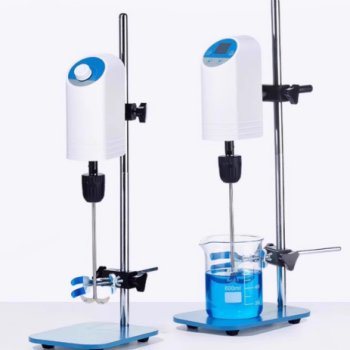
A constant temperature stirrer is strictly required to ensure the Ferric Chloride solution thoroughly impregnates the microcrystalline cellulose fibers. By maintaining a steady temperature of 90 °C, the device significantly reduces the solution's viscosity and increases the diffusion capacity of the solute. This allows the Ferric Chloride to penetrate deep into the fiber structure rather than simply coating the exterior.

Achieving a high-quality Magnetic Composite Carbon material depends entirely on creating a homogeneous, paste-like precursor. The constant temperature stirrer provides the necessary thermal and mechanical environment to ensure uniform distribution of the magnetic components within the cellulose matrix.

The Physics of Effective Impregnation

To understand why this equipment is non-negotiable, you must look at the physical interactions between the solute and the fiber structure.

Reducing Solution Viscosity

At lower temperatures, the Ferric Chloride solution may be too viscous to effectively enter the tight structure of microcrystalline cellulose.

Heating the mixture to 90 °C lowers this resistance. This thermal energy makes the solution more fluid, enabling it to flow into the microscopic pores of the fiber.

Enhancing Diffusion Capacity

Impregnation is not just about coating; it is about saturation.

The elevated temperature increases the diffusion capacity of the solute. This ensures that the Ferric Chloride molecules move actively and efficiently into the cellulose structure, rather than remaining stagnant.

Ensuring Material Homogeneity

The physical characteristics of the paste directly dictate the quality of the final product.

Creating a Uniform Paste

The combination of constant mechanical stirring and steady heat results in a homogeneous, paste-like mixture.

Without this dual action, the components would likely separate or clump. The "paste" consistency confirms that the solid and liquid phases have integrated correctly.

Stabilizing Magnetic Distribution

The end goal is to produce Magnetic Composite Carbon.

If the precursor paste is not uniform, the magnetic properties of the final composite will be inconsistent. Thorough impregnation ensures a stable, even magnetic distribution throughout the entire material.

Understanding the Risks of Process Deviation

While the equipment setup is straightforward, failing to maintain these specific conditions leads to compromised material properties.

The Cost of Temperature Fluctuation

If the temperature is allowed to drop, viscosity increases immediately.

This restricts the Ferric Chloride to the surface of the cellulose fibers. The result is a superficial coating rather than the required structural impregnation.

Incomplete Saturation

Stirring without heat, or heating without stirring, will not achieve the desired result.

Lack of agitation leads to uneven saturation, creating "hotspots" of high concentration and areas of low concentration within the composite.

Optimizing the Synthesis Process

To ensure the integrity of your Magnetic Composite Carbon, you must treat temperature and agitation as critical variables, not optional suggestions.

  • If your primary focus is structural integrity: maintain the process at exactly 90 °C to minimize viscosity and maximize the depth of fiber penetration.
  • If your primary focus is magnetic performance: verify that the output is a completely homogeneous paste, as this guarantees a stable magnetic distribution in the final product.

Precise control over the mixing environment is the defining factor in transitioning from a raw mixture to a functional composite material.

Summary Table:

Process Factor Impact on Mixture Key Benefit
90°C Temperature Lowers solution viscosity Enables deep fiber penetration
Constant Agitation Ensures solute diffusion Creates a homogeneous paste
Uniform Impregnation Stable magnetic distribution High-quality composite carbon
Thermal Stability Prevents phase separation Consistent material properties

Elevate Your Material Synthesis with KINTEK Precision

Achieving the perfect magnetic composite requires more than just mixing; it demands precise thermal and mechanical control. KINTEK specializes in high-performance laboratory equipment designed for rigorous research environments. From high-temperature furnaces (muffle, vacuum, and CVD) for carbonization to advanced homogenizers, shakers, and constant temperature stirring solutions, we provide the tools necessary to ensure your precursors are perfectly impregnated and your final materials are flawlessly uniform.

Whether you are developing battery materials using our research consumables or synthesizing advanced composites in our high-pressure reactors, KINTEK delivers the reliability your lab deserves.

Ready to optimize your synthesis process? Contact our technical experts today to find the ideal equipment for your specific application.

References

  1. Pascal S. Thue, Éder C. Lima. Magnetic Composite Carbon from Microcrystalline Cellulose to Tackle Paracetamol Contamination: Kinetics, Mass Transfer, Equilibrium, and Thermodynamic Studies. DOI: 10.3390/polym16243538

This article is also based on technical information from Kintek Solution Knowledge Base .

Related Products

People Also Ask

Related Products

Laboratory Small Constant Temperature Heated Magnetic Stirrer Heater and Stirrer

Laboratory Small Constant Temperature Heated Magnetic Stirrer Heater and Stirrer

The Laboratory Small Constant Temperature Heating Magnetic Stirrer is a versatile tool designed for precise temperature control and efficient mixing in various laboratory applications.

High Performance Laboratory Stirrers for Diverse Applications

High Performance Laboratory Stirrers for Diverse Applications

Precise laboratory overhead stirrers for high-viscosity mixing. Durable, customizable, and ideal for research. Explore models now!

Laboratory Vortex Mixer Orbital Shaker Multifunctional Rotation Oscillation Mixer

Laboratory Vortex Mixer Orbital Shaker Multifunctional Rotation Oscillation Mixer

The inching mixer is small in size, mixes quickly and thoroughly, and the liquid is in a vortex shape, which can mix all the test solutions attached to the tube wall.

Custom PTFE Teflon Parts Manufacturer Laboratory High Temperature Mixing Paddle Mixer

Custom PTFE Teflon Parts Manufacturer Laboratory High Temperature Mixing Paddle Mixer

The PTFE mixing paddle mixer is a versatile and robust tool designed for laboratory use, particularly in environments requiring high resistance to chemicals and extreme temperatures. Crafted from high-quality PTFE, this mixer boasts several key features that enhance its functionality and durability.

Custom PTFE Teflon Parts Manufacturer for Magnetic Stirring Bar

Custom PTFE Teflon Parts Manufacturer for Magnetic Stirring Bar

The PTFE magnetic stirring bar, made from high-quality PTFE, offers exceptional resistance to acids, alkalis, and organic solvents, coupled with high-temperature stability and low friction. Ideal for laboratory use, these stirring bars are compatible with standard flask ports, ensuring stability and safety during operations.

Laboratory Oscillating Orbital Shaker

Laboratory Oscillating Orbital Shaker

Mixer-OT orbital shaker uses brushless motor, which can run for a long time. It is suitable for vibration tasks of culture dishes, flasks and beakers.

Laboratory Disc Rotary Mixer for Efficient Sample Mixing and Homogenization

Laboratory Disc Rotary Mixer for Efficient Sample Mixing and Homogenization

Efficient Laboratory Disc Rotary Mixer for Precise Sample Mixing, Versatile for Various Applications, DC Motor and Microcomputer Control, Adjustable Speed and Angle.

High Shear Homogenizer for Pharmaceutical and Cosmetic Applications

High Shear Homogenizer for Pharmaceutical and Cosmetic Applications

Enhance lab efficiency with our high-speed Laboratory Emulsifier Homogenizer for precise, stable sample processing. Ideal for pharmaceuticals & cosmetics.

Small Vacuum Heat Treat and Tungsten Wire Sintering Furnace

Small Vacuum Heat Treat and Tungsten Wire Sintering Furnace

The small vacuum tungsten wire sintering furnace is a compact experimental vacuum furnace specially designed for universities and scientific research institutes. The furnace features a CNC welded shell and vacuum piping to ensure leak-free operation. Quick-connect electrical connections facilitate relocation and debugging, and the standard electrical control cabinet is safe and convenient to operate.

Vacuum Hot Press Furnace Machine for Lamination and Heating

Vacuum Hot Press Furnace Machine for Lamination and Heating

Experience clean and precise lamination with Vacuum Lamination Press. Perfect for wafer bonding, thin-film transformations, and LCP lamination. Order now!

Twin Screw Extruder Plastic Granulation Machine

Twin Screw Extruder Plastic Granulation Machine

Twin screw extruder plastic granulation machine is designed for the mixing and processing experiments of engineering plastics, modified plastics, waste plastics and masterbatches.

Ultra-Vacuum Electrode Feedthrough Connector Flange Power Electrode Lead for High-Precision Applications

Ultra-Vacuum Electrode Feedthrough Connector Flange Power Electrode Lead for High-Precision Applications

Discover the Ultra-Vacuum Electrode Feedthrough Connector Flange, perfect for high-precision applications. Ensure reliable connections in ultra-vacuum environments with advanced sealing and conductive technology.

Ceramic Evaporation Boat Set Alumina Crucible for Laboratory Use

Ceramic Evaporation Boat Set Alumina Crucible for Laboratory Use

It can be used for vapor deposition of various metals and alloys. Most metals can be evaporated completely without loss. Evaporation baskets are reusable.1

High Purity Pure Graphite Crucible for Evaporation

High Purity Pure Graphite Crucible for Evaporation

Vessels for high temperature applications, where materials are kept at extremely high temperatures to evaporate, allowing thin films to be deposited on substrates.

Carbon Graphite Boat -Laboratory Tube Furnace with Cover

Carbon Graphite Boat -Laboratory Tube Furnace with Cover

Covered Carbon Graphite Boat Laboratory Tube Furnaces are specialized vessels or vessels made of graphite material designed to withstand extreme high temperatures and chemically aggressive environments.

Ultra-High Temperature Graphite Vacuum Graphitization Furnace

Ultra-High Temperature Graphite Vacuum Graphitization Furnace

The ultra-high temperature graphitization furnace utilizes medium frequency induction heating in a vacuum or inert gas environment. The induction coil generates an alternating magnetic field, inducing eddy currents in the graphite crucible, which heats up and radiates heat to the workpiece, bringing it to the desired temperature. This furnace is primarily used for graphitization and sintering of carbon materials, carbon fiber materials, and other composite materials.

Graphite Vacuum Furnace High Thermal Conductivity Film Graphitization Furnace

Graphite Vacuum Furnace High Thermal Conductivity Film Graphitization Furnace

The high thermal conductivity film graphitization furnace has uniform temperature, low energy consumption and can operate continuously.

Custom PTFE Teflon Parts Manufacturer for Culture Dish and Evaporation Dish

Custom PTFE Teflon Parts Manufacturer for Culture Dish and Evaporation Dish

The PTFE culture dish evaporating dish is a versatile laboratory tool known for its chemical resistance and high-temperature stability. PTFE, a fluoropolymer, offers exceptional non-stick properties and durability, making it ideal for various applications in research and industry, including filtration, pyrolysis, and membrane technology.

Molybdenum Tungsten Tantalum Evaporation Boat for High Temperature Applications

Molybdenum Tungsten Tantalum Evaporation Boat for High Temperature Applications

Evaporation boat sources are used in thermal evaporation systems and are suitable for depositing various metals, alloys and materials. Evaporation boat sources are available in different thicknesses of tungsten, tantalum and molybdenum to ensure compatibility with a variety of power sources. As a container, it is used for vacuum evaporation of materials. They can be used for thin film deposition of various materials, or designed to be compatible with techniques such as electron beam fabrication.

High Precision Diamond Wire Cutting Machine Laboratory Saw Precision Wire EDM Cutting Machine

High Precision Diamond Wire Cutting Machine Laboratory Saw Precision Wire EDM Cutting Machine

The high precision diamond wire cutting machine is a versatile and precise cutting tool designed specifically for material researchers. It utilizes a continuous diamond wire cutting mechanism, enabling precise cutting of brittle materials such as ceramics, crystals, glass, metals, rocks, and various other materials.


Leave Your Message