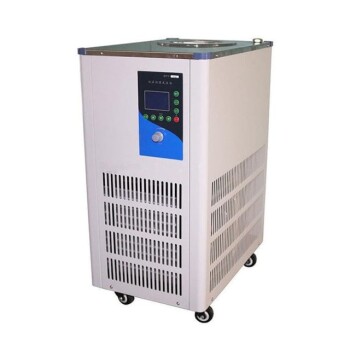
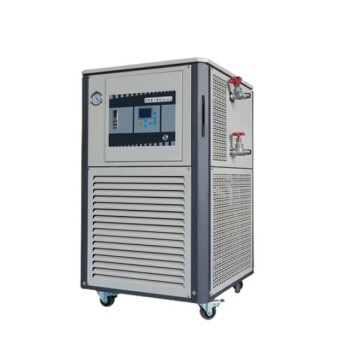
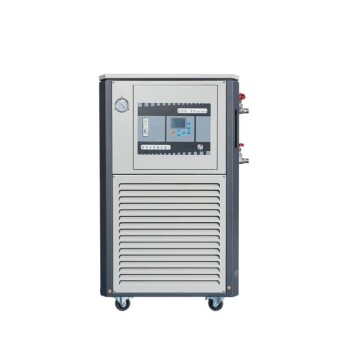
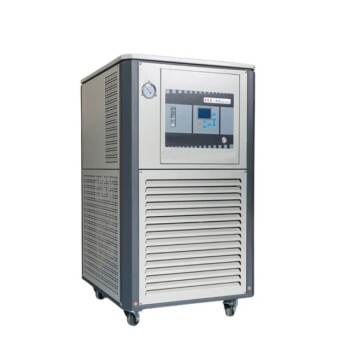
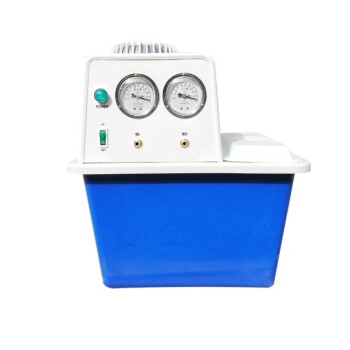
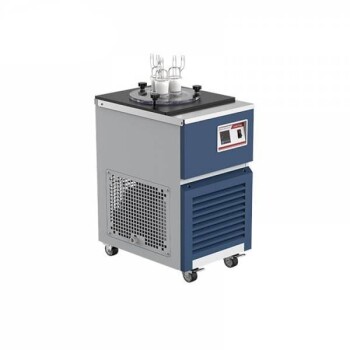
A cooling circulation system is a fundamental requirement for successful plasma-assisted silver nanoparticle synthesis. The plasma discharge process inevitably generates significant thermal effects that must be actively managed. By continuously circulating a low-temperature medium around the reactor, you effectively remove this excess reaction heat to maintain a stable solution temperature.
The plasma discharge process generates heat that threatens both the reaction medium and particle uniformity. A cooling system is essential to dissipate this heat, preventing chemical decomposition and ensuring controlled, uniform nanoparticle growth.
The Source of the Thermal Challenge
The Nature of Plasma Discharge
Plasma-assisted synthesis is an energetic process. The discharge required to initiate the reaction generates significant thermal effects as a byproduct.
Accumulation of Reaction Heat
This thermal energy does not simply dissipate on its own. Without intervention, heat accumulates rapidly within the reactor. This causes the temperature of the solution to spike uncontrollably.
Protecting the Chemical Environment
Preventing Medium Decomposition
The reaction medium—the liquid solution in which the synthesis occurs—is sensitive to high temperatures. Excessive heat can cause the decomposition of reaction medium components.
Maintaining Chemical Stability
If the medium degrades, the chemical environment changes unpredictably. A cooling circulation system ensures the solution stays within a stable range. This preserves the integrity of the reactants throughout the process.
Controlling Nanoparticle Formation
Regulating Nucleation Rates
Temperature directly influences how silver atoms come together to form the initial particle "seeds" (nucleation). Uncontrolled heat leads to erratic nucleation rates.
Managing Growth Rates
Once the seeds form, they begin to grow. A stable, cool temperature allows you to control the growth rate of the nanoparticles. This prevents the reaction from accelerating too quickly.
Ensuring Size Uniformity
The ultimate goal of this synthesis is a high-quality colloidal solution. By controlling nucleation and growth through cooling, you achieve a uniform size distribution. Without this thermal control, particles would likely vary significantly in size.
Understanding the Risks of Inadequate Cooling
The Consequence of Overheating
Omitting the cooling system is not a viable shortcut. The primary trade-off is a distinct loss of quality control.
Loss of Homogeneity
If the temperature fluctuates or rises too high, the resulting silver nanoparticles will likely suffer from polydispersity (varying sizes). This renders the colloidal solution less effective for applications requiring precision.
Making the Right Choice for Your Goal
To ensure your synthesis yields the best possible results, prioritize thermal management based on your specific needs:
- If your primary focus is Size Uniformity: Ensure the cooling medium circulates continuously to lock in consistent nucleation and growth rates.
- If your primary focus is Chemical Stability: Utilize the cooling system to keep the solution temperature below the degradation threshold of your reaction medium.
Effective thermal management is the difference between a chaotic reaction and a precise, high-quality synthesis.
Summary Table:
| Thermal Challenge | Impact on Synthesis | Role of Cooling System |
|---|---|---|
| Plasma Heat Generation | Solution overheating & medium decomposition | Dissipates excess heat to maintain thermal stability |
| Nucleation Control | Erratic "seed" formation | Regulates nucleation rates for consistent particle starts |
| Growth Rate Regulation | Uncontrolled particle size (polydispersity) | Slows growth for high-quality, uniform size distribution |
| Medium Integrity | Chemical degradation of reactants | Keeps solution below decomposition thresholds |
Optimize Your Nanoparticle Synthesis with KINTEK Precision
Achieving uniform silver nanoparticles requires more than just plasma—it demands rigorous thermal control. KINTEK specializes in advanced laboratory solutions, offering high-performance cooling systems, chillers, and high-temperature reactors designed to maintain the precise chemical environments your research requires.
From battery research tools and consumables to our specialized crushing, milling, and induction melting systems, KINTEK provides the comprehensive equipment needed for cutting-edge material science.
Ready to elevate your lab's output? Contact our technical experts today to find the perfect cooling solution or high-pressure reactor for your synthesis needs.
References
- Маргарита Скіба, Victoria Vorobyova. The Production of Silver Nanoparticles and Their Effect on Sulfate Reducing Bacteria Under Steel Microbial Corrosion. DOI: 10.23939/chcht14.01.070
This article is also based on technical information from Kintek Solution Knowledge Base .
Related Products
- 100L Chilling Circulator Cooling Water Circulator for Low Temperature Constant Temperature Reaction Bath Water Bath Cooling
- 100L Heating Chilling Circulator Cooling Water Bath Circulator for High and Low Temperature Constant Temperature Reaction
- 10L Heating Chilling Circulator Cooling Water Bath Circulator for High and Low Temperature Constant Temperature Reaction
- 5L Heating Chilling Circulator Cooling Water Bath Circulator for High and Low Temperature Constant Temperature Reaction
- 80L Chilling Circulator Cooling Water Circulator for Water Bath Cooling and Low Temperature Constant Temperature Reaction Bath
People Also Ask
- What function does a circulating cooling chiller perform during the gas adsorption isotherm testing of nanoporous carbon?
- Why is a circulating water chiller required for Prussian Blue nanoparticles? Ensure Stability & Batch Reproducibility
- What is the purpose of a cooling circulation water bath system in electrochemical experiments? Enhance Lab Precision
- How does a constant temperature circulator support the leaching reaction of gold scrap? Optimize Gold Recovery Results
- How do constant temperature circulators impact weight-loss immersion tests? Ensure Precision in Corrosion Analysis