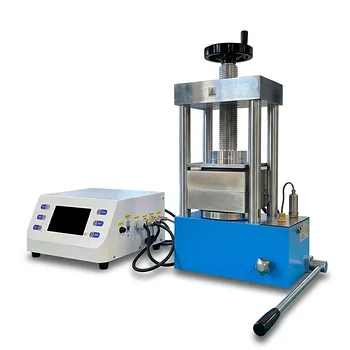
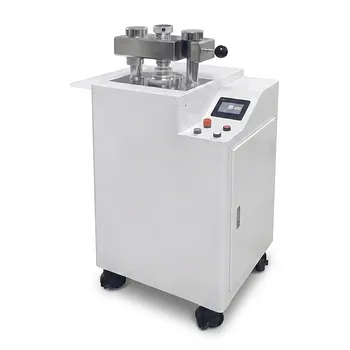
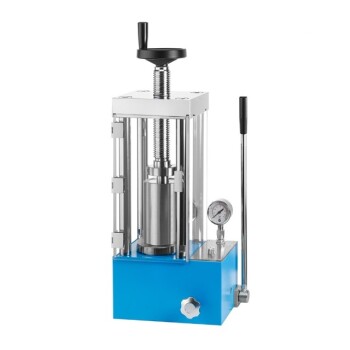
High-pressure compaction is essential for transforming loose powder into a cohesive solid capable of withstanding rigorous chemical and electrical testing. For $Pr_4Ni_{3-x}Co_xO_8$ pellets, a cubic-anvil apparatus provides up to 3 GPa of isotropic pressure to achieve maximum densification. This process is critical for maintaining structural integrity during post-processing and ensuring accurate measurements of the material's intrinsic metallic conductivity.
Core Takeaway: The use of a cubic-anvil apparatus or high-pressure press eliminates internal voids and optimizes grain-to-grain contact. This creates a dense "green body" that can survive chemical treatments and provide the reliable electrical data necessary for characterizing advanced nickelates.
Achieving Maximum Densification through Isotropic Pressure
The Role of the Cubic-Anvil Apparatus
A cubic-anvil apparatus is specifically used because it can generate ultra-high isotropic pressure, often reaching 3 GPa. Unlike standard uniaxial presses, this isotropic force compresses the sample uniformly from all sides, ensuring a homogeneous density throughout the $Pr_4Ni_{3-x}Co_xO_8$ pellet.
Eliminating Porosity and Voids
The primary mechanical goal is to reduce inter-particle voids and minimize porosity within the powder mold. By forcing particles into the closest possible proximity, the press reduces the risk of tortuous transport paths and ensures the sample simulates a pressurized, sedimentary-like solid state.
Establishing the Physical Foundation
This pre-forming stage establishes the necessary physical foundation for any subsequent high-temperature treatments. Mechanical force causes particle displacement and deformation, which significantly increases the initial density of the "green body" before it ever enters a furnace.
Enhancing Electronic and Structural Performance
Optimizing Inter-grain Electrical Contact
To measure the intrinsic metallic conductivity of $Pr_4Ni_{3-x}Co_xO_8$, grain boundaries must be tightly knit. High pressure improves the electrical contact between individual grains, preventing resistance artifacts that would otherwise result from loose packing or air gaps.
Ensuring Integrity During De-intercalation
Samples of this type often undergo subsequent sulfur de-intercalation treatments. The high degree of densification achieved by the cubic-anvil press ensures the pellet maintains its structural integrity and does not crumble or degrade during these aggressive chemical interventions.
Promoting Atomic Diffusion
By forcing particles into intimate contact, the press shortens atomic diffusion paths. This is vital for phase transformations and grain bonding, as it allows atoms to migrate more efficiently across particle boundaries during the sintering process.
Understanding the Trade-offs and Pitfalls
Risk of Internal Micro-cracking
While high pressure is beneficial, applying force too rapidly or releasing it abruptly can cause elastic recovery issues. This may lead to micro-cracks or "capping" in the pellet, where the top layers delaminate from the body, compromising the sample's utility.
Tooling Wear and Contamination
Operating at pressures near 3 GPa places extreme stress on the tungsten carbide anvils or steel molds. Over time, this can lead to deformation of the tooling or potential cross-contamination if the mold surfaces are not meticulously maintained between different sample compositions.
Pressure Gradients in Large Samples
As the thickness of the pellet increases, achieving uniform density becomes more difficult. Even with isotropic setups, friction between the powder and the mold walls can create slight pressure gradients, which may result in non-uniform reaction kinetics during later stages of synthesis.
How to Apply Compaction Methods to Your Project
Recommendations for Sample Preparation
The choice of equipment should be dictated by your material's final environment and the precision required for your data.
- If your primary focus is intrinsic electrical characterization: Utilize a cubic-anvil apparatus to reach GPa-level pressures, ensuring grain contact is maximized to eliminate measurement error.
- If your primary focus is routine chemical synthesis or XRF analysis: A standard laboratory hydraulic press applying 300–500 MPa is typically sufficient to ensure sample integrity and component uniformity.
- If your primary focus is studying diffusion-controlled reactions: Prioritize maximizing the contact area between different powder components to shorten diffusion paths and accelerate phase transformations.
By mastering the mechanics of high-pressure compaction, researchers can ensure their materials possess the durability and density required for definitive scientific analysis.
Summary Table:
| Feature | Cubic-Anvil Apparatus | Standard Hydraulic Press |
|---|---|---|
| Pressure Capability | Ultra-high (up to 3 GPa) | Moderate (300–500 MPa) |
| Force Application | Isotropic (uniform from all sides) | Uniaxial (single direction) |
| Primary Benefit | Maximum densification & grain contact | Structural integrity & uniform mixing |
| Best Application | Intrinsic conductivity & phase studies | Routine synthesis & XRF analysis |
| Sample Result | Homogeneous, void-free "green body" | Cohesive solid for general handling |
Elevate Your Material Synthesis with KINTEK Precision
Precision in high-pressure compaction is the foundation of reliable material characterization. At KINTEK, we specialize in providing high-performance laboratory equipment tailored for advanced research. Whether you are preparing $Pr_4Ni_{3-x}Co_xO_8$ pellets or developing new alloys, our solutions ensure maximum density and structural integrity.
Our Comprehensive Portfolio Includes:
- Hydraulic Presses: Pellet, hot, and isostatic presses for superior compaction.
- High-Temperature Furnaces: Muffle, tube, vacuum, CVD, and atmosphere furnaces.
- Advanced Reactors: High-temperature high-pressure reactors and autoclaves.
- Material Processing: Crushing, milling, sieving equipment, and premium crucibles.
- Specialized Tools: Electrolytic cells, battery research consumables, and ULT freezers.
Don't let internal voids or poor grain contact compromise your data. Contact KINTEK today to find the perfect high-pressure or thermal solution for your laboratory needs!
References
- Tomonori Miyatake, M. Uehara. X-ray Absorption Spectroscopic Study of Layered Nickelates Pr<sub>4</sub>Ni<sub>3−</sub><i><sub>x</sub></i>Co<i><sub>x</sub></i>O<sub>8</sub> for High-<i>T</i><sub>c</sub> Superconductor Candidate. DOI: 10.7566/jpscp.38.011042
This article is also based on technical information from Kintek Solution Knowledge Base .
Related Products
- Cylindrical Press Mold with Scale for Lab
- Cylindrical Press Mold for Lab Applications
- Assemble Square Lab Press Mold for Laboratory Applications
- Automatic Hydraulic Hot Press with 500x500mm Heating Plates and Multi Stage PLC Control for Material Sintering
- Large Format Automatic Laboratory Hot Press 400x400 Plate for Industrial Material Sintering and Polymer Lamination
People Also Ask
- How to use a press mold? Master the Art of Creating Consistent Ceramic Forms
- Why are pressure molds with non-conductive resin inner walls required for battery testing? Ensure Data Accuracy
- What is the press mould method? A Guide to Consistent, Detailed Ceramic Forms
- What is the process of mold press? A Step-by-Step Guide to Compression Molding
- What is the primary function of mold pressing for LAGP powders? Achieve High-Performance Solid Electrolytes