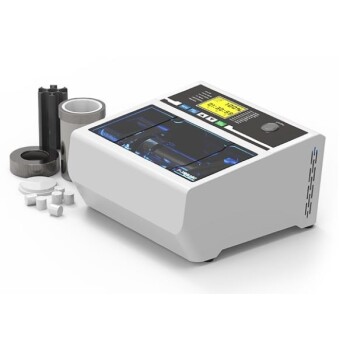
A high-precision co-precipitation apparatus is required to strictly regulate pH levels and liquid dripping speeds during the synthesis process. By maintaining these variables within a tight range, the apparatus ensures that Magnesium, Aluminum, and Zinc ions precipitate simultaneously rather than separately. This uniformity is the critical factor in developing the specific physical and chemical properties needed for effective adsorption.
Core Takeaway Achieving the correct crystal structure in mixed oxide adsorbents is impossible without rigorous control over reaction dynamics. High-precision equipment synchronizes the precipitation of multiple metal ions, directly optimizing porosity and maximizing the material's capacity to remove contaminants like Cobalt and Nickel.
The Mechanics of Simultaneous Precipitation
Controlling Chemical Dynamics
Synthesizing a mixed oxide involves managing multiple metal ions—Magnesium, Aluminum, and Zinc—that naturally react at different rates.
Without intervention, these elements would precipitate sequentially, leading to a segregated, ineffective mixture. A high-precision apparatus forces simultaneous precipitation by locking in specific environmental conditions.
The Role of pH Stability
The pH level of the reaction solution serves as the primary "trigger" for precipitation.
High-precision equipment eliminates pH fluctuations that occur during manual or low-tech synthesis. By keeping the pH constant, the apparatus ensures that all three metal ions solidify at the exact same moment, creating a homogenous compound.
Regulating Dripping Speed
The rate at which reactants are introduced (dripping speed) dictates how crystals form and grow.
If reactants are added too quickly or unevenly, the resulting structure may become disordered or clumped. Precision equipment maintains a steady, calculated dripping speed, allowing for the uniform growth of the material at a microscopic level.
From Structure to Performance
Defining Crystal Structure
The primary goal of using precision equipment is to dictate the final internal architecture of the material.
The simultaneous precipitation described above results in a specific crystal structure. This organized lattice is required for the material to function as a stable adsorbent rather than a loose collection of oxides.
Optimizing Porosity
Performance in adsorption applications depends heavily on surface area and pore structure.
Precise physical regulation during synthesis ensures the material develops the correct porosity. An optimized pore structure allows fluids to flow through the material effectively while providing ample surface area for chemical interactions.
Targeting Specific Contaminants
The ultimate measure of the synthesis success is the material's ability to trap target ions.
Because the apparatus ensures a uniform distribution of active components, the resulting Mg-Al-Zn oxides achieve maximum capacity for adsorbing Cobalt (Co(II)) and Nickel (Ni(II)). A less precise synthesis would leave these active sites inaccessible or unevenly distributed.
Understanding the Trade-offs
Equipment Cost vs. Performance Consistency
High-precision co-precipitation apparatuses represent a significant capital investment compared to standard glassware or manual setups.
However, relying on manual methods introduces human error and environmental variance. While cheaper, low-precision methods often yield inconsistent batches where the metal ions separate, leading to adsorbents with unpredictable or significantly lower removal efficiencies.
Making the Right Choice for Your Goal
To determine if this level of precision is necessary for your specific project, consider your performance targets.
- If your primary focus is maximum adsorption capacity: You must use high-precision apparatus to guarantee the optimal porosity and crystal structure required for capturing ions like Cobalt and Nickel.
- If your primary focus is reproducibility: You need the strict control of pH and dripping speeds to ensure every batch performs identically to the last.
- If your primary focus is basic feasibility testing: You may be able to use standard equipment initially, but be aware that the resulting data will not reflect the material's true potential.
Precision in synthesis is the only pathway to reliability in performance.
Summary Table:
| Parameter | Influence on Synthesis | Impact on Adsorbent Performance |
|---|---|---|
| pH Stability | Ensures simultaneous precipitation of Mg, Al, and Zn | Creates a homogenous crystal lattice structure |
| Dripping Speed | Regulates crystal nucleation and growth rates | Optimizes surface area and internal porosity |
| Ion Distribution | Prevents sequential segregation of metal ions | Maximizes removal efficiency for Co(II) and Ni(II) |
| Automation | Eliminates manual variance and human error | Guarantees batch-to-batch reproducibility |
Elevate Your Materials Research with KINTEK Precision
Achieving the perfect crystal structure for Mg-Al-Zn mixed oxide adsorbents requires more than just chemistry—it requires engineering excellence. At KINTEK, we specialize in high-precision laboratory equipment designed to meet the rigorous demands of advanced material synthesis.
From our sophisticated high-precision co-precipitation systems and high-temperature furnaces (muffle, vacuum, and CVD) to our specialized crushing and milling systems and hydrothermal autoclaves, KINTEK provides the tools necessary to ensure your research is both reproducible and high-performing. Whether you are developing adsorbents, battery materials, or advanced ceramics, our comprehensive range of laboratory equipment and high-quality consumables ensures you never have to compromise on precision.
Ready to optimize your synthesis process? Contact our technical experts today to find the perfect equipment solution for your laboratory’s unique requirements.
References
- Khalid Z. Elwakeel, Abdullah S. Al‐Bogami. Perspectives regarding metal/mineral-incorporating materials for water purification: with special focus on Cr(<scp>vi</scp>) removal. DOI: 10.1039/d0ma00153h
This article is also based on technical information from Kintek Solution Knowledge Base .
Related Products
- Laboratory Micro Horizontal Jar Mill for Precision Sample Preparation in Research and Analysis
- High Purity Pure Graphite Crucible for Evaporation
- Laboratory Benchtop High Speed Small Centrifuge for Low Temp Serum Separation Dehydration Research
People Also Ask
- What are the different types of laboratory mills? Choose the Right Grinder for Your Sample Material
- What is use for grinding in the laboratory? Select the Right Mill for Accurate Sample Prep
- What is the function of laboratory mills? Achieve Precise Particle Size Control for Accurate Analysis
- What is the use of a laboratory mill? Achieve Accurate Sample Homogenization for Reliable Results
- What is the purpose of sample preparation? Ensure Accurate & Reliable Analytical Results