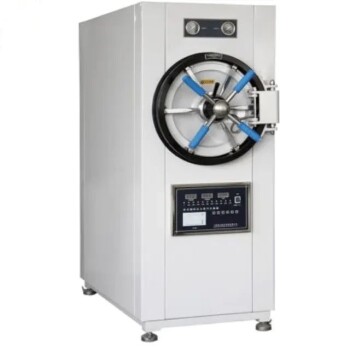
A high-pressure hydrothermal autoclave is mandatory for this synthesis because it creates the sealed, pressurized environment necessary to force specific precipitation reactions. Without this containment, you cannot achieve the precise phase composition or the high crystallinity required for the material to function effectively. It is the only reliable method to generate the mesoporous structure and high specific surface area that defines the material's catalytic performance.
Core Takeaway: The autoclave acts as a precision reactor that uses heat and autogenous pressure to drive in-situ crystallization. This process ensures the uniform integration of molybdate anions and the formation of mesoporous structures, which are critical for the material’s reproducibility and catalytic efficiency.
The Role of the Reaction Environment
Generating Autogenous Pressure
The autoclave provides a hermetically sealed vessel that withstands high temperatures.
As the temperature rises within this closed system, it generates autogenous pressure (pressure created by the heating of the liquid itself).
This high-pressure liquid-phase environment is the physical catalyst that accelerates dissolution and drives the recrystallization of raw materials into the desired structure.
Ensuring High Reproducibility
Consistency is a major challenge in synthesizing complex powders.
The sealed nature of the high-pressure reactor ensures that the reaction conditions are identical for every batch.
By strictly controlling temperature, pressure, and time, you eliminate environmental variables, resulting in high reproducibility of the material's final properties.
Controlling Material Properties
Optimizing Phase Composition
To act as an effective heterogeneous catalyst, the hydroxyapatite must have a specific crystal phase.
The hydrothermal environment allows for the precise regulation of phase transformation.
This ensures the final powder consists of the correct crystalline structure rather than an amorphous or mixed-phase mixture that would perform poorly.
Engineering Mesoporous Structures
The primary value of this material lies in its surface area.
The specific conditions inside the autoclave facilitate the formation of a mesoporous structure.
This structure significantly increases the specific surface area, providing more active sites for chemical reactions when the material is used as a catalyst.
Integrating Molybdate Anions
Simple mixing is insufficient for incorporating functional anions like molybdate effectively.
The high-pressure environment enables in-situ crystallization.
During this process, molybdate anions are uniformly doped into the hydroxyapatite structure, enhancing its specific ion exchange capacities and overall catalytic activity.
Understanding the Trade-offs
The Dependency on Parameter Precision
While the autoclave enables superior material quality, it introduces a strict dependency on process parameters.
You cannot achieve these results with approximate settings; the temperature, exposure time, and pressure must be regulated with extreme precision.
Failure to control these variables results in poor particle dispersion or incorrect phase composition, rendering the material ineffective for catalysis.
Making the Right Choice for Your Goal
The use of a high-pressure hydrothermal autoclave is not just a procedural step; it is a strategic choice to define the material's end-use capability.
- If your primary focus is Catalytic Performance: Prioritize the autoclave’s ability to maximize specific surface area and create mesoporous porosity.
- If your primary focus is Manufacturing Consistency: Rely on the sealed reactor’s ability to guarantee high reproducibility and uniform particle dispersion across batches.
The autoclave transforms raw chemical inputs into a highly engineered, functional catalyst through the rigorous control of heat, pressure, and time.
Summary Table:
| Feature | Hydrothermal Autoclave Benefit | Impact on Material |
|---|---|---|
| Environment | Hermetically sealed, autogenous pressure | Drives in-situ crystallization & phase purity |
| Structural Control | Regulated high-pressure liquid phase | Forms high-surface-area mesoporous structures |
| Doping Efficiency | Uniform integration of anions | Enhances ion exchange and catalytic activity |
| Consistency | Strict control of temp/pressure/time | Ensures high reproducibility & uniform dispersion |
Elevate Your Material Research with KINTEK Precision
Achieving the precise crystallinity and mesoporous structures required for advanced catalysis demands equipment that never compromises on performance. KINTEK specializes in high-performance laboratory solutions, providing researchers with the high-temperature high-pressure reactors and autoclaves necessary for sophisticated hydrothermal synthesis.
From high-pressure autoclaves and muffle furnaces to specialized PTFE consumables and ceramics, our portfolio is engineered to ensure your experiments are reproducible and your results are superior. Whether you are developing catalysts, conducting battery research, or perfecting dental ceramics, KINTEK provides the reliability your lab deserves.
Ready to optimize your synthesis process? Contact KINTEK today to find the perfect reactor for your application!
References
- Miloš Janeček, Tomáš Chráska. Microstructure and mechanical properties of biomedical alloys spark plasma sintered from elemental powders. DOI: 10.21175/rad.abstr.book.2023.19.8
This article is also based on technical information from Kintek Solution Knowledge Base .
Related Products
- High Pressure Laboratory Autoclave Reactor for Hydrothermal Synthesis
- Mini SS High Pressure Autoclave Reactor for Laboratory Use
- Stainless High Pressure Autoclave Reactor Laboratory Pressure Reactor
- Customizable High Pressure Reactors for Advanced Scientific and Industrial Applications
- Laboratory High Pressure Horizontal Autoclave Steam Sterilizer for Lab Use
People Also Ask
- What role does a high-pressure reactor (autoclave) play in the synthesis of NiCuFe-LDH? Master Hydrothermal Growth
- What Role Does a High-Pressure Reactor or Autoclave Play in HA Catalyst Synthesis? Achieve High Surface Area Materials
- What equipment is required for hydrothermal synthesis of Ga0.25Zn4.67S5.08? Optimize Your Semiconductor Production
- What is the function of a high-pressure reactor in the hydrothermal synthesis of boehmite? Expert Process Insights
- What role does an autoclave play in the synthesis of MnO2 nanofibers? Mastering Hydrothermal Growth