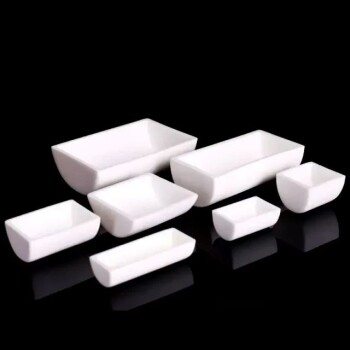
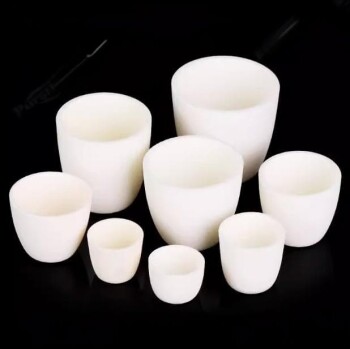
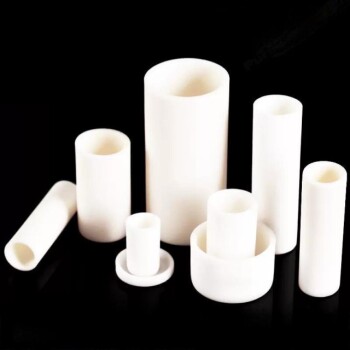
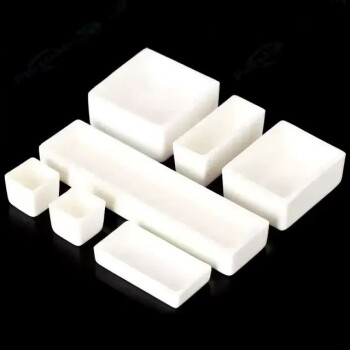
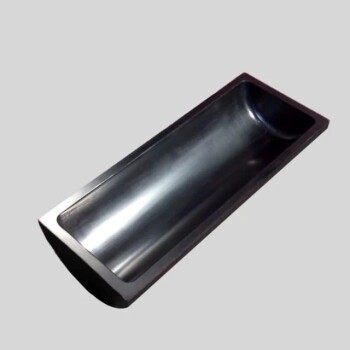
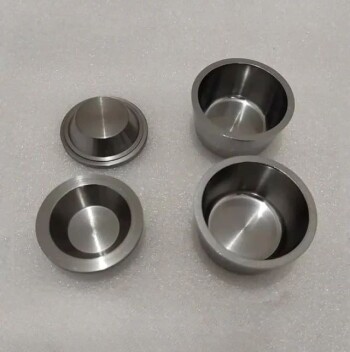
High-purity alumina (Al2O3) crucible boats are used because they provide a unique combination of extreme thermal resistance and chemical inertness at the high temperatures required for synthesis. During the thermal evaporation of tungsten oxide (WO3) at 1050 °C, these boats act as a stable carrier that does not react with the precursor powder. This prevents impurities from entering the gas transport phase, ensuring the synthesized nanowires maintain their structural and chemical integrity.
Core Takeaway: The use of high-purity alumina is essential to prevent chemical "leaching" and contamination during high-heat processes. By remaining non-reactive at temperatures exceeding 1000 °C, the boat ensures that the resulting tungsten oxide nanowires achieve the high levels of purity required for advanced technical applications.
Superior Thermal Resilience
Withstanding Extreme Temperatures
Thermal evaporation of tungsten oxide requires consistent temperatures reaching 1050 °C. High-purity alumina is specifically engineered to maintain structural integrity in these environments without softening or degrading.
Reliability Through Thermal Cycling
In many laboratory settings, materials undergo frequent heating and cooling cycles. Alumina ceramic boats exhibit excellent thermal stability, allowing them to withstand these cycles without cracking or losing their shape.
High Melting Point Advantage
The melting point of alumina is significantly higher than the temperatures used in tungsten oxide synthesis. This provides a wide safety margin, ensuring the container does not fail even if there are unexpected temperature spikes during the CVD or evaporation process.
Chemical Inertness and Purity Control
Preventing Material Leaching
At high temperatures, many materials become reactive and can "leach" elements into the precursor powder. High-purity alumina is chemically inert, meaning it does not trade atoms with the tungsten oxide, preserving the powder’s original composition.
Maintaining the Gas Transport Phase
Nanowire growth depends on the purity of the vaporized precursor. By preventing side reactions, alumina ensures that the vapor phase is free of metallic impurities that could alter the growth kinetics or the final properties of the nanowires.
Protection Against Oxidation
Alumina is an oxide itself and is highly resistant to further oxidation. This makes it an ideal carrier in environments where oxygen or other reactive gases are present to facilitate the growth of metal oxide nanostructures.
Surface Properties and Efficiency
Resisting Adhesion and Wetting
Alumina surfaces often exhibit low wetting characteristics for various evaporants. This prevents the tungsten oxide from sticking aggressively to the boat, which simplifies the cleaning process and allows for a more efficient release of vapor.
Consistent Vapor Release
Because the boat does not react with the precursor, the evaporation rate remains predictable and stable. This consistency is vital for controlling the diameter and length of the synthesized tungsten oxide nanowires.
Understanding the Trade-offs
Heating Efficiency and Current
While alumina is an excellent insulator, this can be a drawback in certain resistance-heating setups. Alumina-coated boats or thick alumina crucibles may require higher current levels to reach target temperatures compared to more conductive, yet less stable, materials.
Sensitivity to Thermal Shock
Despite their high-temperature resistance, alumina ceramics can be brittle. Rapid, uneven heating or cooling can lead to thermal shock, which may cause the boat to crack over time if temperature ramps are not carefully controlled.
Cost vs. Purity
High-purity alumina (99% or higher) is more expensive than standard ceramic or lower-grade refractories. However, using lower-purity carriers often results in elemental contamination, which can render the synthesized nanowires useless for electronic or catalytic applications.
Applying This to Your Synthesis Goals
Recommendations for Material Selection
- If your primary focus is maximum nanowire purity: Always opt for 99.9% high-purity alumina to ensure no trace metals (like iron or silicon) interfere with the crystal lattice of the tungsten oxide.
- If your primary focus is high-volume thermal cycling: Ensure your heating profile includes gradual "ramp-up" and "ramp-down" phases to extend the lifespan of the alumina boat and prevent cracking.
- If your primary focus is cost-efficiency in low-temp tests: You may use lower-grade alumina for temperatures below 600 °C, but for tungsten oxide synthesis at 1050 °C, the high-purity variant is non-negotiable.
Choosing high-purity alumina ensures that the only variables in your synthesis are the precursors themselves, providing a clean and predictable environment for nanowire growth.
Summary Table:
| Feature | Advantage for Nanowire Synthesis | Key Performance Metric |
|---|---|---|
| Thermal Resilience | Maintains integrity during 1050°C evaporation | High melting point >2000°C |
| Chemical Inertness | Prevents material leaching & elemental contamination | 99% - 99.9% Al2O3 purity |
| Oxidation Resistance | Stable in reactive gas environments (CVD/evaporation) | Naturally non-reactive oxide |
| Low Wetting | Prevents adhesion for easy cleaning & stable vapor release | Optimized surface tension |
| Structural Stability | Withstands frequent laboratory thermal cycling | High mechanical strength |
Elevate Your Materials Synthesis with KINTEK Precision
Achieving high-purity nanowire growth requires more than just the right process—it requires the right tools. At KINTEK, we specialize in providing high-performance laboratory equipment and consumables tailored for advanced research.
Whether you are conducting thermal evaporation, CVD, or PECVD, our high-purity alumina boats, ceramics, and crucibles provide the chemical inertness your precursors demand. Pair them with our industry-leading high-temperature furnaces (muffle, tube, and vacuum) and high-pressure reactors to ensure consistent, repeatable results every time.
Ready to eliminate contamination and optimize your yields?
Contact our specialists today to find the perfect ceramic solutions and laboratory systems for your specific application. Let KINTEK be your partner in scientific excellence.
References
- Po-Heng Sung, Kuo‐Chang Lu. Synthesis and Physical Characteristics of Undoped and Potassium-Doped Cubic Tungsten Trioxide Nanowires through Thermal Evaporation. DOI: 10.3390/nano13071197
This article is also based on technical information from Kintek Solution Knowledge Base .
Related Products
- Alumina Al2O3 Ceramic Crucible Semicircle Boat with Lid for Engineering Advanced Fine Ceramics
- High Purity Pure Graphite Crucible for Evaporation
- Ceramic Evaporation Boat Set Alumina Crucible for Laboratory Use
- Arc-Shaped Alumina Ceramic Crucible High Temperature Resistant for Engineering Advanced Fine Ceramics
- Engineering Advanced Fine Ceramics Alumina Crucibles (Al2O3) for Thermal Analysis TGA DTA
People Also Ask
- Why are alumina crucibles and mother powder essential for LATP sintering? Optimize Your Solid Electrolyte Performance
- Why are high-purity alumina crucibles used for liquid lead corrosion experiments? Ensure Data Accuracy at 550°C
- Why Use Alumina Crucibles & Powder Burial for NaSICON? Ensure Phase Purity and Prevent Elemental Volatilization
- What is the primary purpose of using alumina crucibles for LLTO ceramics? Optimize Your High-Temperature Sintering
- What are the benefits of using an alumina crucible with a lid for TiB2 nanopowder heat treatment? Ensure High Purity