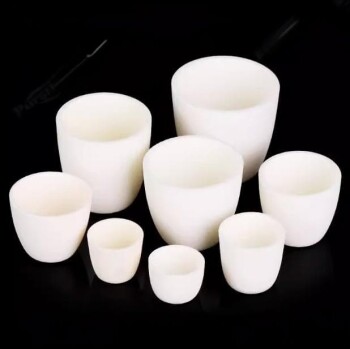
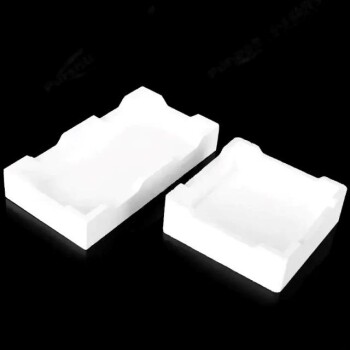
High-purity alumina boats are the preferred container for CdSe synthesis because they provide an exceptionally stable, chemically inert environment at high temperatures. During the synthesis of cadmium selenide (CdSe) nanocomposites, the boat holds precursors like cadmium carbonate (CdCO3) at temperatures around 500°C. Its primary role is to prevent any chemical reaction between the vessel and the reactants, ensuring that no impurities leach into the nanocomposite and compromise its material properties.
The use of high-purity alumina ensures a "zero-contamination" environment by acting as a non-reactive stage for chemical precursors. This stability is critical for maintaining the precise atomic composition and high performance of synthesized nanomaterials.
Ensuring Chemical Purity and Inertness
Preventing Material Leaching
At the elevated temperatures required for tube furnace synthesis, many standard materials begin to shed trace elements or react with the contents. High-purity alumina (Al2O3) possesses superior chemical stability, ensuring that it does not introduce metallic or oxide impurities into the CdSe powder.
Protecting Precursor Integrity
Precursors like cadmium carbonate must undergo specific thermal transformations to form high-quality nanocomposites. The inert nature of the alumina boat ensures that the chemical pathway remains focused on the reactants themselves, rather than side reactions with the container wall.
Maintaining Atomic-Level Cleanliness
In semiconductor synthesis, even parts-per-million contamination can significantly alter electronic and optical performance. High-purity alumina is specifically selected to maintain atomic-level cleanliness throughout the heating and cooling cycles within the tube furnace.
Thermal Stability in the Tube Furnace
Resistance to Structural Deformation
Tube furnace processes often require sustained heat that can cause lesser materials to sag or deform. High-purity alumina can withstand temperatures well exceeding 1000°C without losing its structural integrity, providing a consistent surface for the vaporization and reaction of materials.
Facilitating Uniform Heat Distribution
The material properties of alumina allow for even thermal distribution across the precursor bed. This uniformity is essential for the consistent growth of nanocomposites, as temperature gradients can lead to variations in particle size or crystal structure.
Resilience in Specific Gas Environments
CdSe synthesis often occurs under specific gas flows (such as inert or reducing atmospheres) to prevent unwanted oxidation. Alumina remains stable in these environments, ensuring that the boat does not degrade or outgas during the process.
Understanding the Trade-offs
Thermal Shock Sensitivity
While alumina is highly resistant to heat, it is relatively sensitive to thermal shock. Rapid heating or cooling can cause the ceramic to crack, necessitating controlled ramp rates within the tube furnace to preserve the life of the boat.
Cost vs. Purity
High-purity alumina (typically 99% or higher) is more expensive than standard industrial ceramics. However, using lower-grade alumina introduces binders and silica that can contaminate the CdSe system, making the higher investment a technical necessity for high-performance applications.
Physical Fragility
Unlike metal alloy containers, alumina boats are brittle and susceptible to mechanical failure if mishandled. They require careful storage and placement within the quartz furnace tube to avoid physical impact.
How to Apply This to Your Project
Making the Right Choice for Your Goal
- If your primary focus is maximum electronic performance: Use the highest purity alumina (99.7%+) to eliminate trace metal contamination that could act as charge traps in the CdSe.
- If your primary focus is high-throughput synthesis: Implement strict thermal ramping protocols (e.g., 5°C/min) to prevent boat cracking and extend the lifecycle of your containers.
- If your primary focus is cost-effective prototyping: Consider smaller alumina "micro-boats" to minimize material costs while still benefiting from the inert environment required for valid chemical results.
By prioritizing chemical inertness and thermal stability, the high-purity alumina boat serves as a foundational tool in the precise engineering of cadmium selenide nanocomposites.
Summary Table:
| Feature | Benefit for CdSe Synthesis | Key Consideration |
|---|---|---|
| Chemical Inertness | Prevents impurity leaching and side reactions. | Maintains atomic-level cleanliness. |
| High Thermal Stability | Withstands temperatures >1000°C without deformation. | Supports consistent vaporisation. |
| Uniform Heat Distribution | Ensures even growth and consistent particle size. | Critical for crystal structure integrity. |
| Atmospheric Resistance | Remains stable in inert or reducing gas flows. | Prevents outgassing during synthesis. |
Elevate Your Material Synthesis with KINTEK
Precision in nanomaterial synthesis starts with the right environment. KINTEK specializes in providing high-performance laboratory equipment and consumables designed for the most demanding research applications. Whether you are synthesizing CdSe nanocomposites or exploring advanced semiconductors, our high-purity alumina boats, crucibles, and ceramics ensure a zero-contamination workspace.
Our extensive portfolio supports your entire workflow, featuring:
- Advanced Furnace Systems: Precise tube, muffle, vacuum, and CVD furnaces.
- Sample Preparation: Hydraulic presses, crushing systems, and high-purity milling tools.
- Specialized Reactors: High-temperature high-pressure reactors and autoclaves.
- Lab Essentials: ULT freezers, cooling solutions, and premium PTFE/ceramic consumables.
Don't let impurities compromise your results. Partner with KINTEK for reliable, high-quality tools that deliver consistent performance.
Contact our experts today to find the perfect solution for your lab!
References
- Arno van der Weijden, Willem L. Noorduin. Architected Metal Selenides via Sequential Cation and Anion Exchange on Self-Organizing Nanocomposites. DOI: 10.1021/acs.chemmater.2c03525
This article is also based on technical information from Kintek Solution Knowledge Base .
Related Products
- Alumina Al2O3 Ceramic Crucible Semicircle Boat with Lid for Engineering Advanced Fine Ceramics
- High Purity Alumina Granulated Powder for Engineering Advanced Fine Ceramics
- Aluminized Ceramic Evaporation Boat for Thin Film Deposition
- Ceramic Evaporation Boat Set Alumina Crucible for Laboratory Use
- High Purity Pure Graphite Crucible for Evaporation
People Also Ask
- Why are alumina crucibles and mother powder essential for LATP sintering? Optimize Your Solid Electrolyte Performance
- Why are high-purity alumina crucibles used for liquid lead corrosion experiments? Ensure Data Accuracy at 550°C
- Why Use Alumina Crucibles & Powder Burial for NaSICON? Ensure Phase Purity and Prevent Elemental Volatilization
- What is the primary purpose of using alumina crucibles for LLTO ceramics? Optimize Your High-Temperature Sintering
- What are the benefits of using an alumina crucible with a lid for TiB2 nanopowder heat treatment? Ensure High Purity