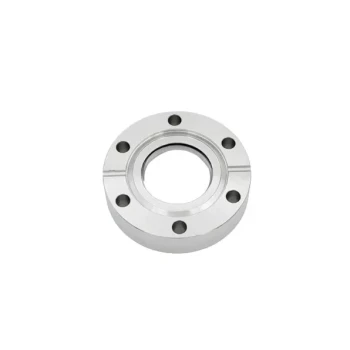
A high-vacuum stainless steel reaction chamber is the foundational component for ensuring purity and precision in non-thermal plasma (NTP) treatment. It creates a controlled low-pressure environment that physically removes atmospheric interference. This allows for the precise excitation of specific process gases without the chaotic influence of background air.
By eliminating atmospheric nitrogen and oxygen, the chamber enables the generation of high-purity plasma from gases like methane and argon. This controlled environment is critical for achieving uniform, contaminant-free carbide film deposition on titanium surfaces.
The Critical Role of Atmospheric Exclusion
Removing Chemical Interference
The primary function of the high-vacuum system is to reduce background pressure to extremely low levels.
This evacuation is necessary to exclude atmospheric gases, specifically nitrogen and oxygen.
If these gases remain present, they will react chemically during the plasma process, contaminating the intended reaction.
Creating a Controlled Baseline
A stainless steel chamber acts as the robust vessel required to maintain this low-pressure state.
By isolating the process from the outside environment, the chamber establishes a "clean slate" for the reaction.
This ensures that the only elements interacting with your substrate are the ones you intentionally introduce.
Facilitating High-Purity Plasma Generation
Precise Gas Excitation
Once the atmospheric interference is removed, specific process gases—methane and argon—are introduced.
Because the environment is controlled, a radio frequency (RF) power source can efficiently excite these gases.
This results in the formation of high-purity plasma, unadulterated by random airborne particles.
Optimizing Film Deposition
The ultimate goal of this setup is the modification of pure titanium surfaces.
The high-vacuum environment allows the plasma to deposit uniform carbide films onto the titanium.
Without the vacuum, the uniformity and chemical composition of these films would be compromised by impurities.
Understanding the Risks of Improper Pressure
The Cost of Background Pressure
If the chamber fails to achieve a sufficiently high vacuum, background pressure creates immediate process instability.
Residual nitrogen or oxygen will compete with the methane and argon during excitation.
This leads to "dirty" plasma, which prevents the formation of a pure carbide film and potentially degrades the titanium substrate.
Making the Right Choice for Your Goal
To achieve the best results in NTP treatment, align your equipment with your specific processing needs:
- If your primary focus is Chemical Purity: Ensure your vacuum system is capable of evacuating atmospheric nitrogen and oxygen to negligible levels before introducing process gases.
- If your primary focus is Surface Uniformity: Rely on the stability of the high-vacuum environment to ensure the RF power source excites only the methane and argon for consistent film deposition.
A controlled, high-vacuum environment is not merely an operational preference; it is the strict requirement for chemically pure and physically uniform surface treatments.
Summary Table:
| Feature | Function in NTP Treatment | Impact on Process Quality |
|---|---|---|
| High-Vacuum Level | Removes atmospheric N₂ and O₂ | Eliminates chemical interference and contamination |
| Stainless Steel Vessel | Maintains low-pressure integrity | Provides a robust, leak-proof environment for stability |
| Controlled Baseline | Establishes a "clean slate" | Ensures only introduced gases (Methane/Argon) react |
| RF Power Compatibility | Enables precise gas excitation | Facilitates uniform and high-purity plasma generation |
Elevate Your Material Research with KINTEK Precision
Achieve uncompromising purity in your plasma processes with KINTEK’s advanced laboratory solutions. Whether you are developing uniform carbide films or exploring cutting-edge surface modifications, our high-performance stainless steel reaction chambers, high-temperature high-pressure reactors, and vacuum systems provide the stable, contaminant-free environment your research demands.
Why choose KINTEK?
- Precision Engineering: Expertly designed chambers for high-vacuum and high-pressure stability.
- Comprehensive Portfolio: From CVD/PECVD furnaces to crushing and milling systems, we equip your entire workflow.
- Targeted Reliability: Trusted by researchers for battery development, ceramic sintering, and advanced metallurgy.
Don't let atmospheric interference compromise your results. Contact KINTEK today to find the perfect high-vacuum solution for your lab!
References
- Aljomar José Vechiato Filho, Valentim Adelino Ricardo Barão. Effect of nonthermal plasma treatment on surface chemistry of commercially-pure titanium and shear bond strength to autopolymerizing acrylic resin. DOI: 10.1016/j.msec.2015.11.008
This article is also based on technical information from Kintek Solution Knowledge Base .
Related Products
- KF Ultra-High Vacuum Observation Window Stainless Steel Flange Sapphire Glass Sight Glass
- CF Ultra-High Vacuum Observation Window Stainless Steel Flange Sapphire Glass Sight Glass
- Stainless High Pressure Autoclave Reactor Laboratory Pressure Reactor
- Customer Made Versatile CVD Tube Furnace Chemical Vapor Deposition Chamber System Equipment
- Split Chamber CVD Tube Furnace with Vacuum Station Chemical Vapor Deposition System Equipment Machine
People Also Ask
- What is high vacuum used for? Essential for Particle Beams and Advanced Lab Instruments
- Why Use High-Pressure Reactors with Sapphire Windows in Photothermal Catalysis? Enhance Yields & Control
- What function do baffle plates serve inside a reaction vessel? Enhance Photovoltaic Backsheet Recycling Efficiency
- Is Sputter Tint good? Premium Heat Rejection & Long-Term Durability Explained
- What is the primary purpose of introducing a high-purity Argon (Ar) protective atmosphere during boriding? Expert Guide