The selection of a porous graphite rod as a counter electrode is driven by its ability to provide a massive effective surface area while maintaining exceptional chemical stability. This specific combination ensures that the reaction rate at the counter electrode significantly exceeds that of the working electrode, preventing the counter electrode from becoming a bottleneck in the electrochemical cell.
A counter electrode must function as a non-limiting facilitator of charge transfer. By using a high-surface-area porous graphite rod, you prevent polarization at the auxiliary side, ensuring that all recorded data points—specifically peak potentials and current densities—reflect the true performance of your modified carbon paper, not artifacts of the test setup.
The Physics of Surface Area
Overcoming Rate Limitations
In electrochemical testing, the current flowing through the system is dictated by the reaction rates at both the working and counter electrodes.
To measure the working electrode accurately, the counter electrode must be able to support a much higher rate of electron transfer.
Porous graphite is ideal because its internal structure offers a significantly higher effective surface area compared to solid rods, ensuring it never limits the total current flow.
Preventing Polarization
If the counter electrode has insufficient surface area, it requires more energy (overpotential) to drive the necessary current.
This phenomenon, known as polarization, can introduce significant errors into your measurements.
By utilizing a porous rod, you minimize the current density at the counter electrode surface, keeping it in a stable, non-polarized state.
Chemical Compatibility and Stability
Resilience in Acidic Environments
The reliability of your data depends heavily on the inert nature of your electrode materials.
Porous graphite exhibits excellent chemical stability, specifically within acidic vanadyl sulfate electrolytes.
This ensures that the electrode does not degrade or introduce contaminants into the electrolyte during the rigorous voltage sweeps of cyclic voltammetry.
The Critical Risk of Component Limitation
Understanding the Consequence of Low Surface Area
It is vital to understand that a three-electrode setup assumes the working electrode is the only variable being tested.
If you were to use a counter electrode with a low surface area, the reaction at that electrode could become the rate-determining step.
Distorted Cyclic Voltammetry Data
When the counter electrode limits the reaction, the resulting cyclic voltammetry (CV) curves become distorted.
Specifically, you may observe shifted peak potentials or artificially suppressed current densities.
Using porous graphite effectively eliminates this risk, guaranteeing that the CV profile represents the true catalytic behavior of the modified carbon paper.
Making the Right Choice for Your Experiment
To ensure the integrity of your electrochemical data, select your counter electrode based on the specific demands of your electrolyte and working electrode activity.
- If your primary focus is determining true catalytic activity: Ensure your counter electrode has a surface area significantly larger than your working electrode to prevent rate limiting.
- If your primary focus is working with acidic vanadyl sulfate: Prioritize graphite for its chemical inertness to prevent electrolyte contamination or electrode degradation.
By removing the counter electrode as a variable, you allow the true performance of the modified carbon paper to stand out.
Summary Table:
| Feature | Advantage for Counter Electrodes | Impact on Results |
|---|---|---|
| High Surface Area | Prevents the counter electrode from becoming the rate-limiting step. | Ensures accurate current density measurements. |
| Chemical Stability | Resists degradation in acidic vanadyl sulfate electrolytes. | Prevents contamination and experimental artifacts. |
| Low Polarization | Minimizes overpotential requirements for charge transfer. | Guarantees peak potentials reflect true catalytic activity. |
| Porous Structure | Maximizes effective reaction sites compared to solid rods. | Eliminates data distortion in cyclic voltammetry. |
Elevate Your Electrochemical Research with KINTEK
Don't let instrumentation limits skew your data. KINTEK specializes in providing high-performance laboratory equipment and consumables designed for precision. Whether you need specialized electrolytic cells and electrodes, advanced battery research tools, or high-temperature furnaces and reactors, we deliver the quality your research demands.
From porous graphite rods to PTFE consumables and ceramics, we support target customers in energy and materials science with reliable solutions. Contact us today to discuss how our high-quality electrodes and laboratory tools can ensure the integrity of your next experiment.
References
- Ahmed Sodiq, Belabbes Merzougui. Enhanced electrochemical performance of modified thin carbon electrodes for all-vanadium redox flow batteries. DOI: 10.1039/d0ma00142b
This article is also based on technical information from Kintek Solution Knowledge Base .
Related Products
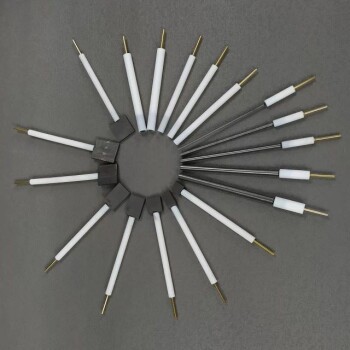
- Graphite Disc Rod and Sheet Electrode Electrochemical Graphite Electrode
- High Purity Pure Graphite Crucible for Evaporation
- Carbon Graphite Plate Manufactured by Isostatic Pressing Method
- High Purity Pure Graphite Crucible for Electron Beam Evaporation
- Engineering Advanced Fine Alumina Al2O3 Ceramic Rod Insulated for Industrial Applications
People Also Ask
- Why is a graphite electrode used as a counter electrode? Achieve Pure Electrochemical Reduction with KINTEK
- What is the correct procedure for installing and connecting a graphite electrode during an experiment? Ensure Accurate Electrochemical Results
- What are the potential risks when using a graphite electrode in electrochemical tests? Avoid Decomposition and Contamination
- What are the key precautions for handling graphite electrodes? Ensure Safety & Maximize Performance
- Why are Dimensionally Stable Anodes (DSA) preferred for indium electrowinning? Ensure High-Purity Results.