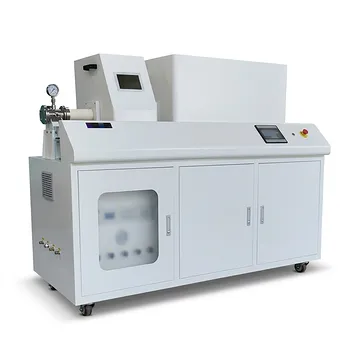
A precision atmospheric control furnace is the critical tool for simulating the long-term thermal conditions of a nuclear reactor environment without damaging the sample. It enables researchers to heat high-entropy alloys (HEAs) for hundreds of hours in an inert environment, allowing for the observation of internal structural changes under thermodynamic equilibrium while preventing surface oxidation.
The Core Value In radiation damage research, separating thermal effects from environmental contamination is essential. These furnaces provide the stability and protection required to prove whether an alloy will remain structurally sound or become brittle over years of service.
Establishing Thermodynamic Equilibrium
The Necessity of Time
To understand how an alloy will behave in a nuclear reactor, short-term tests are insufficient. Researchers must perform annealing for hundreds of hours.
This extended duration allows the material to reach a state of thermodynamic equilibrium. Only then can the true long-term stability of the material's microstructure be evaluated.
Precise Temperature Regulation
The furnace maintains a strictly controlled isothermal environment, typically between 600°C and 800°C.
This specific temperature range is critical for accelerating the aging process. It simulates the high-heat service environment of a reactor to reveal how the material evolves over time.
Protecting Sample Integrity
Preventing Oxidation
The "atmospheric control" aspect of the furnace allows for the use of inert gas protection.
Without this protection, heating metals to such high temperatures would result in rapid oxidation or decarburization. These surface reactions would ruin the sample and obscure the internal data researchers are trying to capture.
Isolating Internal Mechanisms
By eliminating surface defects caused by air, researchers ensure that any changes observed are intrinsic to the alloy.
This isolation allows for a pure analysis of grain growth kinetics. It ensures that the structural changes recorded are a result of the material's chemistry and heat, not external contamination.
Detecting Critical Phase Changes
Monitoring Precipitation
The primary goal of this long-term annealing is to observe the precipitation of second phases.
Researchers specifically look for the formation of the sigma phase or the L12 phase. Identifying these phases is non-negotiable, as they dictate the mechanical future of the alloy.
Predicting Material Failure
Data regarding these phases is vital for evaluating organizational stability.
If an alloy precipitates a brittle sigma phase during annealing, it is likely unsuitable for nuclear service. This thermal baseline data is essential for predicting how the material will hold up against actual radiation damage.
Understanding the Trade-offs
The Cost of Equilibrium
Achieving true thermodynamic equilibrium is resource-intensive. The requirement for hundreds of continuous hours of operation demands significant energy and limits the throughput of testing facilities.
Simulation vs. Reality
While these furnaces simulate thermal conditions perfectly, they do not inherently replicate the neutron flux of a reactor.
Therefore, this testing represents a thermal baseline. It must be combined with separate radiation testing to build a complete picture of the material's survivability.
Making the Right Choice for Your Goal
To effectively utilize a precision atmospheric control furnace in your research, align your parameters with your specific objectives:
- If your primary focus is Phase Stability: Prioritize long-duration holds (100+ hours) to ensure the material has fully settled into its equilibrium state.
- If your primary focus is Microstructural Integrity: Ensure the inert gas flow is rigorously maintained to prevent even trace oxidation from altering grain boundary data.
The ultimate value of this process lies in its ability to predict catastrophic failure before a material ever enters a reactor.
Summary Table:
| Feature | Benefit in HEA Research | Impact on Results |
|---|---|---|
| Inert Atmosphere | Prevents surface oxidation/decarburization | Ensures data reflects intrinsic material properties |
| Isothermal Control | Maintains stable 600°C - 800°C range | Accurately simulates reactor heat environments |
| Long-term Stability | Supports 100+ hours of continuous operation | Allows samples to reach true thermodynamic equilibrium |
| Phase Monitoring | Identifies Sigma or L12 phase precipitation | Predicts potential brittleness and material failure |
Advance Your Nuclear Material Research with KINTEK
Precise thermal baselines are the foundation of reliable radiation damage studies. KINTEK specializes in high-performance laboratory equipment designed for the rigorous demands of material science. Our comprehensive range of high-temperature atmosphere and vacuum furnaces provides the exact environmental control needed to prevent oxidation during long-term annealing of high-entropy alloys.
Whether you are analyzing grain growth kinetics or phase stability, KINTEK offers the specialized tools—including crushing systems, hydraulic presses, and advanced ceramic consumables—to support your entire workflow.
Don't let contamination compromise your equilibrium data. Contact our technical experts today to find the ideal furnace solution for your laboratory and ensure the structural integrity of your next-generation alloys.
References
- A. V. Levenets, O.V. Nemashkalo. HIGH-ENTROPY ALLOYS AS A PROSPECTIVE CLASS OF NEW RADIATION-TOLERANT MATERIALS RESEARCH DEVELOPMENT ANALYSIS BASED ON THE INFORMATION DATABASES. DOI: 10.46813/2021-132-003
This article is also based on technical information from Kintek Solution Knowledge Base .
Related Products
- 1200℃ Controlled Atmosphere Furnace Nitrogen Inert Atmosphere Furnace
- 1700℃ Controlled Atmosphere Furnace Nitrogen Inert Atmosphere Furnace
- 1400℃ Controlled Atmosphere Furnace with Nitrogen and Inert Atmosphere
- Controlled Nitrogen Inert Hydrogen Atmosphere Furnace
- Mesh belt controlled atmosphere furnace
People Also Ask
- What is a controlled atmosphere furnace for heat treatment? Master Surface Chemistry and Metallurgy
- Can you braze copper to brass without flux? Yes, but only under these specific conditions.
- What is a controlled atmosphere furnace? Achieve Purity and Precision in High-Temp Processing
- What is the necessity of a controlled atmosphere furnace for corrosion research? Replicating Realistic Industrial Risks
- What is controlled atmosphere furnace? Precision Heating Without Oxidation for Superior Materials