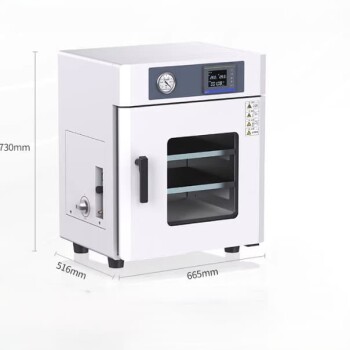
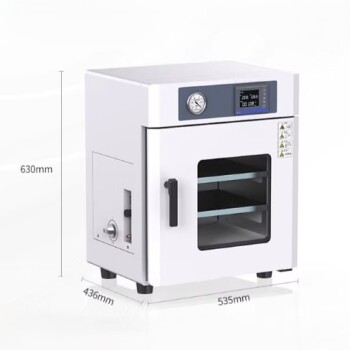
A vacuum drying oven is critically necessary for Aluminum-Tin (Al-Sn) mixed powder slurries to prevent the oxidation of these highly reactive metals while enabling efficient solvent removal. By lowering the pressure, the oven allows liquid media to evaporate rapidly at safe, low temperatures (typically around 50°C), ensuring the raw material remains pure and physically stable.
Core Takeaway The vacuum environment acts as a protective shield and a catalyst for efficiency: it eliminates atmospheric oxygen to preserve the chemical purity of the aluminum and tin, while simultaneously lowering the solvent's boiling point to allow for rapid, low-thermal-stress drying.
Preserving Material Purity via Oxidation Control
The Reactivity of Aluminum and Tin
Aluminum and tin are highly reactive metallic powders. When these materials are exposed to oxygen, particularly in the presence of heat or moisture, they are prone to rapid oxidation.
Isolating the Environment
A vacuum drying oven operates by evacuating the air from the chamber. This creates an oxygen-depleted environment that isolates the Al-Sn powder from the atmosphere.
Preventing Chemical Degradation
Without this isolation, the drying process would introduce oxides into the mixture. This ensures that the high purity of the raw materials is maintained, which is essential for the quality of the final sintered product.
Thermal Management and Solvent Removal
Lowering the Boiling Point
The physical principle driving this process is the relationship between pressure and boiling points. Under vacuum conditions, the boiling point of solvents reduces significantly.
Enabling Low-Temperature Drying
This allows solvents to be removed rapidly at relatively low temperatures, such as 50°C, rather than requiring high heat. High temperatures could otherwise alter the microstructure of the metal powders or induce unwanted thermal reactions.
Efficiency and Speed
Despite the lower temperatures, the evaporation rate is accelerated due to the vacuum. This shortens the overall drying time compared to conventional atmospheric drying, making the process more efficient without sacrificing material quality.
Understanding the Trade-offs
Equipment Complexity and Cost
While necessary for quality, vacuum drying introduces complexity. Unlike simple convection ovens, vacuum systems require pumps, seals, and pressure controllers that demand regular maintenance to ensure a perfect seal.
Process Control Sensitivity
The rate at which the vacuum is applied must be controlled. If pressure drops too suddenly, the solvent may boil violently ("bumping"), potentially splashing the slurry or causing uneven drying crusts rather than a uniform powder.
Making the Right Choice for Your Goal
To maximize the quality of your Al-Sn powder processing, align your drying strategy with your specific objectives:
- If your primary focus is Chemical Purity: Prioritize the integrity of the vacuum seal to ensure near-zero oxygen exposure, preventing the formation of oxide layers that degrade material performance.
- If your primary focus is Process Efficiency: Optimize the temperature setting around 50°C to balance rapid solvent evaporation with thermal safety, preventing heat damage while maximizing throughput.
The vacuum drying oven is not just a drying tool; it is a preservation chamber that guarantees the chemical and physical integrity of your reactive metal powders.
Summary Table:
| Feature | Vacuum Drying Advantage | Impact on Al-Sn Powder |
|---|---|---|
| Environment | Oxygen-depleted atmosphere | Prevents oxidation and maintains chemical purity |
| Temperature | Low-temperature drying (~50°C) | Prevents thermal degradation and microstructural changes |
| Boiling Point | Significantly lowered pressure | Enables rapid evaporation of solvents without high heat |
| Efficiency | Accelerated evaporation rate | Shortens processing time while ensuring material stability |
Elevate Your Powder Processing with KINTEK Precision
Maintaining the chemical integrity of reactive metals like Aluminum and Tin requires specialized thermal equipment. KINTEK offers high-performance vacuum drying solutions designed to prevent oxidation and ensure uniform material stability. Beyond drying, our comprehensive laboratory portfolio includes high-temperature furnaces (muffle, vacuum, and CVD), high-pressure reactors, and precision crushing and milling systems to support every stage of your material research.
Ready to optimize your drying process? Contact us today to discover how KINTEK’s laboratory equipment and consumables can enhance your lab's efficiency and material quality.
Related Products
- 56L Vertical Laboratory Vacuum Drying Oven
- 23L Laboratory Vacuum Drying Oven
- Laboratory Scientific Electric Heating Blast Drying Oven
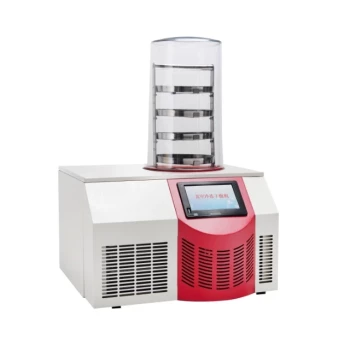
- Benchtop Laboratory Vacuum Freeze Dryer
- Dental Porcelain Zirconia Sintering Ceramic Vacuum Press Furnace
People Also Ask
- Why is a laboratory vacuum drying oven recommended for rice straw residues? Protect Your Biomass Integrity
- What role does a laboratory vacuum drying oven play in the preparation of modified multi-walled carbon nanotubes?
- What is the importance of using a laboratory vacuum drying oven? Preserving Slow-Release Microcapsule Integrity
- Why is a Laboratory Vacuum Drying Oven recommended for PBAT microspheres? Protect Sensitive Polymer Integrity
- What role does a laboratory vacuum drying oven play in processing nanoparticle powder samples? Protect Sample Integrity