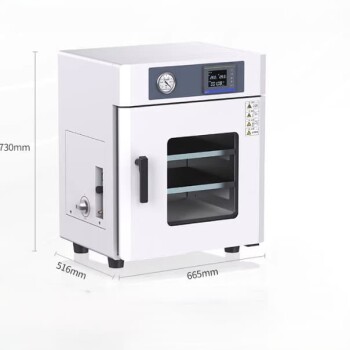
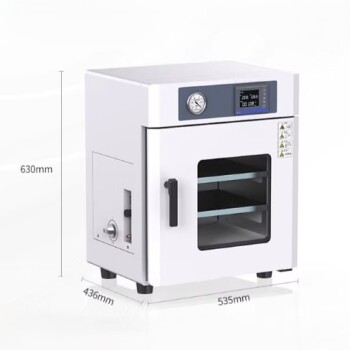
The vacuum drying oven is the critical engine of vacuum impregnation because it removes air from the internal pores of a matrix to create a pressure gradient. This negative pressure environment allows molten or liquid phase change materials (PCMs) to penetrate deep into micropores through capillary action, ensuring maximum loading capacity and preventing material leakage during thermal cycles.
Core Takeaway: A vacuum drying oven is essential to eliminate air blockages within the carrier material and facilitate deep penetration of phase change materials. This process maximizes energy storage density while ensuring the structural and chemical stability of the resulting composite.
Driving Deep Impregnation through Pressure Differentials
The Removal of Trapped Air
Porous carrier materials, such as biomass charcoal or carbon matrices, are naturally filled with air that acts as a physical barrier. A vacuum drying oven evacuates this air, creating a negative pressure environment within the carrier's micropores and mesopores. Without this step, trapped air would resist the entry of the phase change material, leading to incomplete loading and reduced thermal performance.
Capillary Action and Pressure Gradients
Once the air is removed and the liquid phase change material (like polyethylene glycol or octadecane) is introduced, a powerful pressure gradient is formed. The combination of atmospheric pressure differences and capillary forces drives the molten PCM into the finest pores of the matrix. This mechanism ensures that the PCM is thoroughly distributed and physically confined within the carrier.
Maximizing Loading Capacity
The primary goal of vacuum impregnation is to achieve the highest possible loading efficiency. By utilizing a vacuum environment, researchers can fill nearly all available pore volume with the active PCM. This increases the overall latent heat storage capacity of the composite material, making it more effective for thermal energy management.
Ensuring Material Purity and Structural Integrity
Elimination of Volatile Solvents
In many preparation methods, solvents are used to dissolve the PCM or electrolytes. A vacuum drying oven allows for the thorough removal of residual solvents at lower temperatures by reducing their boiling points. This prevents subsequent side reactions, interfacial instability, or gas expansion that could occur during the material's operational lifecycle.
Prevention of Oxidative Degradation
Sensitive materials, such as certain biodegradable polymers (PBAT) or carbon structures, can oxidize or degrade when exposed to oxygen at high temperatures. The vacuum environment provides a protective atmosphere that maintains the physicochemical properties and surface activity of the components. This preservation is vital for ensuring the long-term mechanical stability of the composite.
Removal of Micro-bubbles
During the mixing process, microscopic air bubbles can become trapped within the composite suspension. If not removed by the vacuum oven, these bubbles create voids or surface irregularities in the final solidified material. Eliminating these defects ensures the structural integrity and uniform thermal conductivity of the finished product.
Understanding the Trade-offs and Pitfalls
Risk of Material Volatilization
While the vacuum oven is necessary for removing solvents, it can also cause the undesired volatilization of the phase change material itself if the temperature and vacuum levels are not carefully controlled. Some low-molecular-weight PCMs may evaporate under high vacuum, leading to a decrease in the final loading ratio.
Thermal Stress and Cooling Rates
Rapid heating or cooling cycles within the oven can induce thermal stress in the composite matrix. If the carrier material is brittle, such as certain ceramic or charcoal structures, aggressive temperature changes can lead to micro-cracking. It is essential to balance the speed of the drying process with the structural limitations of the carrier.
How to Apply This to Your Process
Making the Right Choice for Your Goal
- If your primary focus is maximum energy density: Prioritize a high-vacuum environment to ensure every micropore is evacuated before introducing the PCM to maximize loading.
- If your primary focus is material longevity: Focus on the solvent removal stage at controlled temperatures to prevent side reactions and oxidative degradation of the matrix.
- If your primary focus is structural precision: Use the vacuum oven to meticulously degas the suspension, preventing micro-bubbles that lead to surface defects or structural weaknesses.
By precisely controlling the vacuum and thermal conditions, you transform a simple mixture into a high-performance, stable composite capable of efficient thermal energy storage.
Summary Table:
| Process Aspect | Role of the Vacuum Drying Oven | Key Benefit |
|---|---|---|
| Air Removal | Evacuates air from carrier micropores | Eliminates physical barriers to PCM entry |
| Pressure Gradient | Creates a negative pressure environment | Drives deep penetration via capillary action |
| Loading Capacity | Ensures maximum pore occupancy | Increases latent heat storage density |
| Purity & Safety | Removes residual solvents at low temps | Prevents side reactions and gas expansion |
| Oxidation Control | Provides an oxygen-free atmosphere | Protects sensitive polymers and carbon matrices |
Elevate Your Material Research with KINTEK Precision
Precise control over vacuum and thermal environments is critical for achieving maximum loading and structural integrity in composite phase change materials. KINTEK specializes in high-performance laboratory equipment designed to meet the rigorous demands of material science.
From our advanced vacuum drying ovens and high-temperature furnaces (muffle, tube, vacuum, CVD) to high-pressure reactors, autoclaves, and hydraulic presses, we provide the tools necessary for superior impregnation and synthesis. Whether you are developing thermal energy storage solutions or advanced carbon matrices, our team offers the technical expertise and reliable equipment—including PTFE products, ceramics, and cooling solutions—to ensure your project's success.
Ready to optimize your vacuum impregnation process? Contact KINTEK today to discuss your specific application and discover how our comprehensive laboratory solutions can enhance your research outcomes.
References
- Xifeng Lv, Fang Wang. Waste Plastic Polypropylene Activated Jujube Charcoal for Preparing High-Performance Phase Change Energy Storage Materials. DOI: 10.3390/nano13030552
This article is also based on technical information from Kintek Solution Knowledge Base .
Related Products
- 56L Vertical Laboratory Vacuum Drying Oven
- 23L Laboratory Vacuum Drying Oven
- Laboratory Scientific Electric Heating Blast Drying Oven
- Benchtop Laboratory Vacuum Freeze Dryer
- Dental Porcelain Zirconia Sintering Ceramic Vacuum Press Furnace
People Also Ask
- Why is a laboratory vacuum drying oven recommended for rice straw residues? Protect Your Biomass Integrity
- What role does a laboratory vacuum drying oven play in the preparation of modified multi-walled carbon nanotubes?
- What is the importance of using a laboratory vacuum drying oven? Preserving Slow-Release Microcapsule Integrity
- Why is a Laboratory Vacuum Drying Oven recommended for PBAT microspheres? Protect Sensitive Polymer Integrity
- What role does a laboratory vacuum drying oven play in processing nanoparticle powder samples? Protect Sample Integrity