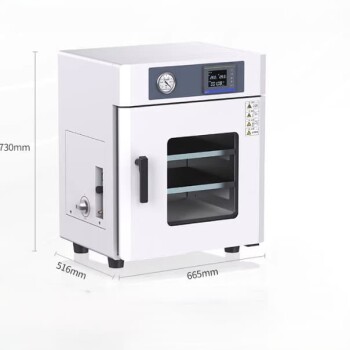
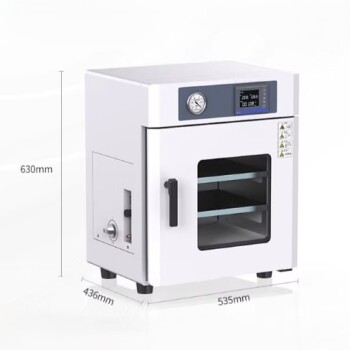
A vacuum drying oven is indispensable for Silicon-Fluorinated Graphene (Si-FG) post-treatment because it enables rapid solvent removal at low temperatures while preserving the material's chemical and physical structure. By lowering the pressure, the oven reduces the boiling point of solvents like ethanol, allowing them to evaporate efficiently at safe temperatures (e.g., 70°C).
Core Takeaway Atmospheric drying poses a high risk of oxidation and clumping for sensitive nanomaterials. Vacuum drying solves this by isolating the material from air and enabling low-temperature evaporation, ensuring the final Si-FG product emerges as a pure, loose powder rather than a hard, oxidized aggregate.
Preserving Chemical Integrity
Thermal Protection via Reduced Pressure
The fundamental advantage of a vacuum oven is its ability to manipulate the boiling point of liquids. By reducing the pressure inside the chamber, solvents such as ethanol can boil and evaporate at significantly lower temperatures. This allows you to dry Si-FG precipitates effectively at mild temperatures (around 70°C), protecting the material from thermal degradation.
Prevention of Oxidation
Si-FG can be sensitive to environmental reactivity during the drying phase. A vacuum environment effectively isolates the precipitates from atmospheric oxygen. This prevents oxidation reactions that would otherwise degrade the quality of the graphene structure during the heating process.
Optimizing Physical Properties
Preventing Hard Agglomerates
One of the most common issues with drying nanomaterials at atmospheric pressure is the formation of hard "cakes" or clumps. These hard agglomerates are difficult to disperse later and compromise the material's utility. Vacuum drying facilitates a gentler evaporation process that leaves the Si-FG as a dry and loose powder.
Efficient Solvent Removal
Post-treatment often involves washing precipitates with solvents like ethanol. Vacuum drying accelerates the evaporation rate of these solvents compared to standard air drying. This ensures the complete removal of liquid residues without requiring excessive time or heat.
Understanding the Trade-offs
Batch Processing vs. Continuous Flow
Vacuum drying is typically a batch process, which requires sealing the chamber and pumping down pressure for each load. This can sometimes create a bottleneck compared to continuous atmospheric drying methods used for less sensitive materials.
Operational Sensitivity
While effective, vacuum drying requires precise control over pressure and temperature ramp rates. If pressure drops too quickly, solvents may "bump" (boil violently), potentially displacing the powder or coating the oven walls. Operators must carefully manage the vacuum levels to ensure smooth evaporation.
Making the Right Choice for Your Goal
To ensure the success of your Si-FG synthesis, consider your specific processing needs:
- If your primary focus is chemical purity: Rely on vacuum drying to eliminate oxygen exposure and prevent surface oxidation of the graphene sheets.
- If your primary focus is processability: Use vacuum drying to prevent particle caking, ensuring the final powder is loose and easy to disperse in subsequent applications.
By utilizing vacuum drying, you guarantee that the intricate properties of Silicon-Fluorinated Graphene are fully preserved for high-performance applications.
Summary Table:
| Feature | Vacuum Drying (Recommended) | Atmospheric Drying (Standard) |
|---|---|---|
| Drying Temperature | Low (approx. 70°C) | High (Varies) |
| Oxidation Risk | Minimal (Isolated from air) | High (Oxygen exposure) |
| Material Texture | Loose, dry powder | Hard, dense agglomerates |
| Solvent Removal | Rapid & efficient via low pressure | Slower; risk of residues |
| Material Integrity | Fully preserved structure | Potential thermal degradation |
Elevate Your Nanomaterial Synthesis with KINTEK Precision
Don't compromise the purity of your Silicon-Fluorinated Graphene with suboptimal drying methods. KINTEK specializes in advanced laboratory solutions designed for high-performance research. From high-precision vacuum drying ovens and high-temperature furnaces to our robust vacuum systems, we provide the tools necessary to ensure your precipitates remain pure, loose, and ready for application.
Whether you are focusing on battery research, graphene synthesis, or advanced material science, our comprehensive portfolio—including PTFE consumables, ceramics, and cooling solutions—is engineered to meet the most demanding lab requirements.
Ready to optimize your post-treatment process? Contact KINTEK today to consult with our experts and find the perfect equipment for your specific laboratory needs.
Related Products
- 56L Vertical Laboratory Vacuum Drying Oven
- 23L Laboratory Vacuum Drying Oven
- Laboratory Scientific Electric Heating Blast Drying Oven
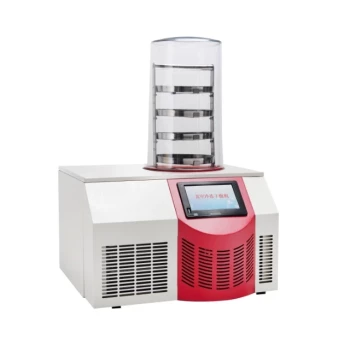
- Benchtop Laboratory Vacuum Freeze Dryer
- Dental Porcelain Zirconia Sintering Ceramic Vacuum Press Furnace
People Also Ask
- Why is a laboratory vacuum drying oven recommended for rice straw residues? Protect Your Biomass Integrity
- What role does a laboratory vacuum drying oven play in the preparation of modified multi-walled carbon nanotubes?
- What is the importance of using a laboratory vacuum drying oven? Preserving Slow-Release Microcapsule Integrity
- Why is a Laboratory Vacuum Drying Oven recommended for PBAT microspheres? Protect Sensitive Polymer Integrity
- What role does a laboratory vacuum drying oven play in processing nanoparticle powder samples? Protect Sample Integrity