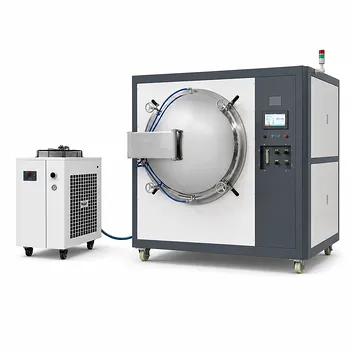
The primary advantage of a vacuum hot pressing furnace is its ability to achieve material densification below the melting point of aluminum. unlike traditional liquid phase infiltration, which requires molten metal, hot pressing operates within the solidus temperature range. This lower processing temperature effectively blocks the formation of aluminum carbide ($Al_4C_3$), a harmful interface reaction that destroys thermal conductivity and causes brittle fractures.
Core Takeaway By substituting high thermal loads with mechanical pressure, vacuum hot pressing solves the "carbide problem" inherent in diamond/aluminum composites. It allows for a chemically stable interface that preserves the intrinsic thermal properties of the diamond, while the vacuum environment ensures a pore-free, oxide-free matrix.
The Chemistry of Thermal Performance
Preventing the Carbide Barrier
The critical flaw in traditional liquid phase infiltration is the requirement for high temperatures to melt the aluminum.
At these elevated temperatures, aluminum reacts aggressively with diamond carbon to form aluminum carbide ($Al_4C_3$). This compound accumulates at the interface between the metal and the diamond. Because aluminum carbide is brittle and has poor thermal properties, it acts as a thermal barrier, significantly degrading the composite's ability to dissipate heat.
Solid-State Densification
Vacuum hot pressing circumvents this issue by utilizing mechanical pressure rather than just heat.
By applying continuous axial pressure (often around 50 MPa), the furnace forces the aluminum matrix to flow and fill voids while it is still in a softened or solid state. This keeps the process temperature low enough to suppress the chemical reaction that creates aluminum carbide, ensuring the diamond-aluminum interface remains chemically stable and thermally conductive.
Optimizing the Interface via Vacuum
Eliminating Oxidation
Aluminum powder is highly susceptible to oxidation, readily forming alumina films that act as thermal insulators.
The high vacuum environment (often reaching $10^{-3}$ Pa or lower) prevents oxygen from contacting the aluminum during heating. This preserves the metallic characteristics of the matrix. Furthermore, the combined heat and pressure help break existing oxide films through plastic deformation, facilitating direct metallic bonding between the matrix and the reinforcement.
Removing Interstitial Impurities
Achieving high density requires more than just compressing powder; trapped gases must be evacuated to prevent porosity.
The vacuum system actively extracts volatile gases and air trapped in the interstices between powder particles before densification occurs. This "degassing" phase is vital for creating cleaner particle contact. It allows for solid-state diffusion bonding, resulting in a composite with high material density and low interfacial thermal resistance.
Understanding the Trade-offs
While vacuum hot pressing offers superior material quality, it introduces specific process limitations compared to liquid infiltration.
Geometric Constraints
Because the process relies on a hydraulic loading system to apply uniaxial pressure, it is generally limited to producing simple shapes like plates or discs. Complex, near-net-shape components that are easily produced via liquid casting are difficult or impossible to manufacture directly in a hot press.
Production Throughput
Vacuum hot pressing is inherently a batch process. The cycle times—which include vacuum pumping, heating, dwell time under pressure, and cooling—are typically longer than liquid phase infiltration methods. This makes the process better suited for high-performance, high-value applications rather than high-volume, low-cost commodity production.
Making the Right Choice for Your Goal
When selecting a manufacturing method for diamond/aluminum composites, prioritize based on your specific thermal and structural requirements.
- If your primary focus is Maximum Thermal Conductivity: Choose vacuum hot pressing to minimize interfacial resistance and completely avoid the formation of thermal-blocking aluminum carbide ($Al_4C_3$).
- If your primary focus is Structural Integrity: Rely on vacuum hot pressing to eliminate internal porosity and oxide films, ensuring the highest possible density and mechanical strength.
The vacuum hot pressing furnace is the definitive tool when the quality of the thermal interface cannot be compromised.
Summary Table:
| Feature | Vacuum Hot Pressing (VHP) | Liquid Phase Infiltration |
|---|---|---|
| Processing Temp | Lower (Solid-state/Softened) | Higher (Molten metal) |
| Carbide Formation ($Al_4C_3$) | Effectively suppressed | High risk (Acts as thermal barrier) |
| Interface Quality | Clean, chemically stable | Prone to brittle reaction layers |
| Densification Method | Mechanical pressure (Axial) | Capillary action / Pressure casting |
| Oxidation Control | High vacuum ($10^{-3}$ Pa) | Variable/Atmospheric risk |
| Final Product Shape | Simple (Plates, Discs) | Complex (Near-net-shape) |
Maximize Your Material Performance with KINTEK
Don't let interfacial reactions compromise your high-thermal conductivity projects. KINTEK specializes in advanced laboratory solutions, offering industry-leading vacuum hot pressing furnaces and hydraulic presses designed for precision solid-state densification.
Our extensive portfolio—from high-temperature furnaces (muffle, vacuum, CVD) to crushing systems and battery research tools—empowers researchers to achieve pore-free, high-density results.
Ready to optimize your diamond/aluminum composite production?
Contact KINTEK experts today to find the perfect equipment for your material science requirements!
Related Products
- Vacuum Hot Press Furnace Heated Vacuum Press Machine Tube Furnace
- 600T Vacuum Induction Hot Press Furnace for Heat Treat and Sintering
- Vacuum Hot Press Furnace Machine Heated Vacuum Press
- Vacuum Hot Press Furnace Machine for Lamination and Heating
- Vacuum Heat Treat and Pressure Sintering Furnace for High Temperature Applications
People Also Ask
- What advantages does a vacuum hot press furnace provide for LSLBO ceramic electrolytes? Achieve 94% Relative Density
- What role does a Vacuum Hot Press (VHP) furnace play in the densification of austenitic stainless steel 316 composites?
- What are the advantages of using a vacuum hot pressing furnace? Superior Densification for 2024Al/Gr/SiC Composites
- What are the advantages of a vacuum hot press furnace for LTPO solid electrolytes? Boost Density and Conductivity
- What core processing conditions does a vacuum hot press furnace provide? Achieve High-Density Cu-SiC/Diamond Composites