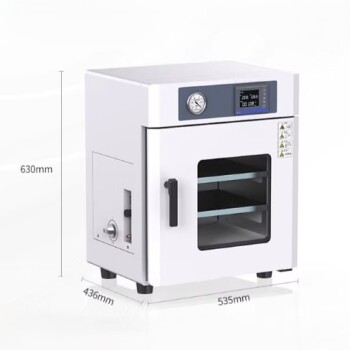
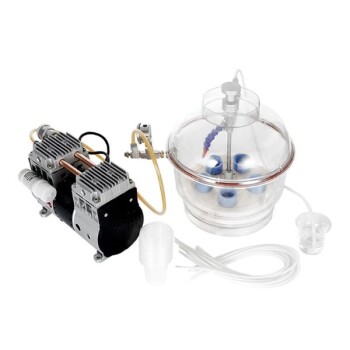
The decisive factor necessitating a vacuum oven for Polybutylene Succinate (PBS) and Baobab Powder (BP) is the extreme moisture sensitivity of the polyester matrix. While standard drying removes surface wetness, only a vacuum environment can effectively extract physically adsorbed and chemically bound water without thermally degrading the materials. This step is mandatory to prevent hydrolytic degradation during the subsequent high-temperature melt processing.
Core Takeaway: The structural integrity of a PBS/BP composite is determined before the mixing even begins. Vacuum drying is the only reliable method to eliminate deep-seated moisture that would otherwise trigger a chemical breakdown (hydrolysis) during processing, ensuring the preservation of molecular weight and mechanical strength.
The Chemistry of Stability
The Vulnerability of Polyesters
PBS is a polyester, a class of materials chemically prone to hydrolysis.
When polyesters are exposed to high temperatures in the presence of water, the polymer chains break down.
This reaction scissions the long molecular chains, drastically reducing the molecular weight of the material.
The Role of Deep Dehydration
Standard thermal drying often fails to remove moisture trapped deep within the porous structure of Baobab Powder or bound chemically to the PBS.
A vacuum oven lowers the boiling point of water by reducing atmospheric pressure.
This allows for the extraction of stubborn, bound moisture at temperatures that are safe for these temperature-sensitive bio-materials.
protecting Material Properties
Preserving Molecular Weight
The primary victim of residual moisture is the molecular weight of the PBS.
If water is present during melt processing, the resulting composite will have shorter polymer chains.
Short chains result in a brittle material that lacks the expected durability and viscosity.
Ensuring Mechanical Performance
The mechanical properties of the final composite—such as tensile strength and impact resistance—rely on the integrity of the polymer matrix.
By preventing hydrolytic degradation, vacuum drying ensures the PBS retains its ability to transfer stress effectively.
This creates a composite where the Baobab Powder reinforces the matrix rather than acting as a defect site.
Maintaining Thermal Stability
Hydrolysis does not just weaken the material mechanically; it compromises its thermal resistance.
A pre-degraded polymer will break down faster when exposed to heat in the future.
Vacuum pre-treatment safeguards the long-term thermal stability of the resulting PBS/BP composite.
Understanding the Trade-offs
The Risk of Over-Drying vs. Degradation
While removing water is critical, the parameters of the vacuum oven must be precise.
Setting temperatures too high, even under vacuum, can induce thermal degradation before processing begins.
You must balance the vacuum level and temperature to dry the material thoroughly without "baking" the organic components of the Baobab Powder.
Re-absorption Windows
Vacuum dried materials are often hygroscopic—they act like sponges for moisture once removed from the oven.
The benefit of the vacuum oven is lost if the material is exposed to humid air for too long between drying and processing.
Transfer times must be minimized to maintain the "dry state" achieved during pre-treatment.
Making the Right Choice for Your Goal
To maximize the quality of your PBS/BP composite, align your drying strategy with your performance metrics:
- If your primary focus is Maximum Tensile Strength: Prioritize longer drying times at moderate vacuum levels to ensure zero residual moisture remains to severe polymer chains.
- If your primary focus is Process Efficiency: Utilize higher vacuum levels (lower pressure) to accelerate the evaporation rate of bound water without raising the temperature.
Ultimately, the vacuum oven is not just a drying tool; it is a chemical preservation chamber that safeguards the molecular backbone of your composite.
Summary Table:
| Feature | Impact of Vacuum Drying on PBS/BP | Benefit to Final Composite |
|---|---|---|
| Moisture Removal | Extracts deep-seated and chemically bound water | Prevents hydrolytic chain scission |
| Processing Temp | Allows lower boiling point for water extraction | Protects bio-materials from thermal degradation |
| Molecular Weight | Prevents polymer chain shortening | Ensures high viscosity and material durability |
| Mechanicals | Maintains matrix structural integrity | Optimizes tensile strength and impact resistance |
| Thermal Stability | Reduces pre-processing chemical breakdown | Extends the lifespan and heat resistance of the product |
Secure the Integrity of Your Bio-Materials with KINTEK
Don't let residual moisture compromise your research. KINTEK specializes in high-performance laboratory solutions, providing the precision vacuum ovens and crushing systems necessary to process sensitive materials like PBS and Baobab Powder without degradation. Our comprehensive portfolio—ranging from advanced high-temperature furnaces and vacuum systems to hydraulic presses and essential ceramic consumables—is designed to ensure your composites meet the highest standards of mechanical and thermal performance.
Ready to elevate your material science outcomes? Contact our technical experts today to find the perfect equipment configuration for your laboratory's unique requirements.
References
- Musa Abubakar Tadda, Dezhao Liu. Impacts of Baobab (Adansonia digitata) Powder on the Poly(Butylene Succinate) Polymer Degradability to Form an Eco-Friendly Filler-Based Composite. DOI: 10.3389/fmats.2021.768960
This article is also based on technical information from Kintek Solution Knowledge Base .
Related Products
- 56L Vertical Laboratory Vacuum Drying Oven
- 23L Laboratory Vacuum Drying Oven
- Vacuum Heat Treat Sintering Brazing Furnace
- 2200 ℃ Graphite Vacuum Heat Treat Furnace
- Dental Porcelain Zirconia Sintering Ceramic Vacuum Press Furnace
People Also Ask
- Why is a laboratory vacuum drying oven recommended for rice straw residues? Protect Your Biomass Integrity
- What role does a laboratory vacuum drying oven play in the preparation of modified multi-walled carbon nanotubes?
- What is the importance of using a laboratory vacuum drying oven? Preserving Slow-Release Microcapsule Integrity
- Why is a Laboratory Vacuum Drying Oven recommended for PBAT microspheres? Protect Sensitive Polymer Integrity
- What role does a laboratory vacuum drying oven play in processing nanoparticle powder samples? Protect Sample Integrity