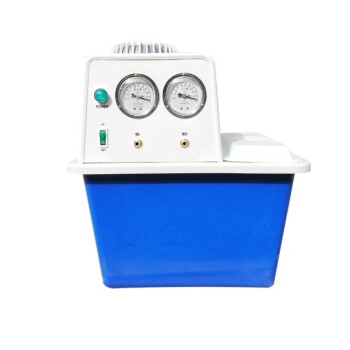
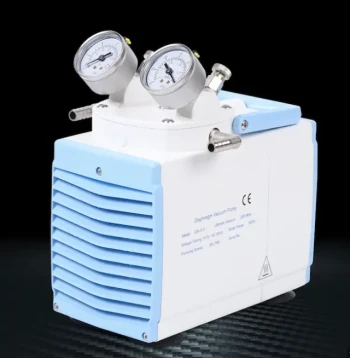
Processing finely dispersed tungstic acid requires significantly more force than gravity alone can supply. Because the particle sizes in this slurry are extremely small, natural settling is inefficient and leads to production bottlenecks. A vacuum pump and Buchner funnel system is necessary to create negative pressure, which forces the liquid through the filter, drastically accelerating separation and ensuring the removal of impurities.
Core Takeaway Finely dispersed slurries create a dense barrier that blocks standard gravity filtration. You must use a vacuum system to overcome this resistance, reducing production time and enabling the deep cleaning necessary to remove salts like sodium chloride.
The Challenge of Fine Particle Physics
The primary reason for employing a vacuum system lies in the physical properties of the tungstic acid slurry itself.
Extremely Small Particle Size
Finely dispersed tungstic acid consists of extremely small particles. In a standard filtration setup, these particles pack closely together.
The Barrier to Gravity
This tight packing creates a dense filter cake that resists liquid flow. Conventional gravity filtration becomes inefficient because the gravitational force is not strong enough to push the liquid through these microscopic gaps effectively.
Slow Settling Speeds
Due to their size, these particles have very slow settling and thickening speeds. Relying on natural sedimentation would make the production cycle unacceptably long.
The Mechanical Advantage of Vacuum Filtration
To overcome the limitations of gravity, you must introduce an external force.
Creating Negative Pressure
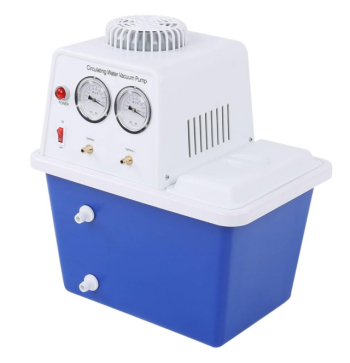
A vacuum pump attached to a Buchner funnel creates a pressure differential (negative pressure) beneath the filter medium.
Accelerating Separation
This pressure differential acts as a powerful suction force. It significantly accelerates the solid-liquid separation speed, pulling the liquid through the dense tungstic acid layer far faster than gravity could.
Shortening Production Cycles
By rapidly dewatering the slurry, the system drastically reduces the time required for filtration. This leads to shortened production cycles and higher overall throughput.
Optimizing Purity Through Washing
Beyond speed, the vacuum system is critical for achieving the required chemical purity of the final product.
Forced Convection Washing
The negative pressure allows for forced convection during the washing phase. Wash water is pulled forcefully through the filter cake rather than just sitting on top of it.
Removing Residual Impurities
This active flow effectively flushes out contaminants trapped between particles. It is particularly effective at removing residual impurities like sodium chloride from the tungstic acid, ensuring a cleaner final product.
Common Pitfalls: The Cost of Passive Filtration
While vacuum systems add mechanical complexity, attempting to process this specific slurry without one results in significant operational failures.
The Efficiency Trap
Attempting to use gravity filtration for fine tungstic acid is a common error. It results in a process that stalls, as the fine particles effectively seal the filter paper, halting liquid flow almost entirely.
Compromised Purity
Without the suction force of a vacuum, washing is superficial. Impurities like sodium chloride remain trapped deep within the filter cake, leading to a product that fails to meet purity specifications.
Making the Right Choice for Your Process
If you are designing a filtration protocol for tungstic acid, prioritize your equipment based on your specific output goals.
- If your primary focus is Production Speed: Implement a high-capacity vacuum pump to overcome the slow settling speed of fine particles and minimize cycle times.
- If your primary focus is Chemical Purity: Utilize the Buchner funnel system to enable forced convection washing, ensuring the complete removal of sodium chloride contaminants.
The vacuum pump and Buchner funnel are not optional upgrades; they are essential tools for overcoming the physical resistance of fine particles to achieve a viable production timeline.
Summary Table:
| Challenge | Gravity Filtration | Vacuum/Buchner System |
|---|---|---|
| Filtration Speed | Extremely slow; particles block flow | Fast; negative pressure pulls liquid |
| Particle Handling | Ineffective for fine dispersions | Ideal for micro-sized particles |
| Purity Level | High residual salt (NaCl) content | Deep cleaning via forced convection |
| Production Cycle | Frequent bottlenecks/stalling | Shortened cycles & higher throughput |
| Efficiency | Passive and inefficient | Active and highly controlled |
Elevate Your Laboratory Efficiency with KINTEK
Don't let production bottlenecks slow your research. KINTEK specializes in high-performance laboratory equipment designed to handle the most challenging separations. From robust vacuum pumps and Buchner systems to our advanced crushing and milling systems, high-temperature furnaces, and hydraulic presses, we provide the tools needed for precision material processing.
Whether you are refining tungstic acid or conducting complex battery research, our comprehensive range of PTFE products, ceramics, and crucibles ensures your results are never compromised.
Ready to optimize your workflow? Contact us today to discover how KINTEK's premium lab solutions can bring unparalleled speed and purity to your process.
References
- E. A. Mazulevsky, N. M. Seidakhmetova. Production of fine-dispersed tungstic acid. DOI: 10.17580/nfm.2022.02.06
This article is also based on technical information from Kintek Solution Knowledge Base .
Related Products
- Vacuum Induction Melting Spinning System Arc Melting Furnace
- Circulating Water Vacuum Pump for Laboratory and Industrial Use
- 304 316 Stainless Steel Vacuum Ball Valve Stop Valve for High Vacuum Systems
- Custom PTFE Teflon Parts Manufacturer for PTFE Buchner Funnel and Triangular Funnel
- Vacuum Cold Mounting Machine for Sample Preparation
People Also Ask
- What are the advantages of a vacuum induction melting furnace? Achieve High-Purity Alloys with Precision VIM
- Why use VIM for rare earth steel? Essential Precision for Melting Reactive Lanthanum and Cerium
- What is the primary function of a vacuum induction melting furnace in Ni-Mo-Cr-Fe master alloy prep? Ensure High Purity
- What is the function of a vacuum induction melting furnace? Essential Guide for High-Purity FeCrAl Alloy Production
- What types of metals are typically processed in a vacuum induction melting furnace? High-Purity Alloys for Critical Applications