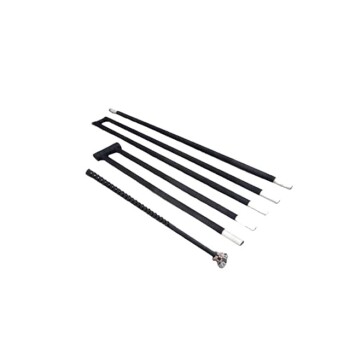
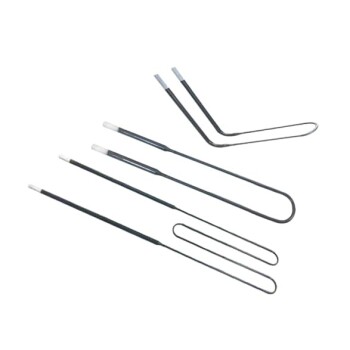
High-temperature stability and precise thermal management are the primary reasons for selecting this specific furnace configuration. Synthesis of boride materials requires temperatures exceeding 1500°C, which Silicon Carbide (SiC) elements provide reliably, while the vertical tube orientation creates the necessary thermal gradients to control crystal growth and ensure structural integrity.
Core Insight: The synthesis of borides is not just about reaching a high temperature; it is about controlling that heat. The vertical tube furnace with SiC elements creates a synergy where extreme thermal capability meets the directional heat distribution required for high-quality crystalline structures.
Solving the Heat Challenge: Why SiC Elements?
Reaching Extreme Melting Points
Boride materials are characterized by exceptionally high melting points. Standard metal heating elements often fail or degrade at the temperatures required for synthesis.
Silicon Carbide (SiC) resistance heating elements are specifically engineered to possess high-temperature strength. They maintain stability and structural integrity even when operating effectively above 1500°C, making them one of the few viable options for this material class.
Precision and Power Density
Achieving the melting point is not enough; the temperature must be stable. SiC elements offer high thermal conductivity and high power radiation.
This capability allows for rapid heat-up times and, more importantly, precise temperature control. This ensures the synthesis environment remains constant, preventing fluctuations that could introduce defects into the boride material.
Operational Cleanliness
Unlike gas-fired alternatives, SiC elements eliminate flue gases. This results in a cleaner process environment, which is critical when synthesizing high-purity materials where contamination must be minimized.
The Geometry Factor: Why a Vertical Tube?
Mastering the Thermal Gradient
The physical orientation of the furnace is dictated by the physics of crystal growth.
A vertical configuration allows for the establishment of a specific thermal gradient. As the material is processed, this gradient allows for directional solidification, which is essential for growing large, high-quality crystals.
Convection and Stability
Vertical alignment often aids in natural convection and heat distribution profiles that favor cylindrical growth vessels (ampoules).
This setup ensures that the heat is applied uniformly around the circumference of the sample while maintaining the necessary vertical temperature difference.
Reliability and Efficiency Factors
Long-Term Durability
Industrial and research applications require equipment that lasts. The primary reference notes that SiC elements ensure long-term reliability even under high thermal stress.
This durability translates to a longer lifespan for the furnace refractories and reduced downtime for maintenance.
Cost and Safety Implications
Beyond technical performance, this configuration offers economic benefits. The use of SiC elements often leads to cost savings due to their efficiency and longevity.
Furthermore, because they eliminate the need for combustible fuels, they offer a safer working environment with fewer ventilation complexities compared to gas furnaces.
Understanding the Trade-offs
The "Aging" Effect
While SiC elements are robust, they are subject to a phenomenon known as aging. Over time, the electrical resistance of the element increases.
This means your power supply must be capable of providing variable voltage to maintain the same power output as the elements age.
Brittleness
SiC is a ceramic material. While it has immense high-temperature strength, it is mechanically brittle.
Care must be taken during loading and unloading of the vertical tube to avoid physical impact that could fracture the heating elements.
Making the Right Choice for Your Goal
To determine if this setup aligns with your specific synthesis requirements, consider your primary objectives:
- If your primary focus is Crystal Quality: The vertical configuration is non-negotiable, as it provides the thermal gradient necessary to minimize defects during solidification.
- If your primary focus is Temperature Stability: The SiC elements are essential to holding the steady >1500°C environment required to process refractory borides without element degradation.
This furnace configuration represents the industry standard for boride synthesis because it effectively balances the physics of crystal growth with the engineering limits of high-temperature heaters.
Summary Table:
| Feature | Benefit for Boride Synthesis |
|---|---|
| SiC Heating Elements | High-temperature stability (1500°C+), high power density, and rapid heating. |
| Vertical Configuration | Enables precise thermal gradients for directional solidification and crystal growth. |
| Precision Control | Minimizes defects in crystalline structures via stable heat distribution. |
| Process Purity | Eliminates flue gases and combustion byproducts for high-purity material output. |
| Durability | Long-term reliability under high thermal stress compared to metal heaters. |
Elevate Your Advanced Material Synthesis with KINTEK
Precision and reliability are non-negotiable when synthesizing high-melting-point materials like borides. At KINTEK, we specialize in high-performance laboratory equipment designed to meet the most rigorous research demands. Our comprehensive range of vertical and horizontal tube furnaces, vacuum systems, and CVD/PECVD equipment is engineered for superior thermal management up to 1500°C and beyond.
Whether you require SiC or MoSi2 heating elements, specialized crushing and milling systems, or high-purity ceramics and crucibles, KINTEK provides the tools necessary to ensure crystal integrity and process efficiency. Partner with us to access cutting-edge solutions tailored for battery research, metallurgical synthesis, and advanced thermal processing.
Ready to optimize your lab's thermal capabilities? Contact our technical experts today to find the perfect furnace configuration for your application.
References
- Takeo Oku. Direct structure analysis of advanced nanomaterials by high-resolution electron microscopy. DOI: 10.1515/ntrev-2012-0018
This article is also based on technical information from Kintek Solution Knowledge Base .
Related Products
- Silicon Carbide SiC Thermal Heating Elements for Electric Furnace
- Vertical Laboratory Tube Furnace
- Molybdenum Disilicide (MoSi2) Thermal Elements Electric Furnace Heating Element
- Rotary Tube Furnace Split Multi Heating Zone Rotating Tube Furnace
- 1700℃ Controlled Atmosphere Furnace Nitrogen Inert Atmosphere Furnace
People Also Ask
- What is the function of the heating element in a furnace? The Engine of Your Thermal Process
- What is the best heating element for a furnace? A Guide to Selecting the Right Material for Your Temperature Needs
- What is SiC elements? The Ultimate High-Temperature Heating Solution
- How long does a heating element last on the furnace? Understand Lifespan & Safety for Your System
- What are silicon carbide heating elements used for? Reliable High-Temp Heating for Industrial Processes