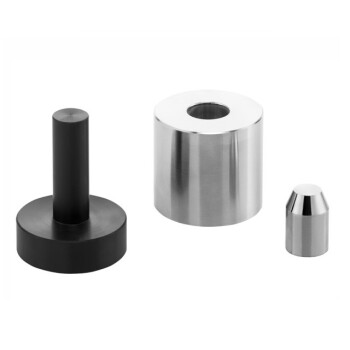
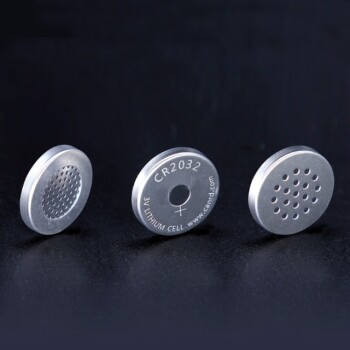
An adjustable pressure battery fixture with pressure monitoring serves as a critical process control tool for managing the solid-solid interfaces within a battery cell. It enables the application of high instantaneous pressure to bond components during assembly, followed by a precise reduction to lower pressures for safe, long-term operation.
The core purpose of this fixture is to reconcile two conflicting requirements: the massive force needed to eliminate initial gaps and the moderate force required to prevent short circuits during actual battery cycling.
The Engineering Challenge: Contact vs. Integrity
Eliminating Interfacial Gaps
In all-solid-state batteries, the electrolyte is a solid material, meaning it cannot "wet" the electrode surface like a liquid electrolyte would.
To ensure ions can move between layers, you must force the solid components together to remove microscopic gaps.
This requires high instantaneous pressure (e.g., 25 MPa) during the early assembly stage to physically fuse the lithium metal and electrolyte interfaces.
Preventing Lithium Creep
While high pressure creates excellent contact, maintaining that same intensity during operation is dangerous.
Under excessive, continuous pressure, lithium metal is prone to "creep," a deformation process where the metal squeezes through pores in the electrolyte.
This creep can lead to internal short circuits, destroying the battery.
The Role of Dynamic Pressure Control
Two-Stage Pressure Application
The adjustable fixture allows engineers to execute a specific pressure profile that static clamps cannot match.
It facilitates the initial high-pressure step (25 MPa) to establish the interface, and then allows for a controlled reduction to a safe operating level (e.g., 5 MPa).
Maintaining Interface Stability
Once lowered to the operating level, the fixture maintains a constant stack pressure (typically 1.5 MPa to 10 MPa) during cycling.
This ensures that the electrode-electrolyte interface remains intact without being crushed.
Compensating for Volume Changes
During charging and discharging (deposition and stripping), lithium metal changes volume.
An adjustable fixture with monitoring capabilities compensates for these physical shifts, ensuring steady physical contact and reducing interfacial resistance throughout the battery's life.
Understanding the Trade-offs
Mechanical Complexity
Adjustable fixtures are significantly more complex and expensive than static pressure molds or simple clamps. They require sensors and mechanical actuators to adjust force dynamically.
The "Goldilocks" Zone
There is a narrow margin for error when selecting pressure set-points.
Too little pressure results in high interfacial resistance and poor performance due to loss of contact.
Too much pressure accelerates lithium dendrite penetration and short circuits. The monitoring functionality is essential to staying within this safe operating window.
Making the Right Choice for Your Goal
To maximize the utility of adjustable pressure fixtures, align your pressure strategy with your specific development phase:
- If your primary focus is Assembly and Fabrication: Prioritize the high-pressure capability (approx. 25 MPa) to ensure zero-gap contact between the lithium metal and the solid electrolyte.
- If your primary focus is Cycle Life and Safety: Prioritize the monitoring and lower-pressure maintenance (approx. 5 MPa) to prevent lithium creep and accommodate volume expansion.
Precision pressure control is the key to transforming a stack of solid materials into a high-performance energy storage device.
Summary Table:
| Feature | Assembly Stage (High Pressure) | Operating Stage (Low Pressure) | Benefit |
|---|---|---|---|
| Pressure Level | ~25 MPa | 1.5 - 10 MPa | Balance of contact vs. safety |
| Core Function | Eliminates interfacial gaps | Prevents lithium creep | Ensures ion mobility & prevents shorts |
| Monitoring | Ensures uniform bonding | Tracks volume expansion | Real-time adjustment for cycle stability |
| Result | Optimized solid-solid contact | Enhanced safety & cycle life | High-performance energy storage |
Elevate Your Battery Research with Precision Pressure Solutions
Unlock the full potential of your all-solid-state battery development with KINTEK’s specialized laboratory equipment. Our high-precision adjustable pressure battery fixtures and hydraulic presses are designed to meet the rigorous demands of solid-state interface engineering, ensuring you hit the 'Goldilocks' zone for every cell.
From high-temperature furnaces and crushing systems to advanced battery research tools and consumables, KINTEK provides the comprehensive infrastructure needed for cutting-edge energy storage innovation. Don't let interfacial resistance or lithium creep stall your progress.
Ready to optimize your battery assembly process? Contact KINTEK today to discover how our customized solutions can enhance your lab's efficiency and results!
Related Products
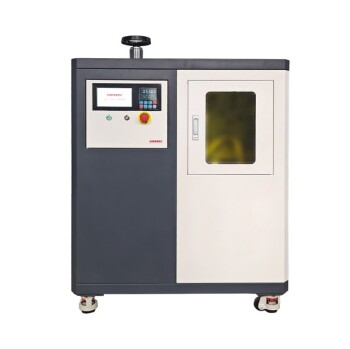
- Warm Isostatic Press for Solid State Battery Research
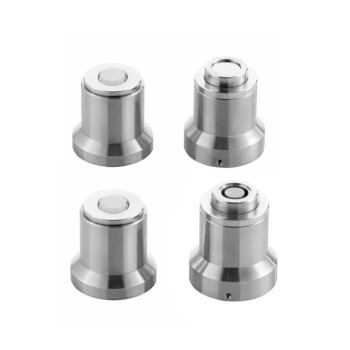
- Button Battery Disassembly and Sealing Mold for Lab Use
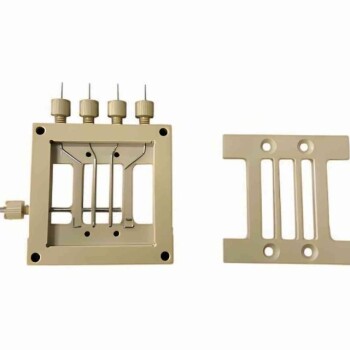
- Custom Ion Conductivity Test Fixtures for Fuel Cell Research
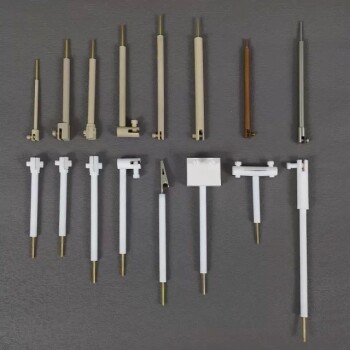
- Electrode Fixture for Electrochemical Experiments
- Button Battery Tablet Press Sealing Mold for Lab Use
People Also Ask
- What is the temperature of a warm isostatic press? Achieve Optimal Densification for Your Materials
- What is the function of a Warm Isostatic Press (WIP) in all-solid-state pouch cells? Optimize Battery Density
- Why are Warm Isostatic Presses (WIP) necessary for solid-state batteries? Achieve Atomic-Level Contact
- What advantages does a warm isostatic press offer over a traditional uniaxial press for Li6PS5Cl electrolyte sheets?
- How do warm isostatic presses improve dry electrode performance? Enhance ASSB Conductivity with Heat & Pressure