Physical separation is the defining requirement. An H-type reactor equipped with a proton exchange membrane is necessary because it isolates the reduction environment from the oxidation environment. This setup allows the essential transport of protons to the cathode while strictly prohibiting the synthesized ammonia from diffusing back to the anode, where it would be destroyed.
The membrane functions as a selective filter that enables the nitrogen fixation reaction to proceed by supplying protons, while simultaneously acting as a shield that prevents product re-oxidation and ensures data accuracy.
The Mechanics of Selective Transport
Facilitating the Reaction
The core challenge in ammonia synthesis is fueling the reaction at the cathode. The anode generates protons ($H^+$) through water oxidation.
These protons are the necessary feedstock for nitrogen fixation. The proton exchange membrane allows these ions to migrate freely from the anode chamber to the cathode chamber, completing the circuit and enabling synthesis.
Blocking Product Diffusion
While protons must move forward, the product must stay put. Ammonia produced at the cathode has a natural tendency to diffuse throughout the solution.
The H-type reactor’s membrane acts as a physical barrier against this diffusion. It confines the ammonia to the cathode compartment, allowing it to accumulate effectively for measurement and collection.
Preventing Chemical Interference
The Danger of Re-oxidation
The anode in an electrochemical cell creates a highly oxidative environment. If ammonia were to diffuse back into this chamber, it would be chemically unstable.
Without the barrier, the ammonia would undergo re-oxidation, reverting to nitrogen or other oxidized nitrogen species. This process effectively destroys the product you are trying to create.
Maintaining Faradaic Efficiency
Faradaic efficiency measures how effectively electrical current is converted into chemical product. It is the gold standard for evaluating catalyst performance.
If the product is destroyed by the anode, your yield measurements will be artificially low. The H-type reactor prevents this loss, ensuring that the calculated efficiency reflects the true performance of the catalyst, not the flaws of the reactor design.
Common Pitfalls to Avoid
The Single-Chamber Misstep
A common experimental error is attempting ammonia synthesis in a single-compartment cell without a membrane.
In this configuration, the anode and cathode share the same electrolyte. The product immediately encounters the oxidative anode surface, leading to rapid degradation and unreliable results.
False Negatives in Catalyst Research
When re-oxidation occurs due to a lack of separation, researchers often mistakenly attribute low yields to a poor catalyst.
The H-type configuration eliminates this variable. It ensures that a lack of product is due to catalytic inactivity, rather than the reactor actively destroying the synthesized ammonia.
Making the Right Choice for Your Experiment
To ensure your data holds up to scrutiny, you must prioritize reactor geometry based on your analytical goals.
- If your primary focus is Accurate Yield Quantification: The membrane is non-negotiable to prevent the re-oxidation of ammonia at the counter electrode.
- If your primary focus is Calculating Faradaic Efficiency: You must use an H-type reactor to ensure that the current measured corresponds to the accumulated product, not a cyclic generation-degradation loop.
The H-type reactor is not merely a container; it is an active component of the experimental control that preserves the integrity of your results.
Summary Table:
| Feature | Single-Chamber Reactor | H-Type Reactor with PEM |
|---|---|---|
| Physical Separation | None (Cathode/Anode share electrolyte) | Complete (Physical barrier between chambers) |
| Ammonia Stability | Low (Re-oxidized at the anode) | High (Confined to cathode chamber) |
| Proton Transport | Unrestricted | Selective (Via exchange membrane) |
| Data Integrity | Poor (False negatives/low yield) | High (Reflects true catalyst performance) |
| Faradaic Efficiency | Artificially Low | Accurately Measured |
Elevate Your Electrochemical Research with KINTEK Precision
Don't let flawed reactor design compromise your nitrogen fixation breakthroughs. KINTEK specializes in high-performance laboratory solutions, providing the critical tools researchers need for accurate data and reliable scale-up.
From specialized H-type electrolytic cells and high-purity electrodes to advanced high-temperature high-pressure reactors and autoclaves, we offer a comprehensive portfolio designed for the rigors of modern battery and chemical research. Our range also includes crushing systems, vacuum furnaces, and precision cooling solutions like ULT freezers to support every stage of your workflow.
Ready to optimize your ammonia synthesis experiments? Contact KINTEK today to discover how our expert-engineered equipment can enhance your lab's efficiency and ensure the integrity of your results.
References
- Prita Amelia, Jarnuzi Gunlazuardi. Development of BiOBr/TiO2 nanotubes electrode for conversion of nitrogen to ammonia in a tandem photoelectrochemical cell under visible light. DOI: 10.14710/ijred.2023.51314
This article is also based on technical information from Kintek Solution Knowledge Base .
Related Products
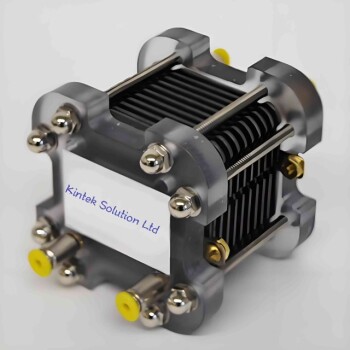
- Customizable PEM Electrolysis Cells for Diverse Research Applications
- FS Electrochemical Hydrogen Fuel Cells for Diverse Applications
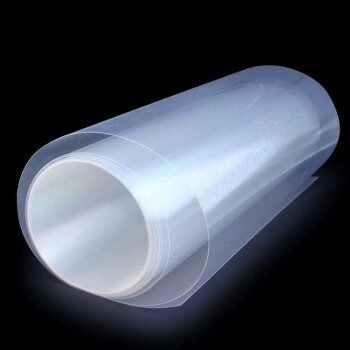
- Proton Exchange Membrane for Batteries Lab Applications
- Customizable Laboratory High Temperature High Pressure Reactors for Diverse Scientific Applications
- Customizable High Pressure Reactors for Advanced Scientific and Industrial Applications
People Also Ask
- What are the risks of improper voltage control in an electrolysis cell? Avoid Costly Damage and Inefficiency
- What are the opening configurations for the non-sealed and sealed versions of the electrolysis cell? Optimize Your Electrochemical Setup
- What is an electrolysis cell? A Guide to Driving Chemical Reactions with Electricity
- What parameters must be strictly controlled during the electrolysis process? Ensure Precision and Efficiency
- What are the precautions for heating or sterilizing an electrolysis cell? Avoid Damaging Sensitive Components