Knowledge Why is grinding equipment used for sulfur-carbon solid-state battery cathodes? Achieve Peak Conductivity
Author avatar

Tech Team · Kintek Solution

Updated 1 day ago

Why is grinding equipment used for sulfur-carbon solid-state battery cathodes? Achieve Peak Conductivity


Grinding equipment is technically necessary to process sulfur and carbon composite materials because sulfur is inherently an electrical and ionic insulator.

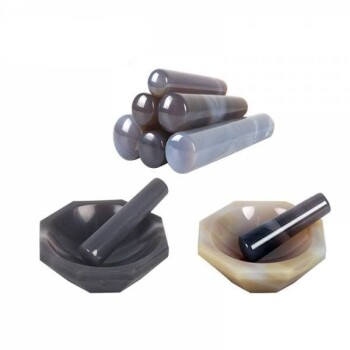
To make the battery function, mechanical grinding—specifically using tools like planetary mills with agate jars—is required to physically force sulfur into intimate contact with conductive carbon and solid electrolyte powders. This "long-duration" mechanical mixing creates the conductive pathways required for electrons and ions to flow, enabling the battery to store and release energy.

Core Takeaway Simple mixing is insufficient for sulfur cathodes because the active material cannot conduct electricity on its own. Grinding applies the necessary mechanical shear force to construct a "three-phase interface," integrating sulfur, carbon, and electrolyte into a unified, conductive network.

Overcoming the Conductivity Barrier

The Insulating Nature of Sulfur

Sulfur offers high theoretical capacity, but it presents a fundamental material challenge: it is an electrical and ionic insulator.

Without modification, sulfur cannot facilitate the electron or ion flow necessary for electrochemical reactions.

To utilize sulfur in a solid-state battery, it must be physically bonded to materials that can conduct these charges.

Constructing the Three-Phase Interface

The primary role of grinding is to create a uniform three-phase interface.

This involves blending three distinct components: the active sulfur, an electronic conductor (typically Ketjen black carbon), and a solid-state electrolyte (the ionic conductor).

Grinding ensures these three materials touch at a microscopic level, maximizing the active area available for the battery reaction.

The Mechanics of the Process

Utilizing Mechanical Shear Force

Standard stirring is often not aggressive enough to achieve the required contact.

Secondary ball milling is employed to generate mechanical shear forces.

These forces refine the mixture, breaking down components to ensure they are intimately mixed rather than just loosely associated.

Establishing Transport Channels

The ultimate goal of this physical refinement is densification.

Long-duration mixing forms a dense, integrated contact network.

This network acts as a highway system, establishing efficient transport channels that allow for rapid transmission of ions and electrons during battery operation.

Critical Processing Challenges

The Risk of Agglomeration

While grinding creates the necessary network, the processing of these powders must be handled carefully to maintain uniformity.

During drying stages, large-scale agglomerates (clumps) can form, which disrupt the homogeneity of the material.

While grinding addresses the mixing, supplementary processes like sieving are often required before extrusion to eliminate these large clumps and ensure a uniform particle size distribution.

The Necessity of Infiltration

For certain cathode structures, mere surface contact is insufficient.

In complex frameworks, active materials must penetrate deep into the structure.

Refined particle sizes achieved through ball milling are critical for maximizing the loading of active materials, ensuring the powder creates a high-contact area throughout the entire electrode, not just on the surface.

Making the Right Choice for Your Goal

To optimize your solid-state sulfur cathode manufacturing, align your processing steps with your specific performance targets:

  • If your primary focus is High Sulfur Utilization: Prioritize mechanical shear forces during milling to ensure every particle of insulating sulfur is fully surrounded by conductive carbon.
  • If your primary focus is High Rate Capability: Focus on the density of the contact network to establish the most efficient transport channels for rapid ion and electron movement.

Summary: The performance of a solid-state sulfur battery is directly defined by the quality of the mechanical intermixing achieved during the grinding process.

Summary Table:

Component Type Material Role Processing Goal via Grinding
Active Material Sulfur (Insulator) Achieve microscopic contact with conductors
Electronic Conductor Ketjen Black Carbon Create electron transport pathways
Ionic Conductor Solid Electrolyte Establish ion transport channels
Equipment Used Planetary Ball Mills Apply shear force for 3-phase interface

Elevate Your Battery Research with KINTEK Precision

To unlock the full potential of solid-state sulfur cathodes, high-performance material processing is non-negotiable. KINTEK specializes in advanced laboratory equipment designed to help researchers overcome conductivity barriers and achieve superior sulfur utilization.

Our comprehensive range of crushing and milling systems, including high-energy planetary ball mills and agate jars, ensures the precise mechanical shear force needed to construct an ideal three-phase interface. Beyond grinding, we offer the full ecosystem for battery development:

  • Sieving Equipment & Hydraulic Presses: For pelletizing and ensuring uniform particle distribution.
  • High-Temperature Furnaces & Vacuum Systems: For specialized material synthesis and drying.
  • Battery Research Tools: Including coin cell testers, electrolytes, and essential consumables like ceramics and crucibles.

Ready to optimize your transport channels and maximize active material loading? Contact KINTEK today for expert solutions tailored to your laboratory's needs.

Related Products

People Also Ask

Related Products

Laboratory Grinding Mill Mortar Grinder for Sample Preparation

Laboratory Grinding Mill Mortar Grinder for Sample Preparation

KT-MG200 mortar grinder can be used for mixing and homogenizing powder, suspension, paste and even viscous samples. It can help users realize the ideal operation of sample preparation with more regularization and higher repeatability.

Laboratory High Throughput Tissue Grinding Mill Grinder

Laboratory High Throughput Tissue Grinding Mill Grinder

KT-MT is a high-quality, small, and versatile tissue grinder used for crushing, grinding, mixing, and cell wall breaking in various fields, including food, medical, and environmental protection. It is equipped with 24 or 48 2ml adapters and ball grinding tanks and is widely employed for DNA, RNA, and protein extraction.

Laboratory Ball Mill Jar Mill with Metal Alloy Grinding Jar and Balls

Laboratory Ball Mill Jar Mill with Metal Alloy Grinding Jar and Balls

Grind and mill with ease using metal alloy grinding jars with balls. Choose from 304/316L stainless steel or tungsten carbide and optional liner materials. Compatible with various mills and features optional functions.

Laboratory Micro Tissue Grinding Mill Grinder

Laboratory Micro Tissue Grinding Mill Grinder

KT-MT10 is a miniature ball mill with a compact structure design. The width and depth are only 15X21 cm, and the total weight is only 8 kg. It can be used with a minimum 0.2ml centrifuge tube or a maximum 15ml ball mill jar.

Laboratory Jar Ball Mill with Alumina Zirconia Grinding Jar and Balls

Laboratory Jar Ball Mill with Alumina Zirconia Grinding Jar and Balls

Grind to perfection with alumina/zirconia grinding jars and balls. Available in volume sizes from 50ml to 2500ml, compatible with various mills.

Small Cryogenic Grinder Cryomill Cryogrinder with Liquid Nitrogen for Laboratory Use

Small Cryogenic Grinder Cryomill Cryogrinder with Liquid Nitrogen for Laboratory Use

Our KINTEK Cryomilling is perfect for small runs and R&D trials. With a versatile cryogenic system, it can handle a variety of materials, including plastics, rubber, pharmaceuticals, and food grades. Plus, our specialized hydraulic laboratory crushers ensure accurate results through multiple passes, making it suitable for XRF analysis. Get finely-powdered samples with ease!

Laboratory Disc Cup Vibratory Mill for Sample Grinding

Laboratory Disc Cup Vibratory Mill for Sample Grinding

The vibrating disc mill is suitable for non-destructive crushing and fine grinding of samples with large particle sizes, and can quickly prepare samples with analytical fineness and purity.

Laboratory Horizontal Planetary Ball Mill Milling Machine

Laboratory Horizontal Planetary Ball Mill Milling Machine

Improve sample uniformity with our Horizontal Planetary Ball Mills. KT-P400H reduces sample deposition and KT-P400E has multi-directional capabilities. Safe, convenient and efficient with overload protection.

Liquid Nitrogen Cryogenic Grinder Mill Cryomill Airflow Ultrafine Pulverizer

Liquid Nitrogen Cryogenic Grinder Mill Cryomill Airflow Ultrafine Pulverizer

Discover the Liquid Nitrogen Cryogenic Grinding Machine, perfect for lab use, ultra-fine pulverization, and preserving material properties. Ideal for pharmaceuticals, cosmetics, and more.

Small Lab Rubber Calendering Machine

Small Lab Rubber Calendering Machine

Small lab rubber calendering machine is used for producing thin, continuous sheets of plastic or rubber materials. It is commonly employed in laboratories, small-scale production facilities, and prototyping environments to create films, coatings, and laminates with precise thickness and surface finish.

Electric Split Lab Cold Isostatic Press CIP Machine for Cold Isostatic Pressing

Electric Split Lab Cold Isostatic Press CIP Machine for Cold Isostatic Pressing

Split cold isostatic presses are capable of providing higher pressures, making them suitable for testing applications that require high pressure levels.

Laboratory Test Sieves and Vibratory Sieve Shaker Machine

Laboratory Test Sieves and Vibratory Sieve Shaker Machine

Efficiently process powders, granules, and small blocks with a high-frequency vibration sieve. Control vibration frequency, screen continuously or intermittently, and achieve accurate particle size determination, separation, and classification.

Metallographic Specimen Mounting Machine for Laboratory Materials and Analysis

Metallographic Specimen Mounting Machine for Laboratory Materials and Analysis

Precision metallographic mounting machines for labs—automated, versatile, and efficient. Ideal for sample prep in research and quality control. Contact KINTEK today!

Laboratory Vibratory Sieve Shaker Machine for Dry and Wet Three-Dimensional Sieving

Laboratory Vibratory Sieve Shaker Machine for Dry and Wet Three-Dimensional Sieving

KT-VD200 can be used for sieving tasks of dry and wet samples in the laboratory. The screening quality is 20g-3kg. The product is designed with a unique mechanical structure and an electromagnetic vibrating body with a vibration frequency of 3000 times per minute.

Automatic Heated Hydraulic Press Machine with Heated Plates for Laboratory Hot Press 25T 30T 50T

Automatic Heated Hydraulic Press Machine with Heated Plates for Laboratory Hot Press 25T 30T 50T

Efficiently prepare your samples with our Automatic Heated Lab Press. With a pressure range up to 50T and precise control, it's perfect for various industries.

Vibratory Sieve Shaker Machine Dry Three-Dimensional Vibrating Sieve

Vibratory Sieve Shaker Machine Dry Three-Dimensional Vibrating Sieve

The KT-V200 product focuses on solving common sieving tasks in the laboratory. It is suitable for sieving 20g-3kg dry samples.

Lab Blown Film Extrusion Three Layer Co-Extrusion Film Blowing Machine

Lab Blown Film Extrusion Three Layer Co-Extrusion Film Blowing Machine

Lab blown film extrusion is mainly used to detect the feasibility of film blowing of polymer materials and the colloid condition in the materials, as well as the dispersion of colored dispersions, controlled mixtures, and extrudates;

Heated Hydraulic Press Machine with Integrated Manual Heated Plates for Lab Use

Heated Hydraulic Press Machine with Integrated Manual Heated Plates for Lab Use

Efficiently process heat-pressing samples with our Integrated Manual Heated Lab Press. With a heating range up to 500°C, it's perfect for various industries.

Benchtop Laboratory Freeze Dryer for Lab Use

Benchtop Laboratory Freeze Dryer for Lab Use

Premium benchtop laboratory freeze dryer for lyophilization, preserving samples with ≤ -60°C cooling. Ideal for pharmaceuticals & research.

Custom PTFE Teflon Parts Manufacturer for PTFE Mesh F4 Sieve

Custom PTFE Teflon Parts Manufacturer for PTFE Mesh F4 Sieve

PTFE mesh sieve is a specialized test sieve designed for particle analysis in various industries, featuring a non-metallic mesh woven from PTFE filament. This synthetic mesh is ideal for applications where metal contamination is a concern . PTFE sieves are crucial for maintaining the integrity of samples in sensitive environments, ensuring accurate and reliable results in particle size distribution analysis.


Leave Your Message