Knowledge Why is it necessary to use a pressurized test mold for solid-state battery impedance spectroscopy? Optimize Your Data.
Author avatar

Tech Team · Kintek Solution

Updated 3 days ago

Why is it necessary to use a pressurized test mold for solid-state battery impedance spectroscopy? Optimize Your Data.


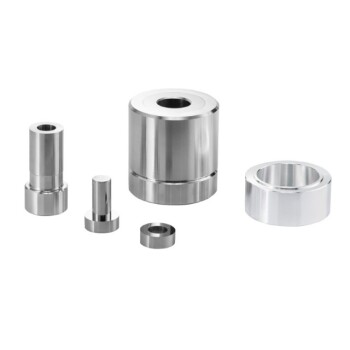
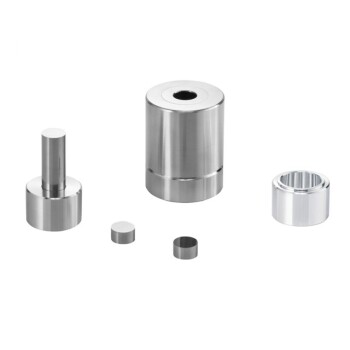
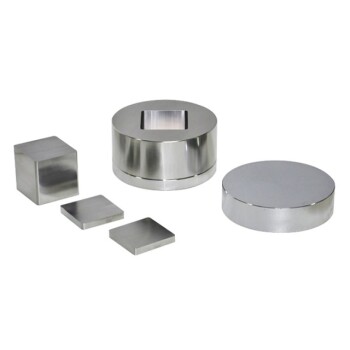
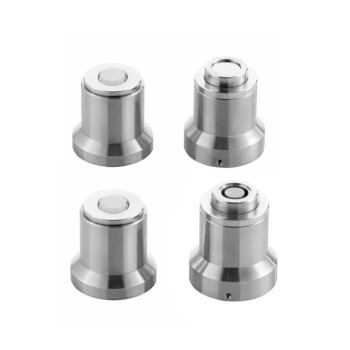
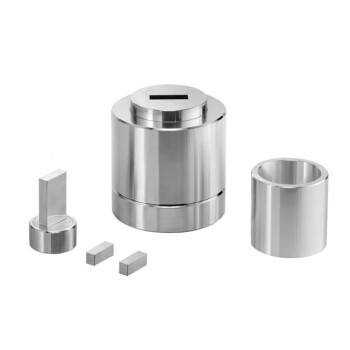
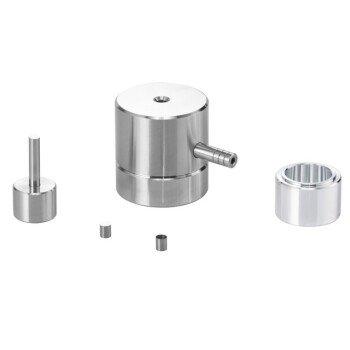
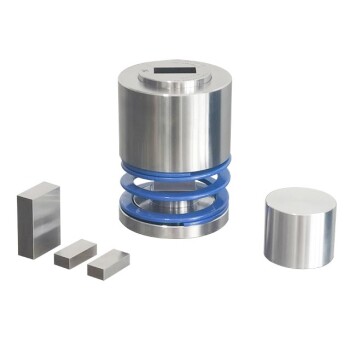
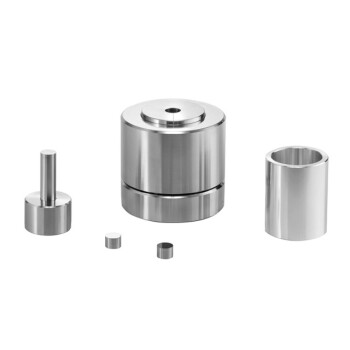
To accurately characterize solid-state battery materials, utilizing a pressurized test mold is mandatory because it simulates the substantial "stack pressure" present in a working battery cell. Without applying and maintaining high constant pressure (e.g., 60 MPa), the rigid nature of solid particles prevents adequate physical contact, resulting in high contact resistance that obscures the true properties of the material you are trying to test.

Unlike liquid electrolytes that naturally wet surfaces, solid-state materials require mechanical force to bridge microscopic gaps. A pressurized mold eliminates these voids to ensure your impedance spectroscopy data reflects the material's intrinsic ionic conductivity, not the quality of the particle contact.

The Fundamental Challenge: Solid-Solid Interfaces

The Problem of Rigidity

In traditional batteries, liquid electrolytes easily flow to fill gaps and create contact. Solid-state electrolytes are rigid; they cannot naturally conform to the rough surfaces of electrode particles or current collectors.

The Creation of Microscopic Voids

When solid powder particles are loosely packed, "microscopic voids" exist at the interfaces. These voids act as barriers to ion transport, creating artificial resistance that has nothing to do with the chemistry of the material itself.

The Need for External Force

To overcome this physical limitation, external mechanical force is required. This force pushes the particles together, mechanically interlocking them to create a continuous path for ion movement.

The Role of the Pressurized Mold

Simulating Operational "Stack Pressure"

Real-world all-solid-state batteries operate under significant compression, known as stack pressure. A pressurized test mold is designed to replicate this specific working environment within a laboratory setting.

Ensuring Continuous Contact

By applying a constant high pressure, such as 60 MPa, the mold forces the powder particles into tight physical contact with one another. It also ensures seamless contact between the powder and the current collectors.

Facilitating Ion Transport

This tight physical contact bridges the gaps between rigid materials. It significantly reduces the energy barrier required for ions to move across the solid-solid interface, facilitating efficient transport.

Isolating Intrinsic Properties

Eliminating Contact Resistance

The primary goal of impedance spectroscopy in this context is to measure the material's capability, not the setup's flaws. Low pressure results in high interfacial contact resistance, which dominates the impedance spectrum and hides the true data.

Revealing Intrinsic Ionic Conductivity

When contact resistance is minimized through high pressure, the interference is removed. This allows researchers to accurately evaluate the intrinsic ionic conductivity of the material, providing data that is reproducible and scientifically valid.

Common Pitfalls to Avoid

Inconsistent Pressure Application

Simply applying pressure once is often insufficient. The mold must be capable of maintaining constant pressure throughout the test, as materials may shift or settle, leading to a loss of contact over time.

Confusing Artifacts with Properties

If a pressurized mold is not used, a low conductivity reading is often misinterpreted as a material failure. In reality, it is often a testing failure caused by poor particle-to-particle contact.

Making the Right Choice for Your Goal

To ensure your impedance spectroscopy results are valuable, apply the following guidelines:

  • If your primary focus is Material Screening: Use high, constant pressure to determine the maximum theoretical conductivity of the electrolyte candidate.
  • If your primary focus is Prototype Development: Use pressure levels that match the engineering limits of your battery pack design to see how the material performs under realistic constraints.

Accurate solid-state battery research depends less on the chemistry alone and more on the physical integrity of the test interface.

Summary Table:

Feature Impact of Low/No Pressure Impact of High Constant Pressure (60 MPa)
Interface Contact Microscopic voids; poor solid-solid contact Continuous path; mechanical interlocking
Ion Transport High barriers due to physical gaps Efficient transport across interfaces
Data Accuracy Dominated by contact resistance artifacts Reflects intrinsic ionic conductivity
Operational Realism Does not simulate stack pressure Accurately replicates working cell conditions

Elevate Your Battery Research with KINTEK

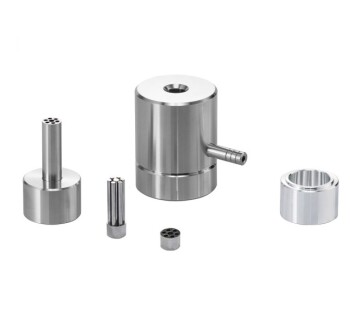
Precise data in solid-state battery research starts with superior physical contact. KINTEK specializes in high-performance hydraulic presses (pellet, hot, isostatic) and specialized battery research tools designed to maintain constant, high-pressure environments for impedance spectroscopy.

Our comprehensive range of equipment—from high-temperature high-pressure reactors to precision crushing and milling systems—ensures your materials are prepared and tested to the highest standards. Don't let interfacial resistance obscure your results.

Contact KINTEK today to find the perfect pressurized mold solution for your lab!

Related Products

People Also Ask

Related Products

Touchscreen Automatic Vacuum Heat Press

Touchscreen Automatic Vacuum Heat Press

Precision vacuum heat press for labs: 800°C, 5-ton pressure, 0.1MPa vacuum. Ideal for composites, solar cells, aerospace.

Vacuum Hot Press Furnace Machine Heated Vacuum Press

Vacuum Hot Press Furnace Machine Heated Vacuum Press

Discover the advantages of Vacuum Hot Press Furnace! Manufacture dense refractory metals & compounds, ceramics, and composites under high temp and pressure.

Vacuum Hot Press Furnace Heated Vacuum Press Machine Tube Furnace

Vacuum Hot Press Furnace Heated Vacuum Press Machine Tube Furnace

Reduce forming pressure & shorten sintering time with Vacuum Tube Hot Press Furnace for high-density, fine-grain materials. Ideal for refractory metals.

600T Vacuum Induction Hot Press Furnace for Heat Treat and Sintering

600T Vacuum Induction Hot Press Furnace for Heat Treat and Sintering

Discover the 600T Vacuum Induction Hot Press Furnace, designed for high-temperature sintering experiments in vacuum or protected atmospheres. Its precise temperature and pressure control, adjustable working pressure, and advanced safety features make it ideal for nonmetal materials, carbon composites, ceramics, and metal powders.

Vacuum Heat Treat and Sintering Furnace with 9MPa Air Pressure

Vacuum Heat Treat and Sintering Furnace with 9MPa Air Pressure

The air pressure sintering furnace is a high-tech equipment commonly used for the sintering of advanced ceramic materials. It combines vacuum sintering and pressure sintering techniques to achieve high-density and high-strength ceramics.

Vacuum Heat Treat and Molybdenum Wire Sintering Furnace for Vacuum Sintering

Vacuum Heat Treat and Molybdenum Wire Sintering Furnace for Vacuum Sintering

A vacuum molybdenum wire sintering furnace is a vertical or bedroom structure, which is suitable for withdrawal, brazing, sintering and degassing of metal materials under high vacuum and high temperature conditions. It is also suitable for dehydroxylation treatment of quartz materials.

2200 ℃ Tungsten Vacuum Heat Treat and Sintering Furnace

2200 ℃ Tungsten Vacuum Heat Treat and Sintering Furnace

Experience the ultimate refractory metal furnace with our Tungsten vacuum furnace. Capable of reaching 2200℃, perfect for sintering advanced ceramics and refractory metals. Order now for high-quality results.

1200℃ Split Tube Furnace with Quartz Tube Laboratory Tubular Furnace

1200℃ Split Tube Furnace with Quartz Tube Laboratory Tubular Furnace

KT-TF12 split tube furnace: high-purity insulation, embedded heating wire coils, and max. 1200C. Widely used for new materials and chemical vapour deposition.

1400℃ Controlled Atmosphere Furnace with Nitrogen and Inert Atmosphere

1400℃ Controlled Atmosphere Furnace with Nitrogen and Inert Atmosphere

Achieve precise heat treatment with KT-14A controlled atmosphere furnace. Vacuum sealed with a smart controller, it's ideal for lab and industrial use up to 1400℃.

Multi Heating Zones CVD Tube Furnace Machine Chemical Vapor Deposition Chamber System Equipment

Multi Heating Zones CVD Tube Furnace Machine Chemical Vapor Deposition Chamber System Equipment

KT-CTF14 Multi Heating Zones CVD Furnace - Precise Temperature Control and Gas Flow for Advanced Applications. Max temp up to 1200℃, 4 channels MFC mass flow meter, and 7" TFT touch screen controller.

Vacuum Heat Treat Sintering Brazing Furnace

Vacuum Heat Treat Sintering Brazing Furnace

A vacuum brazing furnace is a type of industrial furnace used for brazing, a metalworking process that joins two pieces of metal using a filler metal that melts at a lower temperature than the base metals. Vacuum brazing furnaces are typically used for high-quality applications where a strong, clean joint is required.

1700℃ Muffle Oven Furnace for Laboratory

1700℃ Muffle Oven Furnace for Laboratory

Get superior heat control with our 1700℃ Muffle Furnace. Equipped with intelligent temperature microprocessor, TFT touch screen controller & advanced insulation materials for precise heating up to 1700C. Order now!

1800℃ Muffle Oven Furnace for Laboratory

1800℃ Muffle Oven Furnace for Laboratory

KT-18 muffle furnace with Japan Al2O3 polycrystalline fibe and Silicon Molybdenum heating element, up to 1900℃, PID temperature control and 7" smart touch screen. Compact design, low heat loss, and high energy efficiency. Safety interlock system and versatile functions.

1200℃ Controlled Atmosphere Furnace Nitrogen Inert Atmosphere Furnace

1200℃ Controlled Atmosphere Furnace Nitrogen Inert Atmosphere Furnace

Discover our KT-12A Pro Controlled atmosphere furnace - high precision, heavy duty vacuum chamber, versatile smart touch screen controller, and excellent temperature uniformity up to 1200C. Ideal for both laboratory and industrial application.

1400℃ Muffle Oven Furnace for Laboratory

1400℃ Muffle Oven Furnace for Laboratory

Get precise high-temperature control up to 1500℃ with KT-14M Muffle furnace. Equipped with a smart touch screen controller and advanced insulation materials.

1700℃ Laboratory High Temperature Tube Furnace with Alumina Tube

1700℃ Laboratory High Temperature Tube Furnace with Alumina Tube

Looking for a high-temperature tube furnace? Check out our 1700℃ Tube Furnace with Alumina Tube. Perfect for research and industrial applications up to 1700C.

Ultra-High Temperature Graphite Vacuum Graphitization Furnace

Ultra-High Temperature Graphite Vacuum Graphitization Furnace

The ultra-high temperature graphitization furnace utilizes medium frequency induction heating in a vacuum or inert gas environment. The induction coil generates an alternating magnetic field, inducing eddy currents in the graphite crucible, which heats up and radiates heat to the workpiece, bringing it to the desired temperature. This furnace is primarily used for graphitization and sintering of carbon materials, carbon fiber materials, and other composite materials.

Vertical High Temperature Graphite Vacuum Graphitization Furnace

Vertical High Temperature Graphite Vacuum Graphitization Furnace

Vertical high temperature graphitization furnace for carbonization and graphitization of carbon materials up to 3100℃.Suitable for shaped graphitization of carbon fiber filaments and other materials sintered in a carbon environment.Applications in metallurgy, electronics, and aerospace for producing high-quality graphite products like electrodes and crucibles.

1700℃ Controlled Atmosphere Furnace Nitrogen Inert Atmosphere Furnace

1700℃ Controlled Atmosphere Furnace Nitrogen Inert Atmosphere Furnace

KT-17A Controlled atmosphere furnace: 1700℃ heating, vacuum sealing technology, PID temperature control, and versatile TFT smart touch screen controller for laboratory and industrial use.

Vacuum Dental Porcelain Sintering Furnace

Vacuum Dental Porcelain Sintering Furnace

Get precise and reliable results with KinTek's Vacuum Porcelain Furnace. Suitable for all porcelain powders, it features hyperbolic ceramic furnace function, voice prompt, and automatic temperature calibration.


Leave Your Message