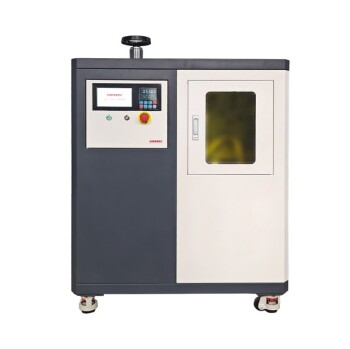
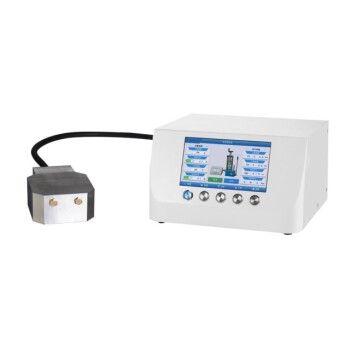
Hot pressing is the critical manufacturing step used to transform loose thallium bromide (TlBr) powder into a solid, high-performance detector material.
By applying vertical pressure while simultaneously heating the material, this process forces the powder particles to undergo plastic flow and bond together. This dual action is the only effective way to convert the raw precursor into a high-density crystal with the structural integrity required for sensitive semiconductor applications.
The Core Value of Hot Pressing The process is not merely about shaping the material; it is a method of structural engineering at the microscopic level. It creates a dense, uniform crystal lattice with minimized internal stress, which is the direct prerequisite for achieving high energy resolution and photon counting efficiency in the final detector.
The Mechanics of Thermomechanical Coupling
Inducing Plastic Flow
The primary mechanism at work during hot pressing is plastic flow.
By subjecting the TlBr powder to heat and pressure simultaneously, the material softens enough to flow into voids without melting completely.
This promotes strong bonding between individual particles, resulting in a cohesive bulk crystal.
Achieving High Density
For a semiconductor detector to stop gamma rays effectively, it must be physically dense.
Hot pressing eliminates porosity that would otherwise exist in a powder compact.
This results in a material with high gamma-ray attenuation coefficients, ensuring that incident radiation interacts with the detector rather than passing through it.
Precise Parameter Control
The success of this process relies on specific environmental controls, often utilizing pressures around 30 kN and temperatures between 455°C and 465°C.
Maintained for several hours, these conditions allow the material to settle into a stable structure.
This controlled environment is essential for achieving the "detector-grade" quality that simple sintering or cold pressing cannot provide.
Enhancing Material Structure
Controlling Crystalline Orientation
Randomly oriented crystals can impede the movement of electrical charges within the detector.
Hot pressing allows researchers to dictate specific crystalline orientations within the final block.
This alignment creates a more efficient pathway for charge carriers, directly boosting the device's charge collection efficiency.
Uniform Stress Distribution
Internal stress within a crystal is a major source of noise and signal degradation.
The steady, thermomechanical coupling of the hot press helps eliminate residual internal stresses.
This results in a uniform stress distribution throughout the depth of the material, preventing the formation of defects that could trap charges.
Direct Impact on Detector Performance
Improved Energy Resolution
Energy resolution defines how well a detector can distinguish between radiation of similar energies.
Because hot pressing ensures a uniform lattice structure and low stress, the resulting detectors exhibit significantly improved energy resolution.
This is often evidenced by superior peak spectra, such as those measured at 662 keV.
Maximized Photon Counting Efficiency
The ultimate goal of a TlBr detector is to count photons accurately.
The high density and structural consistency achieved through hot pressing maximize the probability of interaction.
This directly improves the photon counting efficiency, making the detector more sensitive and reliable for practical applications.
Understanding the Trade-offs
The Precision Requirement
Hot pressing is not a "set it and forget it" process; it requires extreme precision.
The operating window is narrow (typically 455-465°C). Deviating from this range can fail to induce the necessary plastic flow or, conversely, degrade the material's purity.
Thermal History Management
While the process relieves stress, the cooling phase must be managed carefully.
If the high pressure and temperature are removed too abruptly, new thermal stresses can be introduced.
Therefore, the entire thermal history—heating, holding, and cooling—must be strictly controlled to maintain the benefits of the process.
Making the Right Choice for Your Goal
To leverage hot pressing effectively, you must align the process parameters with your specific performance targets.
- If your primary focus is Sensitivity (Efficiency): Prioritize the maximization of density and gamma-ray attenuation to ensure every photon is stopped within the crystal volume.
- If your primary focus is Accuracy (Resolution): Focus on the stability of the temperature and pressure hold times to ensure perfect crystalline orientation and stress elimination, which reduces signal noise.
By strictly controlling thermomechanical conditions, hot pressing bridges the gap between raw chemical potential and practical device performance.
Summary Table:
| Feature | Hot Pressing Benefit for TlBr |
|---|---|
| Material State | Transforms loose powder into high-density solid crystals |
| Mechanism | Thermomechanical coupling inducing plastic flow and bonding |
| Operating Window | Precise control between 455°C and 465°C at ~30 kN pressure |
| Structural Integrity | Eliminates porosity and minimizes internal residual stresses |
| Electrical Impact | Optimizes charge carrier pathways and collection efficiency |
| Performance Goal | Maximizes photon counting efficiency and energy resolution |
Elevate Your Material Research with KINTEK
Precision is the difference between a raw material and a high-performance detector. KINTEK specializes in advanced laboratory solutions, providing the high-precision hydraulic presses (pellet, hot, isostatic) and high-temperature furnaces required to master the thermomechanical coupling of materials like TlBr.
Whether you are focusing on crystalline orientation or maximizing gamma-ray attenuation, our expert-grade equipment ensures the stable, controlled environments your research demands. Explore our comprehensive range of crushing, milling, and thermal processing tools today.
Ready to optimize your semiconductor fabrication? Contact KINTEK today for a consultation!
References
- Arkadiusz Żarski, Janusz Kapuśniak. Starch wars - looking for ecofriendly packaging materials. DOI: 10.21175/rad.abstr.book.2023.17.4
This article is also based on technical information from Kintek Solution Knowledge Base .
Related Products
- Automatic Heated Hydraulic Press Machine with Heated Plates for Laboratory Hot Press 25T 30T 50T
- Manual High Temperature Heated Hydraulic Press Machine with Heated Plates for Lab
- Touchscreen Automatic Vacuum Heat Press
- 30T 40T Split Automatic Heated Hydraulic Press Machine with Heated Plates for Laboratory Hot Press
- Vacuum Hot Press Furnace Machine Heated Vacuum Press
People Also Ask
- Why is the heating function of a laboratory hydraulic press essential for MEA assembly in DEFC? Optimize Cell Bonding
- What technical conditions does a heated hydraulic press provide for PEO batteries? Optimize Solid-State Interfaces
- How is a heated hydraulic press used for Li-LLZO batteries? Optimize Interfacial Bonding with Thermal-Pressure
- What role does a heated hydraulic press play in Cold Sintering (CSP)? Enhancing LATP-Halide Densification
- What are heated hydraulic presses used for? Molding Composites, Vulcanizing Rubber, and More