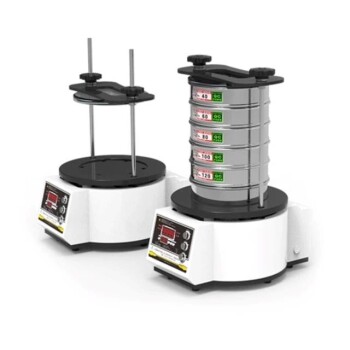
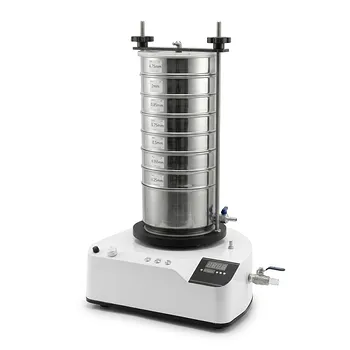
The use of a standard sieve is necessary because it enforces precise control over the raw material's surface area, specifically targeting a particle range of 0.1 to 0.4 mm. This mechanical standardization is the prerequisite for scientific reproducibility; without it, variations in particle size introduce inconsistent reaction rates, uneven heat transfer, and unreliable experimental data during the analysis of Prosopis juliflora.
Core Takeaway Achieving a uniform particle size distribution is not merely a physical preparatory step; it is a chemical necessity. Standard sieving maximizes the specific surface area available for reactions, ensuring that solvent extraction, acid hydrolysis, and thermal analysis occur completely and uniformly across the entire sample mass.
The Critical Role of Uniformity
Creating Consistent Surface Area
The primary function of a standard sieve is to transform variable biomass into a chemically consistent material. By isolating particles between 0.1 and 0.4 mm, you ensure that the specific surface area—the total area available for chemical interaction relative to volume—is maximized and constant.
Facilitating Mass Transfer
Biomass pretreatment relies heavily on mass transfer, which is the movement of mass from one location (the solid interior) to another (the solvent). Uniform particle size allows for predictable penetration of reactants, such as ionic liquids or solvents, into the biomass interior.
Enhancing Chemical and Thermal Efficiency
Optimizing Solvent Extraction
Efficiency in extraction is directly linked to how easily a solvent can contact the target compounds. Fine, sieved particles expose more internal structure to the solvent, reducing the diffusion path length and significantly enhancing extraction efficiency.
Ensuring Complete Acid Hydrolysis
For acid hydrolysis to be effective, the acid must fully penetrate the biomass structure. If particles are too large or irregular, the reaction may remain incomplete in the core of the particle. Sieving ensures the material is fine enough to allow the reaction to proceed to completion throughout the entire sample.
Improving Heat Transfer in TGA
During Thermogravimetric Analysis (TGA), the sample is subjected to controlled temperature changes. A standardized particle size ensures heat transfer uniformity, preventing thermal gradients where the outside of a particle heats faster than the inside. This eliminates thermal lag and results in more accurate, reproducible thermochemical data.
Understanding the Risks of Variability
The "Mixed Kinetics" Trap
If sieving is neglected, your sample will contain a mix of dust and large chunks. This creates a scenario of "mixed kinetics," where fine particles react instantly and large particles react slowly or incompletely.
Data Irreproducibility
The presence of un-sieved, heterogeneous particles introduces random variables into your experiment. One sample might contain more large chunks than the next, leading to significant deviations in data points that make it impossible to validate your findings or compare them with other studies.
Making the Right Choice for Your Goal
To ensure the integrity of your Prosopis juliflora analysis, apply the following principles:
- If your primary focus is Chemical Conversion: Ensure particles are sieved to the 0.1–0.4 mm range to guarantee complete acid hydrolysis and maximum solvent access.
- If your primary focus is Thermal Analysis: rigorous sieving is required to prevent thermal gradients that distort weight loss curves and decomposition temperatures.
- If your primary focus is Data Reproducibility: Treat the sieve as a critical calibration tool that eliminates physical variables before the experiment begins.
Standard sieving is the foundational step that transforms raw biological chaos into reliable engineering data.
Summary Table:
| Parameter | Targeted Sieve Range (0.1–0.4 mm) | Impact on Analysis |
|---|---|---|
| Surface Area | Maximized and Consistent | Uniform chemical interaction & reaction rates |
| Mass Transfer | Optimized Diffusion Path | Predictable penetration of solvents & reactants |
| Heat Transfer | Gradient Elimination | Accurate TGA data without thermal lag |
| Data Integrity | High Reproducibility | Eliminates mixed kinetics and experimental bias |
Elevate Your Biomass Research with Precision Engineering
Unpredictable particle sizes lead to unreliable data. KINTEK provides the high-performance sieving equipment, crushing systems, and milling solutions necessary to transform raw Prosopis juliflora into standardized, high-quality material. Whether you are conducting TGA analysis, acid hydrolysis, or solvent extraction, our laboratory equipment ensures the uniformity your research demands.
Our laboratory solutions include:
- Precision Sieving & Milling: Achieving the exact 0.1–0.4 mm range for consistent surface area.
- Thermal Analysis Support: High-temperature furnaces and reactors for complete biomass conversion.
- Sample Preparation: Hydraulic presses and homogenization tools for superior material integrity.
Contact KINTEK today to discover how our expert-grade laboratory consumables and equipment can optimize your pretreatment workflow and guarantee reproducible results!
References
- G. Gayathri, Kiran Babu Uppuluri. The comprehensive characterization of Prosopis juliflora pods as a potential bioenergy feedstock. DOI: 10.1038/s41598-022-22482-9
This article is also based on technical information from Kintek Solution Knowledge Base .
Related Products
- Custom PTFE Teflon Parts Manufacturer for PTFE Mesh F4 Sieve
- Laboratory Test Sieves and Sieving Machines
- Vibratory Sieve Shaker Machine Dry Three-Dimensional Vibrating Sieve
- Laboratory Vibratory Sieve Shaker Machine for Dry and Wet Three-Dimensional Sieving
- Laboratory Vibratory Sieve Shaker Machine Slap Vibrating Sieve
People Also Ask
- What are the primary reasons for selecting PTFE as a matrix? Enhance Composites with Carbon Nanotube Reinforcement
- How is PTFE utilized for insulation in Alloy 22 corrosion setups? Ensure Signal Purity & Accuracy
- Is PTFE corrosion resistant? Discover the Ultimate Chemical Resistance for Your Lab
- What are the specific applications of PTFE in micro-batch slug flow systems? Enhance Your Microfluidic Reaction Purity
- What is the mesh size of a sieve? A Guide to Particle Size and Sieve Selection