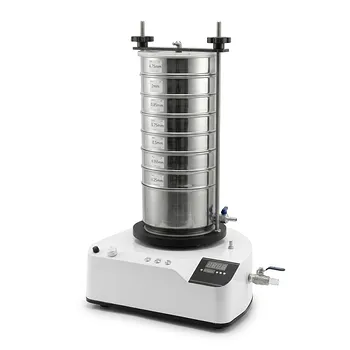
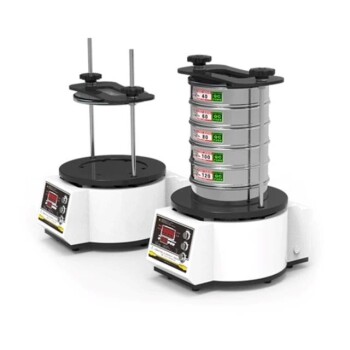
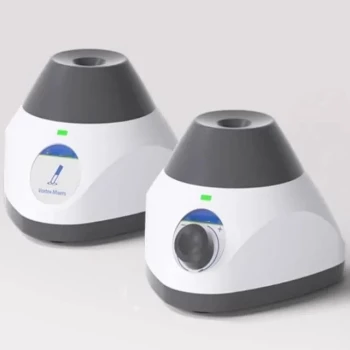
High-precision analytical sieve shakers are strictly required in Laser Powder Bed Fusion (LPBF) to enforce rigorous control over the particle size distribution of metal powders. By targeting specific particle dimensions—typically 40μm or 80μm—these devices ensure that the raw material meets the exacting standards necessary for a consistent layer-by-layer deposition process.
The primary role of high-precision sieving is to secure the microstructural quality of the final part. By removing oversized particles that disrupt spreading and eliminating fines that cause clumping, these machines guarantee the uniformity of the powder bed.
The Critical Role of Particle Size Distribution
Establishing Process Consistency
The LPBF process relies on the deposition of extremely thin, uniform layers of metal powder. High-precision shakers screen the powder to ensure every batch adheres to a specific particle size distribution.
This strict control guarantees that the material behaves predictably during the printing process. Without this step, variations in the feedstock would lead to unpredictable results in the final output.
Securing Microstructural Quality
The ultimate goal of using analytical sieve shakers is to protect the microstructural integrity of the additive manufacturing parts.
If the powder bed is inconsistent, the laser cannot melt the material uniformly. This leads to internal defects that compromise the mechanical properties of the finished component.
Mitigating Deposition Defects
Preventing Uneven Spreading
A major function of the sieving process is the removal of oversized particles.
If particles larger than the layer thickness remain in the feedstock, they disrupt the re-coater blade or roller. This causes streaks and uneven powder spreading, which ruins the flatness required for the next layer.
Avoiding Agglomeration
Conversely, the process must also manage particles that are excessively fine.
Ultra-fine particles tend to stick together due to inter-particle forces, leading to agglomeration (clumping). Sieve shakers remove these fines to ensure the powder flows freely and spreads smoothly across the build plate.
Common Pitfalls of Inadequate Sieving
The Risk of Layer Instability
Failing to use high-precision sieving introduces a high risk of layer instability. If the particle size distribution is too wide, the packing density of the powder bed becomes inconsistent.
Compromised Part Reliability
Neglecting precise screening directly impacts the reliability of the printed part. Variations in powder consistency often result in porosity or weak points within the metal microstructure, rendering the part unsuitable for high-performance applications.
Making the Right Choice for Your Goal
To ensure your LPBF process yields industrial-grade results, you must prioritize the quality of your feedstock preparation.
- If your primary focus is Surface Finish: Ensure your sieving process rigorously removes oversized particles to prevent dragging and uneven spreading during layer deposition.
- If your primary focus is Material Homogeneity: Prioritize the removal of excessively fine particles to prevent agglomeration and ensure a uniform melt pool.
Precision in powder preparation is the prerequisite for precision in performance.
Summary Table:
| Feature | Impact on LPBF Process | Benefit for Final Part |
|---|---|---|
| Particle Size Control | Ensures thin, uniform layer deposition | Predictable mechanical properties |
| Oversized Removal | Prevents re-coater streaks and dragging | Superior surface finish and flatness |
| Fine Particle Removal | Eliminates agglomeration and clumping | Uniform melt pool and homogeneity |
| Strict Distribution | Maintains consistent packing density | Reduced porosity and high reliability |
Elevate Your Additive Manufacturing Precision with KINTEK
Don't let powder inconsistencies compromise your production. KINTEK specializes in advanced laboratory equipment designed to meet the rigorous demands of metal additive manufacturing. From high-precision sieving equipment to ensure perfect particle size distribution, to crushing and milling systems and high-temperature vacuum furnaces for material processing, we provide the tools necessary for industrial-grade results.
Whether you are refining raw metal powders for LPBF or conducting advanced material research, our comprehensive range—including pellet presses, ceramics, and high-pressure reactors—is engineered for reliability and performance.
Ready to optimize your feedstock quality? Contact our technical experts today to find the perfect sieving and processing solutions for your laboratory.
References
- Alexander Metel, Pavel Podrabinnik. Influence of Postprocessing on Wear Resistance of Aerospace Steel Parts Produced by Laser Powder Bed Fusion. DOI: 10.3390/technologies8040073
This article is also based on technical information from Kintek Solution Knowledge Base .
Related Products
- Laboratory Test Sieves and Vibratory Sieve Shaker Machine
- Laboratory Vibratory Sieve Shaker Machine for Dry and Wet Three-Dimensional Sieving
- Laboratory Test Sieves and Sieving Machines
- Laboratory Vibratory Sieve Shaker Machine Slap Vibrating Sieve
- Laboratory Wet Three-Dimensional Vibratory Sieve Shaker Machine
People Also Ask
- How does a laboratory vibratory sieve shaker facilitate the microstructural study of gas-atomized alloy powders?
- What role does a laboratory vibrating sieve shaker play in the LiFePO4 powder processing workflow? Ensure Batch Quality
- What is the use of vibratory sieve shaker? Achieve Precise Particle Size Analysis for Your Lab
- How is a vibratory sieve shaker used in the particle size analysis of mechanically alloyed powders? Expert Guide
- Why use a vibratory sieve shaker for PET powder? Achieve Precise Particle Size Control for Chemical Research