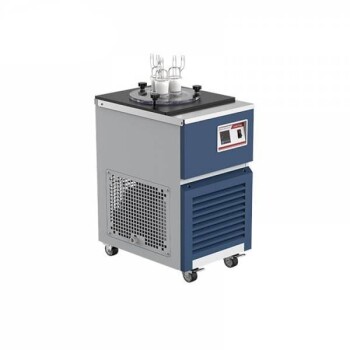
Precise temperature gradient control is the critical mechanism that determines whether you produce safe, high-quality magnesium or a hazardous material. By maintaining condensation plates between 923 K and 1062 K with a specific gradient (such as 0.5 K/mm), operators suppress the direct gas-to-solid phase transition. This control forces the vapor to undergo a gas-to-liquid transition instead, preventing the formation of flammable powder and ensuring the collection of dense, crystalline bulk magnesium.
Controlling the thermal environment inside the condenser is not merely a matter of efficiency; it is a fundamental safety requirement. By manipulating temperature gradients, you dictate the physical morphology of the magnesium, ensuring it condenses into stable, solid blocks rather than dangerous, reactive dust.
The Science of Phase Transition Control
Suppressing Dangerous Phase Changes
The primary goal of the condenser is to manage how magnesium vapor reverts to a solid state. Without precise control, magnesium vapor tends to undergo a direct gas-to-solid transition.
This specific transition pathway results in the formation of fine, dispersed magnesium powder. This powder is extremely hazardous and presents a severe flammability risk when removed from the furnace.
Promoting Liquid Nucleation
To avoid the creation of dangerous powder, the condenser must promote a gas-to-liquid phase transition. This allows for controlled nucleation and growth of the magnesium crystals.
By establishing a specific temperature gradient, such as 0.5 K/mm, the system encourages the magnesium to settle into a denser state. This leads to the formation of safe, crystalline bulk magnesium.
The Role of Thermal Windows
Strict adherence to temperature ranges is required to achieve this phase control. The condensation plates must be maintained within a specific window, typically between 923 K and 1062 K.
Operating within this thermal band ensures the vapor behaves predictably. It allows the material to condense into a solid form that is structurally sound and safe to handle.
Understanding the Operational Trade-offs
The Risk of Excessive Heat
While heat is necessary to prevent immediate freezing, temperatures that are too high or uncontrolled lead to poor morphology.
Excessive heat causes the magnesium particles to become fine and dispersed. As noted previously, this morphology creates a high surface area that makes the material highly flammable upon exposure to air.
The Problem with Over-Cooling
Conversely, cooling the condenser too aggressively introduces a different set of problems. If the temperature drops too low, the crystallization process becomes inefficient.
Low temperatures result in loose crystallization that adheres poorly to the condenser walls. This compromises the density of the final block and complicates the removal process.
Balancing Complexity and Safety
Achieving the "Goldilocks" zone—where the magnesium forms dense, removable blocks—requires sophisticated cooling water temperature control.
This adds complexity to the system design, as simple passive cooling is often insufficient. However, this complexity is a necessary trade-off to ensure the safety of the operation and the quality of the yield.
Making the Right Choice for Your Process
To optimize your magnesium vapor collection, you must prioritize the condenser's thermal regulation capabilities based on your specific safety and quality targets.
- If your primary focus is Safety: Prioritize systems that strictly maintain temperatures above the gas-to-solid transition threshold to prevent the formation of explosive powders.
- If your primary focus is Product Quality: Ensure your system can hold a steady 0.5 K/mm gradient to maximize the density and structural integrity of the harvested magnesium blocks.
- If your primary focus is Operational Efficiency: Calibrate cooling water controls to avoid over-cooling, ensuring the crystals adhere properly and are easy to remove from the walls.
True process control is achieved when you dictate the phase transition, rather than letting the physics of rapid cooling dictate the outcome for you.
Summary Table:
| Factor | Goal Temperature / Gradient | Outcome of Control | Risk of Poor Control |
|---|---|---|---|
| Phase Control | 923 K - 1062 K | Gas-to-liquid transition | Dangerous gas-to-solid transition |
| Gradient Precision | 0.5 K/mm | Dense, crystalline bulk magnesium | Fine, dispersed flammable powder |
| Thermal Window | Strict adherence | Stable, safe-to-handle material | Loose crystallization or explosive dust |
| Cooling Regulation | Active water control | Efficient removal and high density | Poor adhesion and safety hazards |
Maximize Process Safety and Yield with KINTEK Precision Solutions
Don't let unstable phase transitions compromise your laboratory safety or material quality. KINTEK specializes in advanced thermal and material processing equipment, providing the precise control needed for demanding applications like magnesium vapor collection.
From high-performance high-temperature furnaces (vacuum, atmosphere, and tube) to specialized high-pressure reactors and cooling solutions (ULT freezers, cold traps), KINTEK offers the comprehensive tools and consumables required for rigorous research and production.
Ready to optimize your thermal gradients and secure your crystalline yield?
Contact KINTEK today to discuss your equipment needs!
Related Products
People Also Ask
- Why are precision Condensers and Cold Traps necessary at the collection end of a pyrolysis system? Maximize Yield & Purity
- Why is it necessary to configure efficient cold traps in membrane distillation? Ensure Flux Stability & Data Accuracy
- What is the purpose of connecting a cold trap at the reactor outlet? Protect Equipment and Analyze Liquid Products
- What is the role of glass condensation components in arsenic collection? Optimize Niccolite Roasting & Kinetics
- What is the function of a cold trap in bio-ethanol and methane reforming experiments? Optimize Purity & Protect Systems